
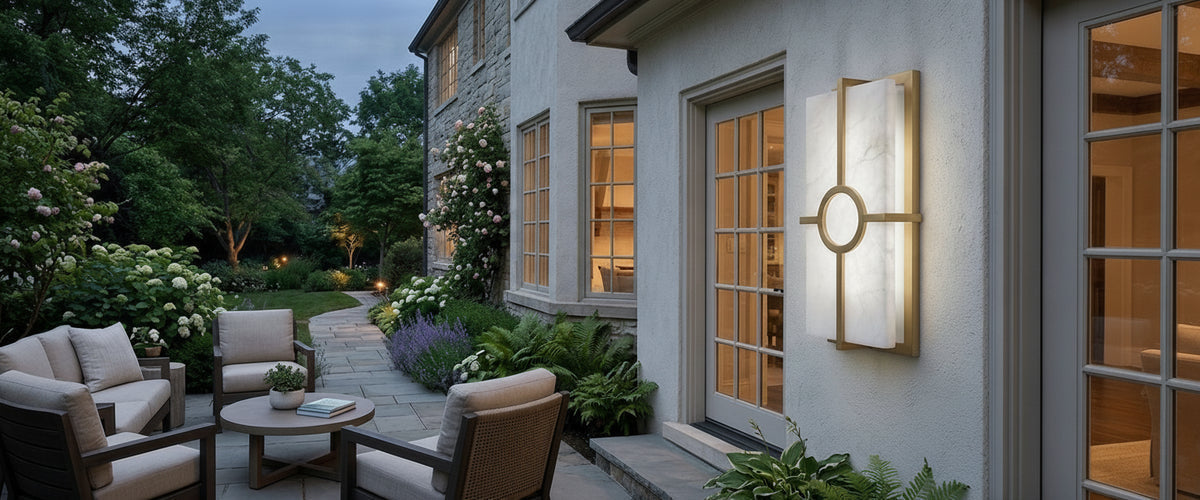

The first thing to fail on a cheap industrial outdoor wall light is never the bulb. It is the gasket: a thin ring of rubber that hardens, shrinks, and quietly lets water sit against the lamp holder until the terminal corrodes green. You notice in February, at night, usually just after the guarantee paperwork went in a drawer. Good exterior lighting is a materials decision before it is a styling decision, and that is as true for a cast bulkhead over a back door as it is for the alabaster pendant hanging in the hallway behind it.

At a Glance: What Actually Matters
Body material beats finish. On an industrial outdoor wall light, marine-grade cast aluminum, solid brass or 316 stainless outlast powder-coated pressed steel every time.
IP44 is a sheltered rating. Exposed walls, coastal sites and anywhere a hose or jet wash reaches want IP65.
Fixings are part of the fitting. Stainless screws, stainless mounting plate, silicone gasket. Mild steel screws bleed rust down brick within a season.
Beam direction sets the mood. A downward-only industrial outdoor wall light throws a pool at the threshold; open-top designs wash the wall and show off texture.
Vintage, antique and industrial are three different claims. Only one of them means the fitting is genuinely old.
Match color temperature inside and out. 2700K outdoors alongside 2700K indoors keeps the transition through the front door coherent.

Genuine Industrial versus Industrial-Looking
Industrial design language came out of function: fittings built for factories, docks, ships and railway platforms, where a lamp had to be knocked, hosed and forgotten about. The details that survive into a contemporary industrial outdoor wall light are the ones that once did a job. A cast body with cooling ribs. A glass shade held in a screwed collar rather than glued into a lip. A cage that protects the glass instead of decorating it. A back plate deep enough to house a proper terminal block.
Industrial-looking fittings copy the silhouette and drop the engineering. Pick one up and you can feel it: the body is light because it is pressed rather than cast, the glass sits in a friction fit, and the cage is spot-welded tinplate with a black coating over bare metal. Unscrew the shade on a serious industrial outdoor wall light and you should find a continuous gasket, an accessible lamp holder in ceramic or high-temperature plastic, and a cable gland you can tighten. Unscrew a weak one and you find a rubber grommet with a slit in it.
There is a second tell. Weight distribution. A properly cast industrial outdoor wall light feels back-heavy, because the mass is in the body and the mounting plate where the loads actually go. Cheap copies feel front-heavy and rattle slightly when you shake them, which is a fair preview of how they will behave in a gale on an exposed gable.
What IP44 and IP65 Mean When British Weather Is the Real Test
Every industrial outdoor wall light carries an IP code, and it is two digits: the first covers solid objects and dust, the second covers water. IP44 means protection against splashing water from any direction. IP65 means dust-tight and protected against low-pressure water jets. The classification is set by the International Electrotechnical Commission, so it is a standard rather than marketing language and the numbers are worth reading literally (IEC guidance on IP ratings).
Here is where UK buyers get caught. Splashing is not the same as a week of horizontal rain driven at a north-west elevation, and it is certainly not the same as salt-laden air on a Cornish or East Neuk coast. IP44 is perfectly sensible under a deep porch, in a covered passage, or on a sheltered courtyard wall. On an open facade, over a garden gate, beside a pool terrace, or anywhere a pressure washer will eventually be pointed, specify an IP65 industrial outdoor wall light and stop worrying.
Coastal sites deserve an extra note. Salt attacks fixings and finishes faster than rain does, and a beautiful powder-coated fitting with mild steel screws will streak within a year. The cheapest useful upgrade on any seaside or exposed elevation is swapping every mounting screw on the industrial outdoor wall light for A4 stainless before it goes up. That single detail does more for longevity than most of the rest of the spec.
Aged Black on Brick versus Raw Steel on Render
The same finish reads completely differently depending on what it is bolted to. Aged or textured black on a red-brick Victorian terrace almost disappears in daylight, which is usually the point: the fitting reads as a shadow, and only the glass and the glow register at night. On pale smooth render, that same black becomes a graphic full stop. Sharp, deliberate, and very visible from the street. Where the elevation can carry that contrast, a tightly proportioned industrial outdoor wall light such as the Klampenborg Outdoor Wall Light in black holds its silhouette against render without turning into a feature in its own right.
Raw or galvanized steel goes the other way. Against render it looks quiet and slightly agricultural, picking up the sky and softening as it weathers. Against dark brick or flint it can read cold and unresolved unless there is other metal nearby to answer it: a steel gate, a zinc canopy, a run of black ironmongery. On exposed or coastal elevations the safer version of that look is bare metal rather than a coating over it, which is the argument for specifying an industrial outdoor wall light like the Helsingor Outdoor Wall Light in stainless steel, where there is no paint layer for salt to lift.
Antique brass is the compromise most designers reach for on period properties. An industrial outdoor wall light in antique brass dulls to a soft brown rather than rusting, it warms the light spill in a way black never does, and it sits comfortably against limestone, sandstone and Bath stone. If the interior scheme already leans on brass detailing, carrying it outside creates a thread that runs from the gate to the hall table.
Mounting Height and Beam Direction on a Real Facade
Mood boards put an industrial outdoor wall light wherever the composition looks balanced. Real facades have door heads, downpipes, meter boxes, alarm boxes and window reveals that decide the position for you.
Flanking a front door: center the industrial outdoor wall light roughly 1.9m to 2.1m (about 6ft 3in to 7ft) above the threshold, above eye level so the lamp is not glaring at anyone standing on the step.
Along a boundary wall or garden path: lower, around 1.5m to 1.8m (5ft to 6ft), spaced far enough apart that the pools of light overlap at the edges rather than stacking.
Above a garage or double-width opening: raise it. A fitting mounted too low over a wide opening looks undersized and lights only the middle third.
Under a canopy or soffit: an industrial bulkhead wall light works hard here, because the shallow profile stays clear of head height and the diffuser spreads light rather than spotting it. In genuinely sheltered positions an IP44 fitting such as the Hornbaek Outdoor Wall Light in black is correctly specified rather than under-specified; move the same fitting onto an open gable and the rating stops being adequate.
Beam direction is the bigger decision. Downward-only fittings are polite to neighbours and good for wayfinding, and they reduce upward spill, which matters more than people think for local wildlife and night skies. An open-top or half-shaded industrial outdoor wall light washes the wall above and shows off brick bond, flint, stone or timber cladding. On a textured facade, that upward wash is what makes the elevation look considered after dark. Mixing the two on one elevation rarely works; pick a logic and hold it.
Vintage, Antique and Industrial: Three Different Claims
These words get used interchangeably in listings for almost every industrial outdoor wall light on the market, and they should not be. Antique industrial wall lights are genuinely old salvage: reclaimed factory or ship fittings, typically rewired, often without a current IP rating and rarely with any certification attached. Beautiful, characterful, and a specification risk unless a qualified electrician has assessed and rewired them. vintage industrial wall lights usually means new production in a mid-century or early industrial idiom, which is what most buyers actually want: the look, with modern sealing and modern terminals. Plain industrial is a style label with no age claim at all.
If you are specifying an industrial outdoor wall light for a hospitality project or a rental property, the distinction has teeth. Reclaimed pieces need inspection and testing against current wiring regulations before they go on a client wall, and installation of any fixed exterior fitting should be carried out by a competent person in line with BS 7671 (IET wiring regulations). Say "industrial outside wall light in a vintage style" on the schedule and everyone knows what is arriving.
What Fails First on a Cheap Fitting
Failures on a cheap industrial outdoor wall light are boringly predictable, which is useful, because it means you can inspect for them before you buy.
The gasket. Thin, glued rather than seated, or absent behind the glass. Water gets in and stays in.
The cable entry. A slit grommet instead of a threaded gland. Look for a gland you can actually tighten around the cable.
The fixings. Zinc-plated or mild steel screws supplied in the box. Replace them with stainless on day one, whatever the fitting cost.
The lamp holder. Soft plastic holders discolor and go brittle under heat. Ceramic E27 holders are the sign of an industrial outdoor wall light built to be re-lamped for years.
The finish. Paint sprayed over bare steel with no primer or pretreatment chips at the edges and rusts outward from the chip. Powder coating over a treated casting behaves entirely differently.
Integrated LED boards. When the board dies, the fitting dies. Replaceable lamps keep the fitting serviceable.
On lamps, a warm 2700K LED at a moderate output is almost always right for a domestic entrance. Cooler 4000K sources read clinical against brick and brass, and they make skin tones look poor when someone answers the door. Where the industrial outdoor wall light sits on a dimmable circuit, check that the driver and the dimmer are compatible before installation rather than after, and if a PIR sensor is involved, position it clear of the fitting's own heat so it does not trigger itself.
Care Checklist for Exterior Fittings
Twice a year, open the industrial outdoor wall light (power off at the consumer unit) and check the gasket for hardening or cracking.
Clean glass with warm water and a soft cloth. Skip solvents, which haze polycarbonate diffusers.
Wipe salt residue off coastal installations more often, roughly every couple of months through winter.
Touch in finish chips promptly so corrosion cannot start under the coating.
Check the wall seal behind the back plate; a bead of exterior silicone along the top edge only, never all the way round, so trapped moisture can drain.
Re-lamp with the same color temperature across the whole elevation. Mismatched lamps are the fastest way to make a good scheme look untidy.
Where the Industrial Look Stops and Alabaster Begins
The strongest exterior schemes we see treat the front door as a hinge rather than a hard break. Outside, a solidly built industrial outdoor wall light in aged black or antique brass, doing an honest job. Inside, something that softens immediately: a wall light or pendant in alabaster, where the stone diffuses the source and gives a warm, grainy glow instead of a bright point. The shift from engineered metal to translucent stone is what makes a hallway feel like arrival, and it is the reason so many of our clients pair rugged exterior fittings with alabaster lighting a meter inside the threshold.
Alabaster is a gypsum stone, soft enough to carve thin and naturally translucent, which is why it has been used to filter light in windows and lamps for centuries. It does not belong outdoors: it is porous, sensitive to moisture and weathers badly under rain. Keep it for hallways, stairwells, dining rooms and bedrooms, and let a cast metal industrial outdoor wall light handle the weather. If you are planning a whole-property scheme and want to see how exterior and interior pieces read together, it is worth browsing the full lighting range with both sides of the door in mind.
Specify one industrial outdoor wall light properly and it will still be working, still sealed, still re-lampable, long after the trend cycle has moved on. That is the only argument for spending well on exterior fittings, and it is a good one. Price tracks material, casting quality, finishing and engineering rather than the silhouette, so compare what is behind the glass before you compare the shape.