
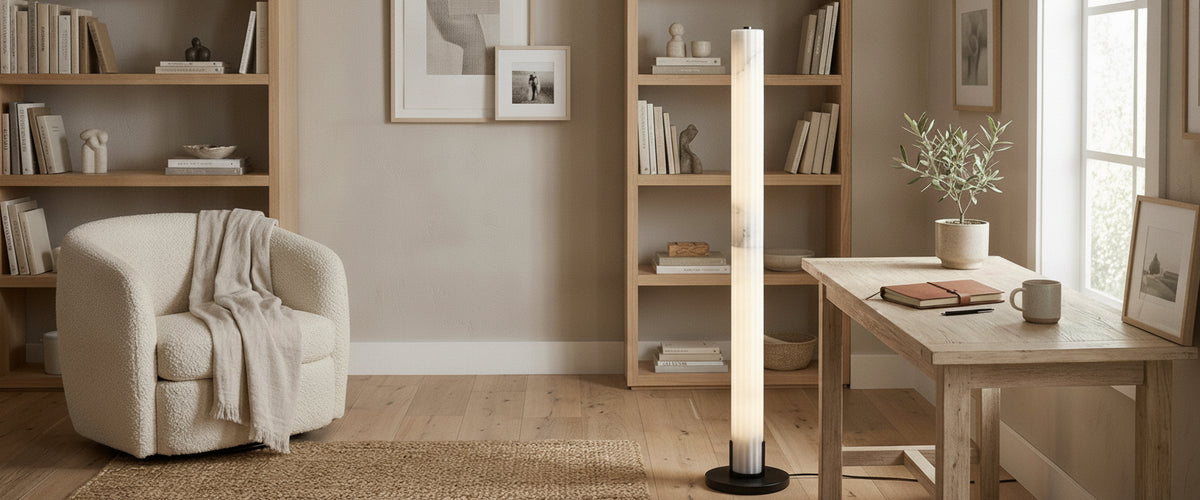

Look behind your monitor. If that is where your home office floor lamps lives, it is working against you: the light sits in your field of view, washes across the screen at a shallow angle and leaves the rest of the room in shadow. A home office floor lamp earns its place by filling the space around the screen, not by pointing at it. Get the position and the shade right and the room stops feeling like a workstation after dark.

At a Glance
- Best position: beside or slightly behind your shoulder, out of the monitor's reflection cone, never directly opposite or behind the screen.
- Job to do: a home office floor lamp is ambient fill that lifts wall and ceiling brightness, so your pupils are not fighting a bright screen in a dark room.
- Diffusion matters most: a translucent alabaster or onyx shade spreads light softly; a bare bulb or a hard glossy shade creates hot spots that land on the display.
- Colour temperature: 2700K to 3000K for evenings, with real dimming rather than a three-step switch.
- Pair, do not replace: keep a proper task light for paperwork; the standing lamp handles the layer the desk lamp cannot reach.
- Check before buying: switch reach from a seated position, cable route, base footprint against chair castors, and total weight if the floor is timber or the room is upstairs.

Why the Corner Behind the Monitor Is the Worst Position in the Room
Two things go wrong at once. First, any light source sitting behind the screen falls inside your direct line of sight, so your eye adapts to the brightest thing in view and the display looks flatter and duller than it is. Second, that geometry almost guarantees veiling reflections: light skimming the front of the panel at a low angle, greying out blacks and reducing contrast without ever looking like obvious glare.
The fix is dull and reliable. Put the home office floor lamp roughly 90 degrees to your sightline, to the side of the desk or just behind the chair, and let the light reach the walls rather than the glass. UK workplace guidance on display screen equipment makes the same point about windows and luminaires: position the screen so that bright sources sit to the side, and avoid having them directly in front of or behind the user, as the HSE's display screen equipment guidance sets out. A home office is still a workstation, even when it doubles as a reading room.
One more practical note from the studio. When we ship a stone-shaded standing light to a client with a glossy monitor, we suggest a two-minute test before the fitter tightens anything: sit at the desk, have someone hold the lamp in position with the light on, and watch the screen. If you can see a soft bright patch of shade reflected in the panel, move it. That patch is what quietly flattens your screen contrast for the rest of the year.
What a Home Office Floor Lamp Adds That a Desk Lamp and Ceiling Light Cannot
A desk lamp lights a rectangle of desk. A ceiling light floods downward, flattens faces and casts your own shadow onto the keyboard. Between them sits a gap: the vertical surfaces. Walls, shelving, the back of the room. Lift those and the whole space reads calmer, because the brightness difference between screen and surroundings drops and your eyes stop making constant adjustments.
This is the layer where a floor lamp in a home office genuinely outperforms extra downlights. It puts light at human height, roughly where a standing person's head would be, which is why a well-placed uplight makes a study feel like a room rather than an office cell. It also gives you an option for the hours when you are not working: the light you leave on while reading a contract on the sofa, or the one that stays on for a video call when the overheads are too harsh. Retailers file these pieces under floor lamps home office listings, but the category label tells you nothing about how the shade actually behaves next to a screen.
Material does real work here. Alabaster and onyx transmit light through the stone itself, so the shade glows rather than simply blocking and bouncing. That glow is low-contrast by nature, which is exactly what you want in a room with a screen in it. You can see the effect across the alabaster lighting collection, where the same warm, even diffusion runs through pendants, wall lights and floor lamps.
Arc Versus Column: Matching the Lamp's Geometry to Your Desk
The two dominant shapes of home office floor lamp solve different problems.
Arc Lamps
An arc reaches over furniture, which is useful when the desk sits against a wall with no floor space either side, or when you want light above a reading chair without a side table. The trade-off is control. The head hangs forward, often at seated eye height, and if it carries a downward-facing shade it can drop a bright pool straight onto a glossy desk surface or into the monitor. Arcs work best behind or beside a chair, angled away from the screen, with a diffusing shade rather than an open cone. Where the reach is genuinely needed, a deep enclosed head such as the Bravisse Floor Light with Dome Shade keeps the source shielded from a seated sightline in a way an open reflector never manages.
Column and Slim-Stem Lamps
A column lamp with a tall, translucent stone or glass shade is the safer choice for most studies. The light source sits high, the shade spreads it in all directions, and nothing overhangs the desk. If your desk is freestanding in the room, a column at the corner of the desk on your non-dominant side gives fill light without shadowing your writing hand. For a narrow gap between desk and wall, a slim-stemmed piece like the Blues Wood Floor Lamp holds height without the visual bulk of a wide reading lamp.
Uplighters
If the ceiling is pale and reasonably low, a torchère-style uplighter turns the ceiling into a large soft source. Excellent for glare control. Less good on dark or beamed ceilings, where the light simply disappears.
One recent project makes the point. A design client converting a garden studio near Bath had a long desk under a north window and a monitor that reflected everything. We swapped a planned arc lamp for a slim column with an alabaster cylinder shade set two paces to the left of the desk. Same wattage, same bulb. The reflection problem went away because the source height changed, which is the short version of why a home office floor lamp is only as good as the height it puts its light at.
Shade Diffusion and the Reflection That Degrades Screen Contrast
Shade choice is the single biggest comfort lever on any home office floor lamp. Ranked roughly from kindest to harshest in a screen-based room:
- Backlit natural stone: alabaster or onyx panels and cylinders, where the stone's own translucency softens the source and the veining breaks up any hot spot.
- Opal or acid-etched glass: even and predictable, slightly cooler in character than stone.
- Fabric drum shades: good sideways diffusion, but they throw a bright disc up and down; check the ceiling reflection.
- Metal cones and open reflectors: sharp, directional, high contrast. Fine aimed at a bookcase, risky anywhere near a monitor.
Alabaster behaves differently from stone to stone, which is part of the appeal and also a reason to ask about the specific piece. Denser blocks read as a deep creamy glow; finer material transmits more light and shows its bands clearly. Alabaster is a soft gypsum stone, historically carved for windows and lamps precisely because it passes light, and conservation literature notes it is also water-sensitive and easily scratched, as the British Museum's collection notes on alabaster objects reflect. In a study that translates to one rule: no damp cloths, no sprays, and keep mugs away from the base.
Colour Temperature and Dimming After Hour Three
Most people set up their office lighting at 10am and never test it at 9pm. That is backwards, because the discomfort shows up late.
For a home office floor lamp, 2700K to 3000K is the sensible band. It sits warm enough to feel domestic, close enough to neutral that paper still looks white, and it flatters brass and stone rather than making them look grey. Leave 4000K and above to under-cabinet strips and garage workshops; in a study it reads clinical and makes the screen look yellow by comparison. If you would rather not audition bulbs, an integrated fixture fixed at the right point of the band removes a variable: the Prios LED Floor Lamp 30W 3000K runs at 3000K as standard, so the only remaining question is dimmer compatibility.
Dimming is not optional. A home office floor lamp that runs at one output is useful for three hours and irritating for the fourth. Specify a dimmable LED lamp plus a compatible dimmer, and confirm the two are a matched pair before buying, because mismatched drivers are the usual cause of flicker and buzz. Tunable-white bulbs are worth considering if you want cooler light for morning admin and a warmer setting for evening, though a simple dimmer plus a good warm bulb solves most of it. Look for a high colour rendering index, ideally CRI 90 or above, if you work with fabrics, paint samples or photographs.
Switch Reach, Cables and the Practical Checks Buyers Skip
- Can you reach the switch while seated? An inline foot switch behind a desk pedestal is useless. Prefer a stem switch at hand height, a smart plug, or a lamp wired to a wall dimmer.
- Where does the cable run? Map the route from lamp to socket before it arrives. Cables crossing a chair path get rolled over, and a repeatedly crushed flex is a genuine hazard, not just an eyesore. Electrical Safety First publishes clear home guidance on flexes, plugs and extension leads worth a read before you route anything.
- Base footprint versus chair castors. A home office floor lamp on a heavy marble or stone disc is stable and quiet, but measure the clearance so the base is not in the swivel arc.
- Floor type and weight. A stone-based lamp on a thick rug can rock. On a sisal or flatweave it is fine. If the study is on an upper floor of an older property, factor total weight into where it stands, not whether you can have it.
- Hardwired options. If you want the lamp on a wall dimmer or a smart circuit, that is electrical work. Use a qualified electrician.
- Bulb access. Check you can change the lamp without dismantling a stone shade. Ask if you are unsure; we would rather answer that question than have a client wrestling a shade off a stem.
How to Choose: Decision Criteria for a Home Office Floor Lamp
Work through these in order and the shortlist shrinks fast.
- Room layout first. Desk against a wall favours an arc or a wall light. Freestanding desk favours a column beside it.
- Screen finish second. Glossy panel means diffused shade, no exceptions. Matte panel gives you more freedom.
- Hours of use third. Evening-heavy use pushes you to warmer light and deeper dimming range.
- Then material and finish. Alabaster for warmth and softness, onyx for stronger figuring and drama, marble for weight and a grounded base, brass detailing to tie in with door furniture and shelving brackets.
- Finally, family resemblance. If the study opens onto a hallway or a living room, choose a design that shares material language with the pendants and wall lights nearby. Browsing the wider lighting range as a set rather than one lamp at a time is the difference between a scheme and a collection of purchases.
Budget sits downstream of these choices. Stone selection, shade scale, metalwork finishing and whether a piece is plug-in or hardwired all move the number, so the honest answer is to send us the room and ask for a tailored quote rather than shopping a headline figure.
Keeping a Stone Floor Lamp Looking Right
Alabaster and onyx reward light-touch care. Dust with a dry, soft brush or a clean microfibre cloth; skip the household sprays, which can leave a haze or etch the surface over time. If the base picks up a scuff from a chair or a vacuum head, mention it to us rather than reaching for a polish. A home office floor lamp that shuttles between a desk corner and a reading chair works its flex hardest where it enters the stem, so check that point annually. Ten years of that movement shows up at the strain relief long before it shows up in the stone.
Niori works almost entirely in alabaster and natural stone, which shapes the advice above: we are less interested in raw output than in how a shade behaves when there is a screen three feet away. A home office floor lamp that sits in the right place, glows rather than glares and dims properly will change how the room feels at 8pm. That is the test worth applying before you buy.