
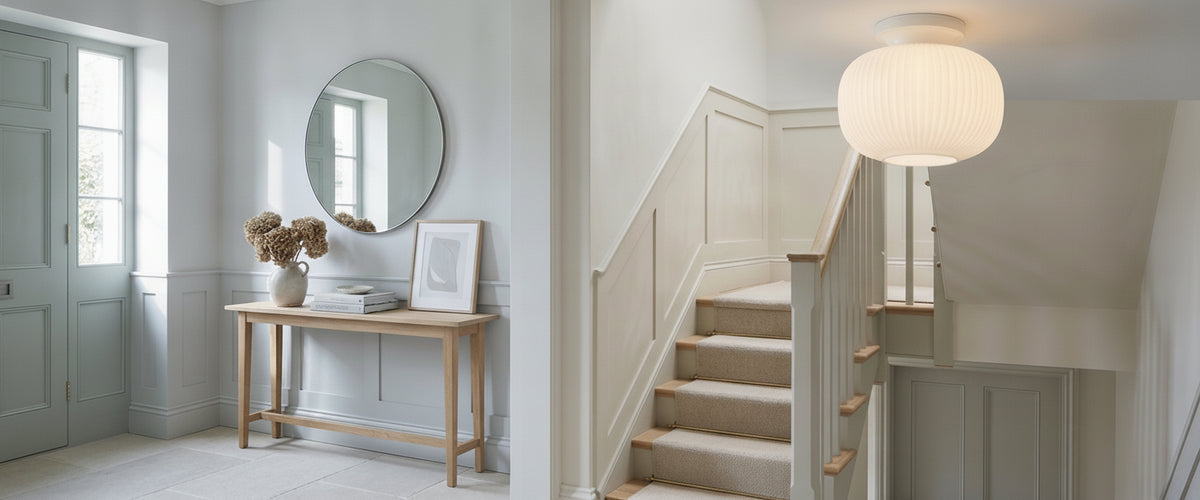

Most flat ceiling lights fail for one reason: the light has nowhere to go but down. A glass semi flush fixes that with a gap of only a few inches, letting light wash back up onto the plaster before it falls into the room. That upward bounce is the difference between a hallway that reads as finished and one that reads as a rental corridor with a lid on the bulb.

At a Glance: Glass Semi Flush Basics
- What it is: a ceiling fixture mounted on a short stem or spacer, typically sitting a few inches clear of the ceiling rather than sealed against it.
- Why the gap matters: light escapes upward, softening the ceiling line and reducing the harsh pool you get from a sealed flush mount.
- Best rooms: hallways, stair landings, bay window corners, bedrooms, powder rooms, and any space under roughly 8 to 9 feet (2.4 to 2.7 m) of ceiling.
- Glass choice drives everything: opal for even diffusion, ribbed for texture and glare control, clear or seeded for sparkle and visible filament.
- Check before you buy: lampholder type, maximum wattage per lamp, dimmer compatibility, and how the metal ring looks in daylight.
- Stone alternative: alabaster and marble shades give a warmer, denser glow than glass and hide the lamp entirely.

Semi Flush vs Flush Mount: Small in Inches, Big in Effect
A flush mount presses its shade directly to the ceiling. All the output is forced downward and sideways, which produces a bright disc overhead and a fairly steep falloff toward the walls. It is the right answer in a tight closet, a low utility landing, or anywhere a ceiling fan or door swing leaves you no room at all.
A semi flush introduces a spacer, stem, or short rod. Two to six inches of air changes the photometry: some of the output reflects off the ceiling plane and returns as indirect light, which flattens shadows on faces and stops the fixture from looking like a glowing manhole cover. You also gain a visible silhouette. The glass reads as a form rather than a disc, the hardware becomes part of the design, and the fixture starts behaving like a small pendant without the headroom penalty.
There is a practical benefit too. Sealed flush mounts trap heat around the lampholder, which shortens the life of cheaper LED lamps. An open or semi-open glass semi flush lets warm air move, and on a stairwell fitting you will be grateful for that the first time you replace a lamp from a ladder.
Clear, Opal, and Ribbed Glass Compared
Opal glass is the workhorse. Milky and fully diffusing, it hides the lamp, spreads output evenly, and keeps brightness comfortable for anyone looking up at it. Opal is the safest pick over a stairwell, in a bedroom, or anywhere a bare source would sit in someone's line of sight. Where the fitting sits low in a sightline and needs a soft even glow rather than a visible point source, a multi-light opal form such as the Hollis 5 Light Semi-Flush in black with opal glass is closer to the right design language than a clear bowl. The trade-off is character: opal glows, but it does not glitter.
Ribbed and fluted glass sits in the middle. The vertical relief breaks up the source into bands of light, cutting glare while still throwing some pattern onto nearby walls. In a hall with paneling or a kitchen with vertical shaker fronts, ribbed glass picks up the rhythm of the joinery. It also hides dust better than a smooth clear bowl, which matters more than people expect in coastal and desert homes.
Clear and seeded glass shows the lamp. That is the point. You get facet, sparkle, and a warm point source, plus visible filament detail if you use decorative LED lamps. Seeded glass, with its deliberate bubbles, scatters tiny freckled shadows across the ceiling, and a multi-light version like the Hollis 5 Light Semi-Flush in black with clear seeded glass multiplies that effect because every lamp casts its own pattern. We shipped a five-light seeded semi flush to a client in Marin who reported those shadows as her favorite detail in the remodel. Two things to accept with clear glass: you must love the lamp you install, and you should dim it. Undimmed clear glass at full output creates the kind of glare that professional lighting bodies flag as the main cause of visual discomfort indoors, and the Illuminating Engineering Society publishes plenty on why shielding and diffusion matter at eye level.
The Ceiling Height Threshold: Semi Flush or Short Pendant?
Height decides this, not taste. Our working rule:
- Under 8 feet (2.4 m): semi flush, and keep the drop tight. Anything longer intrudes into head height in circulation zones.
- 8 to 9 feet (2.4 to 2.7 m): the sweet spot for a glass semi flush. You get the ceiling bounce without losing headroom.
- 9 to 10 feet (2.7 to 3 m): a semi flush still works, but a larger diameter keeps it in proportion. A small bowl on a tall ceiling looks stranded, whereas a wider multi-arm form such as the Collier 4 Light Large Semi-Flush in heritage brass holds its own at that height.
- Over 10 feet (3 m): switch to a pendant or chandelier. At that height a semi flush washes the ceiling beautifully and leaves the room below underlit.
Measure the real clearance, not the nominal ceiling. Crown molding, a coffered edge, or a thick ceiling medallion can eat an inch or two. In stairwells, measure from the nose of the highest tread that sits under the fixture, and leave at least 7 feet (2.1 m) of clearance where anyone walks.
Hallways, Landings, and Bay Windows: Where a Glass Semi Flush Wins
Hallways are narrow, so a pendant swings into shoulder space and casts long shadows down the run. A glass semi flush mounted on center every 8 to 10 feet (2.4 to 3 m) gives an even sequence of pools with no dark gaps. In a Brooklyn brownstone hall we specified three matched opal fittings rather than one large fixture, and the corridor stopped feeling like a tunnel.
Landings are the other obvious case. Stair lighting has to be legible and shadow-free, and a diffused semi flush directly over the landing throws light onto the treads without the pendulum problem of a hanging fixture in a space people move through quickly.
Bay windows are the underrated one. A bay has a lower soffit or a shallow return where a pendant would look awkward, but a small semi flush tucked into the bay adds evening depth so the window does not turn into a black hole after dark. Pair it with a table or floor lamp nearby and the bay becomes usable seating instead of a daytime-only feature. If you are comparing formats across a whole floor plan, it helps to browse the full lighting range and think in layers rather than fixture by fixture.
The Metal Ring Deserves as Much Attention as the Glass
A semi flush is switched off for most of the day, and in daylight what you see is hardware. The backplate, the stem, the ring that clamps the glass, the finials, the visible screws. Brushed brass and heritage brass read warm and settle into age gracefully. Blackened steel gives crispness and works with dark window frames. Polished nickel is cool and formal and shows fingerprints from the installer's thumbs, so wipe it down after fitting.
Look at how the glass meets the metal. A generous collar or gallery reads as considered; a thin pressed ring reads as economy. Check whether the backplate is deep enough to cover the ceiling cut and any old paint shadow from a previous fixture, because that is the most common cosmetic complaint we hear after installation. Solid cast and machined components also survive repeated lamp changes without the threads loosening.
Lampholder, Wattage, and the LED Compatibility Check
Do this before the electrician arrives, not after.
- Confirm the lampholder. Small screw and candelabra bases suit multi-light bowls; larger screw bases suit single-lamp fittings. Match the lamp you actually want to the holder supplied.
- Respect the maximum wattage per lamp. On a multi-light glass semi flush, the total can climb fast. Overlamping cooks the lampholder and can discolor glass over time.
- Choose color temperature deliberately. 2700K suits most living spaces; 2200K to 2400K flatters opal and alabaster in bedrooms and halls. Keep every lamp in one fixture identical, and aim for a high color rendering index so skin and timber look right.
- Verify dimming. Not every LED lamp works with every dimmer. Check the lamp manufacturer's compatibility list against your specific dimmer model, and note that trailing-edge dimmers generally behave better with retrofit LEDs. Standards work on LED and dimmer interoperability is published by bodies such as NEMA, and reputable lamp makers state which control types they support.
- Use a licensed electrician. Ceiling fixtures involve mains wiring, mounting into joists or a rated box, and load calculations on the circuit. Get it certified.
When Alabaster Beats Glass Overhead
Glass diffuses; stone glows. Alabaster is translucent rather than transparent, so light travels through the crystal structure and picks up the veining on the way out, which gives a warmer and slightly uneven light that reads as candlelight rather than lamp light. Historic examples of translucent stone used as glazing appear in museum collections of late antique and medieval architecture, and the effect has not changed: dense, honeyed, quiet.
Choose alabaster or marble over glass when the fixture sits in view at close range, when you want the fitting to feel like a piece of material rather than a lamp cover, or when the room already has plenty of hard reflective surfaces. Choose glass when you need maximum output for the size, when the scheme calls for visible filament sparkle, or when you want to spend less on the fixture and more on the lamping and controls. Niori works across both, and the alabaster lighting collection is the obvious place to compare stone semi flush and flush ceiling forms against glass alternatives. Budget depends on material grade, diameter, the complexity of the metalwork, engineering, and finishing, so ask us for a tailored quote on anything you are weighing up.
Installation and Care Checklist
- Measure clearance from finished floor, and from the highest stair tread beneath the fixture.
- Confirm the ceiling box is rated for the fixture weight and that the mounting bar spans solid timber.
- Dry-fit the backplate against the existing ceiling mark before final wiring.
- Install identical lamps, same color temperature, same dimming behavior.
- Test dimming across the full range before the electrician leaves; look for flicker at the bottom 10 percent.
- Clean glass with a soft cloth and a little warm water; dry immediately to avoid water marks.
- For alabaster and marble shades, dust dry only. No vinegar, no citrus, no bathroom spray. Acidic cleaners etch calcite stone permanently.
- Retighten the glass ring gently after the first few months, then check annually.
Buyer Mistakes We See Most
Going too small is the big one. A bowl that looks generous in a photograph can look like a smoke detector once it is on a 9 foot ceiling. Sketch the diameter on the floor with tape before you order. The second mistake is pairing clear glass with an undimmed switch, which turns a refined fitting into a glare source. The third is ignoring the rest of the room: a glass semi flush is an ambient layer, and it needs a table lamp, wall light, or floor lamp to give the space depth after dark. Start from the Niori homepage if you want to see how ceiling fittings, wall lights, and lamps in the same material family work together.
Get the height right, pick the glass for the job rather than the photo, and check the lamping before the ladder comes out. A glass semi flush handles more rooms well than almost any other ceiling fixture, and it does it without stealing an inch of headroom you cannot spare.