
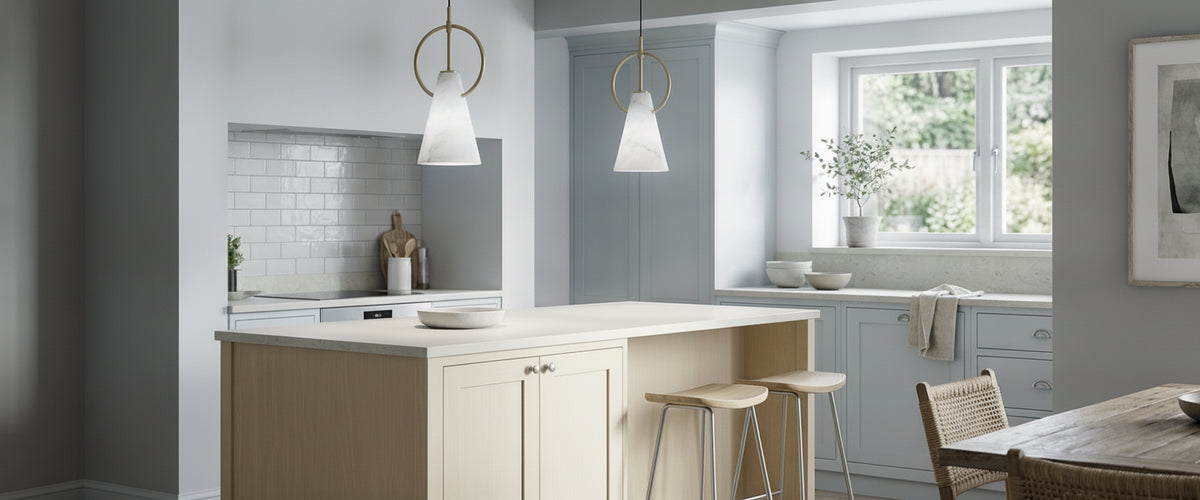

More often than not, when a newly finished kitchen looks slightly off, the pendants are the culprit, and they are hanging too high. Not by a lot. By three or four inches, which is enough to make a beautifully made fixture float in the middle of nowhere while the countertop below it sits in gloom. Getting pendant lighting height right over an island is a short conversation with a tape measure, and it is far cheaper to have before the electrician drills than after. Pendant lighting height is the one dimension nobody checks twice and everybody notices later.

At a Glance
Baseline pendant lighting height: 30 to 33 inches (760 to 840 mm) from the countertop to the lowest point of the shade.
Measure from the counter, not the floor. Island height varies more than people expect.
Wide shades read lower. A broad dome at 32 inches feels heavier than a narrow cone at the same height.
Two or three pendants: space centers roughly 30 to 36 inches apart and keep the outermost shades at least 6 inches inside the island ends.
Linear fixture: aim for around two thirds to three quarters of the island length.
Alabaster earns you room. Because the stone diffuses rather than glares, translucent shades tolerate a lower pendant lighting height than clear glass.
Always use a qualified electrician for wiring, ceiling boxes and load-bearing fixings, especially with stone.

Kitchen Island Versus Dining Table: The Same Rule Does Not Apply
Dining tables and kitchen islands get lumped together in most advice, and that is where the trouble starts. A dining pendant hangs over a surface roughly 29 to 30 inches (740 to 760 mm) off the floor, and its job is atmosphere. People sit still, faces lit, nobody needs to read a knife edge. Dining pendant lighting height can go low and intimate without costing anybody anything.
An island countertop sits higher, typically 36 inches (around 915 mm), and it is a work surface first. Someone is standing at it, chopping, reading a recipe, checking whether the chicken is actually done. So the pendant has to clear sightlines across the room while still pushing usable light onto the stone. That pull in two directions is why pendant lighting height over an island has a narrower tolerance than it does over a table.
One more difference: islands are usually visible from a sofa, a hallway, or a set of bifold doors. A dining fixture is looked at from one seated position. An island fixture is looked at from everywhere, which is why the wrong pendant lighting height is so obvious in an open-plan kitchen and so forgiving in a closed dining room.
The 30 to 33 Inch Baseline and What Changes It
Set your pendant lighting height at 30 to 33 inches (760 to 840 mm) from the countertop to the bottom edge of the shade. Not to the socket, not to the canopy, not to the brass collar. The lowest visible point. That range keeps the light source above standing eye level for most adults while the pool of light still lands where the work happens.
Then adjust for the real conditions in the room. If the household includes people over six feet tall, push toward 33 or 34 inches so nobody ducks. If the island is a serving and seating piece rather than a prep station, you can drop to 29 or 30 and gain intimacy. If the pendant sits on a sightline between the kitchen and a view, pendant lighting height is negotiable but the fixture's opacity is not, and a translucent alabaster shade will interrupt that view far less than a solid metal cone.
We keep a mock-up rail in the studio set at counter height precisely because of this. Every new alabaster shade gets hung at three pendant lighting heights, 30, 32 and 34 inches, before it is photographed, and the differences are not subtle. At 30 inches, a thin-walled alabaster dome throws a warm halo onto the stone and lights the veining from within. At 34 inches, the same shade becomes decorative and the countertop needs help from elsewhere.
Shade Diameter: Why a Wider Pendant Reads Lower
Two pendants hung at identical pendant lighting heights can feel completely different, and diameter is why. Visual weight sits in the silhouette. A 16 inch (about 400 mm) dome occupies far more of the space between counter and ceiling than an 8 inch (about 200 mm) cone, so the eye registers it as lower and closer even when the tape says otherwise.
The practical rule: as diameter goes up, add an inch or two to your pendant lighting height. A generous travertine or marble dome, the kind that reads as a solid object in daylight, usually wants to sit at the upper end of the range; a stone-bodied fixture such as the Belaro Travertine Dome Pendant Light has enough physical presence that 33 inches keeps it from crowding the counter. A slim carved alabaster cylinder or a tapered shade can hang at the lower end without crowding anyone. This is also why three small pendants and one large pendant are not interchangeable decisions; the single large fixture demands more headroom and more accurate centering.
Material matters here too. Alabaster is a gypsum stone, softer and more translucent than marble, and it has been carved into light-transmitting panels since antiquity precisely because it glows rather than blocks. The Getty collections include worked alabaster that shows how thin the stone can go. In a pendant, that translucency means the shade stays visually light even when it is physically wide, so wide alabaster forms survive a lower pendant lighting height better than opaque ones. If you are weighing form against scale, browsing the alabaster lighting collection side by side is the fastest way to see how much difference wall thickness and shade profile make to perceived bulk.
Multiple Pendants: Symmetry Is Not Always Your Friend
The instinct is to divide the island into equal parts and center a pendant in each, often before anyone has settled the pendant lighting height. Sometimes that works. Often it produces end pendants sitting awkwardly close to the island's edges, or a middle pendant hovering directly over a sink cutout while the prep zone gets nothing.
A better sequence: decide where the light needs to land first, then set the spacing. Prep zone, seating overhang, serving stretch. Place pendant centers roughly 30 to 36 inches (760 to 915 mm) apart, keep the outer shades at least 6 inches (150 mm) in from the island ends, and check that no shade edge lands within a few inches of another. Then look at the group as one object and center that object over the island's visual center, which on an island with an asymmetric sink or cooktop is rarely the geometric middle.
Where three pendants have to share a run of eight feet or less, a narrow single-lamp shade like the Darwin 1 Light Pendant in Matte White keeps those 30 inch gaps legible instead of turning the island into a row of overlapping silhouettes. Across the island's width, do center. Off-center pendants over a narrow island read as a mistake from every angle. The one exception is an island with seating on a single long side, where nudging the run an inch or two toward the working side can put more light on the counter and less in a diner's eyes.
A client outside Austin learned this the hard way. Their builder had matched the island pendant lighting height to the adjacent dining fixture, so three pendants hung at roughly 40 inches above the counter, perfectly spaced and perfectly useless. We shortened the rods, kept the spacing, and the cook stopped leaning sideways to see the cutting board. The height fix cost an afternoon. The spacing had been right all along.
Ceilings Under 8 Feet and Over 10 Feet
Standard advice on pendant lighting height assumes a ceiling around 8 to 9 feet (2.4 to 2.7 m). Push past either end and the calculation shifts.
Low Ceilings
Under about 8 feet (2.4 m), headroom is the constraint, not aesthetics. Favor compact shades, shallow profiles and semi-flush fittings over long drops, and take the top of the 30 to 33 inch pendant lighting height range so the fixture does not dominate. A rise and fall mechanism is genuinely useful in a low room; you can set the working height and lift the fixture when the kitchen becomes a party. Where that flexibility matters more than a fixed drop, something like the Provence 1 Light Rise & Fall Pendant in Polished Nickel lets you tune the height after the ceiling box is in rather than committing to a rod length on paper. If the ceiling is truly tight, skip pendants and light the island with recessed fittings plus a pair of alabaster wall lights nearby for warmth.
Tall Ceilings
Above roughly 10 feet (3 m), pendant lighting height barely changes at the shade, but the cord or rod above it becomes a design element in its own right. Long drops of bare cable look unfinished in a double-height space. Use rigid stems, consider a slightly larger shade so the fixture holds its own against the volume, and think about whether the pendant should sit at the lower end of the range to anchor the island rather than floating halfway up a wall of glass. In a Napa project with a vaulted ceiling, we set two large alabaster domes at just under 30 inches above the counter. Low, deliberately, so the island read as a room within a room after dark.
Lighting for a Kitchen Island: Beyond the Pendants
Pendants set at the right pendant lighting height are task lighting and sculpture at once, but they should not carry the whole kitchen. Lighting for a kitchen island works in layers: under-cabinet strips for the perimeter counters, a dimmable ceiling layer for cleaning and cooking, and something warm at low level for the end of the evening. The full lighting range is worth scanning for wall lights and table lamps that share a stone palette with the pendants, because matched material across layers is what makes a scheme look designed rather than assembled.
Illuminance targets for kitchen work surfaces are higher than for most rooms, and guidance from bodies such as the Illuminating Engineering Society reflects that. Two pendants alone rarely hit it, which is why lighting for kitchen island prep zones needs more than a good-looking pair of shades. Plan the pendant lighting height for the island and the atmosphere, then fill the gap with other layers.
Color Temperature and Dimming at Your Chosen Height
Pendant lighting height and color temperature interact more than people expect. The lower a fixture hangs, the more of its light lands in your field of view, and the more a cool source will feel clinical. For alabaster and natural stone, 2700K is the sweet spot; it brings out the honey and cream tones in the veining and keeps the glow from turning gray. At 3000K the stone reads crisper and slightly whiter, which can suit a marble-heavy kitchen. Above that, the warmth that makes stone worth buying starts to disappear.
Specify a high CRI lamp, 90 or above, so food and finishes hold their color. Dim on a trailing-edge or compatible LED dimmer, and test the fixture on the actual dimmer before signing off, because flicker at the bottom of the range is the single most common complaint we hear. Pendant lighting height also changes how bright a lamp needs to be: drop from 34 inches to 30 and the same lamp delivers noticeably more light on the counter, so you may want a lower output than you first assumed.
Checklist Before You Drill
Confirm the finished countertop height, not the cabinet carcass height.
Mark 30, 32 and 34 inches on a stick as candidate pendant lighting heights, and hold a cardboard disc of the shade diameter at each one.
Check sightlines from the sofa, the hallway and the main doorway, standing up.
Decide pendant spacing from the work zones, then center the group.
Verify the ceiling has adequate backing or joist support; stone pendants weigh considerably more than glass equivalents.
Confirm rod, stem or cord lengths are adjustable or cut to your exact ceiling before shipping.
Choose 2700K, CRI 90 plus, and confirm dimmer compatibility.
Have a qualified electrician handle the connection, the ceiling box and the fixings.
Budget and Specification
Cost on stone pendants tracks material, scale, wall thickness, metal finishing and the engineering behind the suspension, so a three-pendant run with custom stem lengths sits in a different place to a single fixture off the shelf. The sensible move is to send your ceiling height, island dimensions and preferred drop and ask for a tailored quote. Niori works in alabaster and natural stone specifically because those materials reward a carefully judged pendant lighting height, and getting the specification right at quote stage is far easier than adjusting a stone shade on a ladder.