
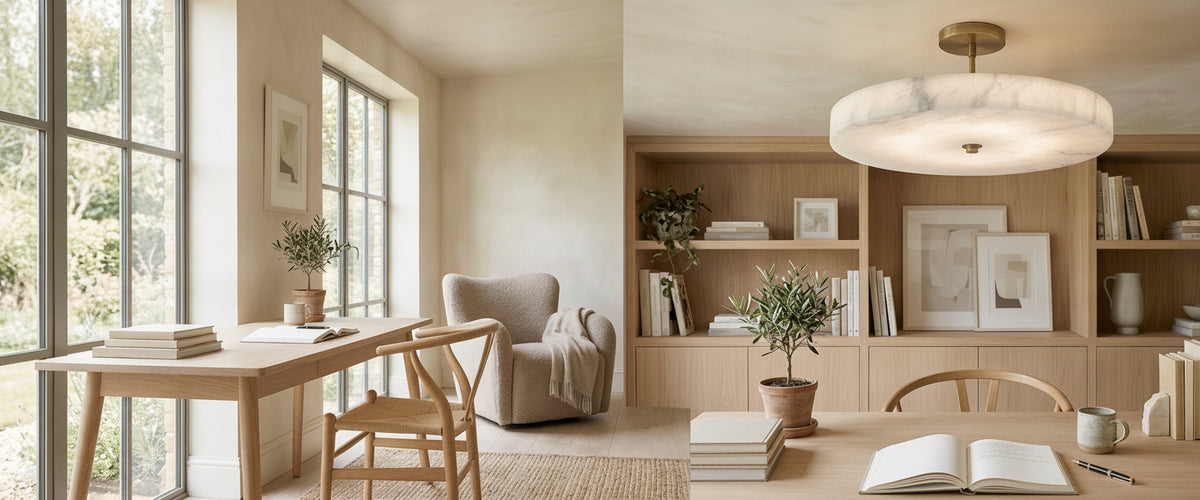

Most home offices get a better chair, a second monitor and a mechanical keyboard long before anyone looks up. Then the afternoons start feeling long, eyes feel gritty by five, and everyone blames the screen. More often the culprit is the home office ceiling lighting: one bright fitting in the middle of the room, aimed straight down at a glossy monitor, with no dimmer and a color temperature borrowed from a supermarket aisle. Badly chosen ceiling lights tire eyes faster than any screen does.
The ceiling fitting is the one light you cannot move once it is installed, which makes home office ceiling lighting the part worth thinking about hardest. Get it right and the rest of the scheme (desk lamp, wall light, a floor lamp in the reading corner) becomes optional rather than corrective.

Quick Answer: Home Office Ceiling Lighting in Six Lines
Type: semi-flush is the safest choice for standard ceilings; flush mount for anything under about 2.4 m (8 ft); pendant only if it sits off the sightline to your screen.
Position: in front of or to the side of your seated position, never directly behind your head or directly above the monitor.
Diffusion: a translucent alabaster or natural-stone shade spreads light rather than punching it, which is the single biggest glare fix.
Colour temperature: 2700K to 3000K for a room you also relax in; up to around 3500K if it is purely a work space.
Beam: wide (90 degrees or more) from the ceiling for even ambient light; leave narrow beams to task lamps.
Dimming: non-negotiable, with a driver and dimmer module confirmed as compatible before install.
Diffused home office ceiling lighting: a translucent stone shade spreads output across a broad luminous surface instead of one hot spot.

Flush Mount, Semi-Flush or Pendant: What Actually Belongs Above a Desk
Ceiling height decides home office ceiling lighting more than taste does. Under roughly 2.4 m (8 ft), a flush mount keeps the light source out of your peripheral vision and stops the fitting reading as an obstacle every time you stand up. A carved alabaster disc or a slim stone drum works well here because the stone itself does the diffusing, so you get a soft wash rather than a hot spot. Where headroom is genuinely tight, something with a low, softly glowing profile such as the Pulcra Tube Flush Ceiling Light is closer to the right design language than a deep drum or a caged fitting.
Between about 2.4 m and 2.9 m (8 to 9.5 ft), semi-flush is usually the better call. Dropping the fitting a few inches from the plaster lets light bounce off the ceiling as well as downward, which lifts the whole room and reduces the contrast between a bright screen and a dark ceiling plane. That contrast is what tires eyes over a long working day, not raw brightness. A rounded white shade on a short stem, along the lines of the Arion Semi-Flush Ceiling Light, gives you that upward bounce without adding a bright edge at eye level.
Pendants earn their place in converted lofts, garden studios with vaulted roofs and double-height rooms. They are also the most common mistake in home office lighting ceiling schemes, because a pendant hung over the centre of a desk sits exactly where your eye travels when you look up from a document. If you want a pendant, hang it off-axis: over a side table, a meeting chair, or a run of shelving, and let a wall light or table lamp handle the desk. Shifting a pendant a metre sideways, clear of the monitor's reflection, usually fixes a glare complaint that dimming alone never touches.
Screen Glare Starts at the Ceiling
Two kinds of glare come from home office ceiling lighting. Direct glare is when you can see the bright source itself in your field of view. Reflected glare is when the fitting appears in your monitor as a pale ghost, forcing your pupils to keep adjusting. UK guidance on display screen equipment is blunt about the fix: position screens and luminaires so windows and fittings are not reflected in the display, and avoid strong contrast between the screen and its surroundings (see the HSE display screen equipment guidance).
In practice, treat your monitor like a mirror. Sit down, look at the screen while it is switched off, and see what appears in it. If the ceiling fitting is in there, you have three options: move the desk, change the fitting to something with a diffusing shade, or dim it and let a task light carry the load. Stone helps enormously. Alabaster and onyx transmit light through the material, so the luminous surface is broad and low in brightness rather than a small intense point. That is why so much of our alabaster lighting reads as comfortable in rooms full of screens, where a bare glass or metal downlight would not.
Placement matters as much as the fixture: home office ceiling lighting set ahead of or beside the desk stays out of the monitor's reflection.
One more thing worth checking: gloss levels. A high-gloss desk, a glass-topped console or a lacquered cabinet door will throw the fitting back up at you from below. Matt and honed surfaces do more for glare control than any specification sheet suggests.
Colour Temperature and Beam Angle: The Numbers That Separate Focus from Fatigue
Two numbers do most of the work in home office ceiling lighting. For a room that doubles as a study, a guest room or a reading corner, 2700K to 3000K is the range to stay in. It flatters plaster, timber and the natural veining in stone, and it does not make evening work feel clinical. If the room is a dedicated office you leave at the end of the day, you can push to around 3500K for a crisper, more alert quality. Above 4000K, skin tones on video calls start to look drained and warm-toned stone loses its character.
Consistency matters as much as the number. Mixing a 4000K ceiling light with 2700K lamps creates a colour clash your eye reads as dirt on one of the surfaces. Pick one temperature and hold it across the room, including any downlights already in the ceiling.
Beam angle is the other half. Light from the ceiling should be wide, ideally 90 degrees or more, so it lands evenly across the desk plane and the walls rather than pooling in one bright circle. Aim for a comfortably lit desk surface with soft shadows and no visible edge where the light stops. Narrow beams (24 to 40 degrees) belong in adjustable task lamps and picture lights. Also look for a high colour rendering index, ideally CRI 90 or above, if you work with fabric samples, artwork or print proofs.
Why a Non-Dimmable Home Office Ceiling Light Quietly Sabotages Your Focus
Dimming is where a lot of home office ceiling lighting quietly fails, because a single output level cannot serve a room used from 8am to 8pm. Morning work with daylight flooding in needs a low fill; a dark January evening needs more; a video call needs light on your face rather than the back of your head. Without a dimmer you either work under a fitting that is too bright for the ambient conditions or switch it off and squint at a monitor in a dark room, which is the worst contrast scenario of the lot.
Two practical notes. First, dimming performance depends on the driver and dimmer module talking to each other properly; flicker and a dead low end are usually a compatibility issue, not a fault in the fitting. Confirm the pairing before install. Second, always use a qualified electrician for ceiling work, including anything involving existing wiring, backplates or a dimmer swap. Stone fittings also carry real weight, so the fixing point needs to be into a joist or a properly specified support, not just plasterboard.
The Desk Orientation Mistake That Undoes a Good Fitting
Desks get pushed against the nearest wall with a socket. That decision, made in ten seconds, dictates how every light in the room performs.
The pattern we see most often: desk against a wall, monitor facing into the room, fitting behind and slightly above the user. Every bit of light lands on the back of the screen and reflects into their eyes. Turn the desk 90 degrees so the ceiling light sits ahead of you or to one side, and the same home office ceiling lighting suddenly behaves. Side-on to a window is the classic recommendation for daylight, and it works for artificial light too.
If the desk truly cannot move, change what the ceiling does. Drop the ambient level, add a wall light above the monitor line to lift the wall behind the screen, and put a stone table lamp on the desk for the document zone. Diffused layers beat one strong source every time.
Buyer's Checklist for a Home Office Ceiling Light
Measure the ceiling first. Under 2.4 m (8 ft) means flush; above that, semi-flush or pendant becomes viable.
Run the monitor reflection test from your actual seated position before you commit to a fixing point.
Choose a diffusing material. Translucent alabaster, onyx or marble shades soften output in a way clear glass cannot.
Confirm dimmability and get the driver and dimmer specified together.
Lock the colour temperature across every light in the room, ceiling included.
Ask about weight and fixing for stone fittings, and book an electrician rather than improvising.
Plan the second layer. Home office ceiling lighting plus one task or wall light will always outperform a single bright fitting.
Budget realistically. Cost depends on stone selection, scale, metalwork and installation, so ask for a tailored quote.
Living with Alabaster in a Working Room
Stone fittings age well in offices because offices are dry, stable rooms. Alabaster is a form of gypsum, soft enough to carve by hand and sensitive to water, which is why it belongs in a study rather than a steamy bathroom; the British Geological Survey has a useful primer on the mineral. Dust with a dry, soft brush or a clean microfibre cloth. Skip ammonia, vinegar, alcohol and anything abrasive, and never spray liquid directly onto the stone.
Brass detailing is the other variable. Lacquered brass stays as supplied and wants nothing more than dusting; unlacquered brass develops a patina over the years, which some clients want and others do not, so ask which finish you are buying. In a larger or L-shaped office where one fixture has to cover too much floor, splitting home office ceiling lighting across a multi-arm semi-flush such as the Brinley 3 Light Semi-Flush in Brushed Brass spreads the same output across several softer sources, which is easier on the eyes than one bright centre point. If you are comparing fixture types across a whole project, browsing the wider lighting range alongside the ceiling options shows how a semi-flush stone fitting sits with matching wall lights and table lamps.
Good home office ceiling lighting is not a heroic centrepiece. It is a broad, warm, dimmable wash that you stop noticing after a week, which is exactly the point. If you are specifying several rooms at once, start from the Niori collections and work backwards from ceiling height and desk position. That is the order we recommend every time.