
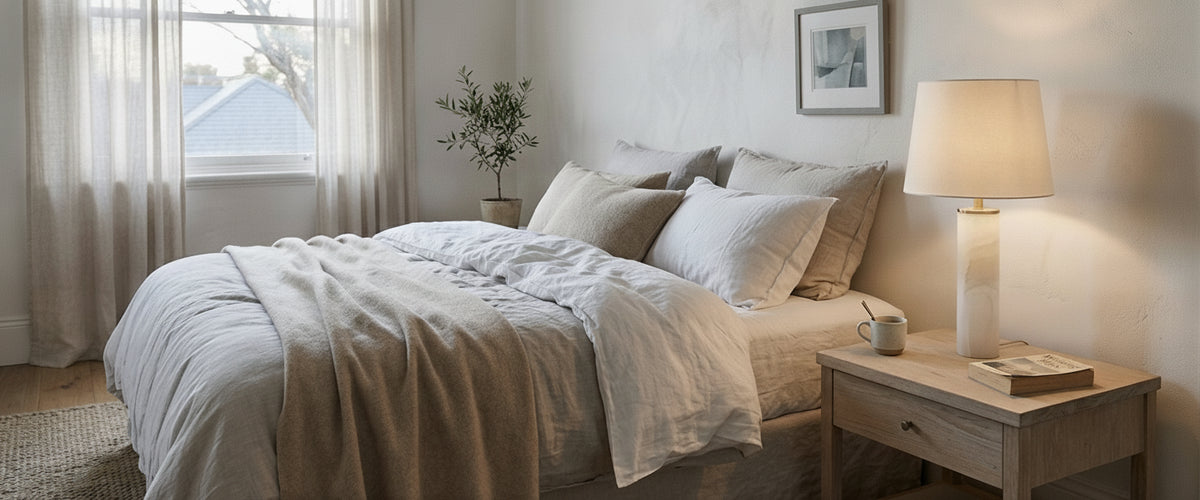

Most lamps are judged in daylight, in a showroom, by someone standing up. A rechargeable bedside table lamps is judged at 2am by someone lying down with one eye open, and that is a far harsher test. It has to switch on without a fumble, throw enough light to find a glass of water, and stop short of waking the person next to you. Get the specification wrong and you notice within a week. Get it right and it becomes the most-used light you own.

Quick Answer: What Matters Most
Seven things separate a good rechargeable bedside table lamp from an expensive ornament.
Warm light, properly warm. Around 2700K or lower at the bedside. Anything cooler reads clinical against linen and pale walls.
Dimming that goes genuinely low. Three steps is the usable minimum; the bottom step should be barely-there rather than simply dimmer.
Shade shape decides the glow direction. Domes wash downwards, mushrooms spread sideways, columns glow all over.
Battery honesty. Quoted run time is measured at full brightness or lowest, and the difference can be many hours. Ask which.
Charging method. USB-C into the body, or a magnetic base you simply drop the lamp onto. The second is far kinder to nightly habits.
Height and reach. Measure from the top of the mattress, not the floor, and leave room for a book and a phone.
Material. Alabaster and onyx diffuse light through the body of the stone, which is why they glow rather than glare.

Why the Bedside Is the Hardest Test a Rechargeable Lamp Faces
Cordless lamps have spread across restaurants, terraces and garden tables, where they are switched on once at dusk and switched off at closing. The bedside works differently. A rechargeable bedside table lamp might be touched four times in a single night: on for reading, off for sleep, on again at 3am, off once more. Each of those touches happens without looking, which means the control matters as much as the light.
Every bedside table lamp, rechargeable or plugged in, lives or dies by its switch. Touch-dim bases and single-press rotary collars work well in the dark because your hand finds the whole lamp, not a small button. Hidden switches on the underside of a base are the most common source of bedside irritation we hear about. So is a lamp that always wakes at full brightness; a rechargeable bedside table lamp with memory, returning to the level you last used, is worth hunting for.
There is a practical advantage too. Bedside sockets are almost never where you want them. Period bedrooms in particular tend to have a single socket stranded behind the headboard, and running a new circuit through a listed building is rarely a quick job. A cordless lamp settles in an afternoon what rewiring would take weeks to do. The same logic applies to a canopy bed with no obvious cable route, or a nightstand that floats away from the wall.
2700K on the Spec Sheet, 2am on the Ceiling
Color temperature is the number buyers read and the thing they most often misjudge. 2700K sounds warm on paper, and it is, but what reaches your eye also depends on what the light passes through. Sent through frosted acrylic, 2700K can still feel flat and slightly gray. Sent through a few millimeters of alabaster, the same LED picks up the mineral's honey and cream tones and lands noticeably warmer and softer on the ceiling.
That is the argument for stone in a rechargeable bedside table lamp. Alabaster is a gypsum stone with natural translucency, so light does not simply bounce off the surface; it travels into the material, scatters against the internal veining, and leaves as a diffused glow with no visible hot spot. Onyx does something similar with more drama, throwing amber and caramel bands across the shade. You can see the effect across our alabaster lighting range, where the same warm LED reads differently depending on the thickness and cut of the stone.
Keep the late-night setting low as well as warm. Research summarized by Harvard Health points to light in the blue part of the spectrum being the most disruptive to melatonin production in the evening, which is why cool-white bedside light is a poor choice however convenient the lamp. Warm, dim and aimed downwards is the combination to aim for.
Dome, Mushroom or Column: How Shade Shape Steers the Glow
At arm's reach, shade geometry does more work on a rechargeable bedside table lamp than wattage does. Three shapes cover most of the market and each behaves differently.
The Dome
A deep dome pushes light straight down onto the nightstand and keeps the source out of sightlines from a lying position. Best for shallow tables, shared beds and anyone who wants a pool of light rather than ambient glow. The trade-off is that the room stays dark, so a dome alone will not help you find the door.
The Mushroom
The wide, low mushroom silhouette spreads light sideways across the table and the lower wall. It is the friendliest shape for reading in bed because it lights the page without lighting your face. In alabaster, the curved profile also shows off the veining beautifully when lit, which is half the reason the form has become so popular again.
The Column
A solid stone column or cylinder glows across its whole surface, acting more like a night light than a task light. Lovely for a guest room, a hallway console or a bathroom shelf. Less useful if you actually read in bed. Column forms in marble and alabaster tend to look strongest in pairs. Where the room needs a soft, upward-spreading glow rather than a hard downlight, a slim shape such as the AI Collaboration Rechargeable LED Table Lamp in white sits closer to the right design language than a deep-shaded reading lamp.
One more consideration: brass detailing. A brushed aged brass base under a pale stone shade catches the warm LED and reflects a second, dimmer layer of light back up into the stone. It also survives nightly handling better than a lacquered polished finish, which shows fingerprints within days. That is why a piece like the Morvenne Rechargeable Table Lamp in brushed aged brass tends to age more gracefully on a nightstand than a high-shine equivalent.
A Year of Nightly Charging: What Battery Longevity Looks Like
Lithium-ion cells age by cycle count and by heat, not by calendar alone. A rechargeable bedside table lamp charged nightly from near-empty will show a shorter run time after twelve months than one topped up from half. Nothing is wrong with the lamp; that is how the chemistry works. Expect a gradual reduction rather than a sudden failure, and plan around it.
Three habits stretch the useful life of a rechargeable bedside table lamp battery. Top it up before it dies rather than running it flat every time. Keep it off radiators, windowsills in direct summer sun and anywhere it will sit above 30°C (86°F) while charging. If a guest room lamp goes unused for months, store it around half charge rather than empty. The London Fire Brigade's guidance on lithium batteries is also worth reading before you get into the habit of charging anything on a soft surface; bedside means duvets, and duvets trap heat.
Ask two questions before buying any rechargeable bedside table lamp. Is the battery replaceable or serviceable, and what charging connection does it use? A magnetic dock that lives permanently on the nightstand means the lamp charges by simply being put down. A bedside table lamp rechargeable by standard USB-C is the more universal option, and the cable is easy to replace if it goes missing. Proprietary barrel connectors are the ones to be wary of.
Height, Footprint and Reach: The Dimensions Buyers Regret
Measure from the mattress top, not the floor. Divans, deep toppers and upholstered bases can add several inches over what the bed frame specification suggests, and a rechargeable bedside table lamp that looked correct in a drawing ends up shining into your eyes. As a working rule, the bottom edge of the shade wants to sit at or just above shoulder height when you are sitting up against the headboard. That keeps the LED hidden and the light on the page.
Footprint is the second trap. Nightstands in older UK bedrooms are often narrower than people assume, and a stone base is deliberately weighty to stop a cordless lamp tipping. Take the Wycvorne 1 Drawer Bedside Table, a fair example of that narrower single-drawer proportion: on a surface that size, a broad mushroom base can swallow the whole top. Leave space for a book, a glass and a phone, or the lamp will be shuffled to the back corner where it lights nothing useful. Pairs need symmetry too; if your two sides of the bed have different tables, size the lamp to the smaller one.
Reach matters for cordless pieces in a way it never did for plugged-in lamps. Because there is no cable, a rechargeable bedside table lamp migrates. Ours end up on bathroom shelves, kitchen islands and garden tables in July. Weight and grip become a specification rather than an afterthought, so look for a base you can lift confidently with one hand. If you are pulling together lighting for a whole room, it helps to browse the wider lighting collection alongside the bedside choice so the finishes agree.
Your Rechargeable Bedside Table Lamp Checklist
Color temperature stated at 2700K or warmer, with dimming to a genuinely low bottom setting.
Control you can find in the dark: touch base, collar dimmer or top button, with brightness memory.
Run time quoted at a stated brightness level, not a vague maximum.
Charging method confirmed: USB-C or magnetic dock, with a spare cable if the connection is unusual.
Shade shape matched to use: dome for task, mushroom for reading, column for ambience.
Height measured from mattress top, with the shade edge near shoulder height.
Base footprint leaves room for the rest of your nightstand.
Stone finish sealed and confirmed suitable for regular handling.
IP rating checked if it will ever visit a bathroom or terrace.
Caring for Stone at the Bedside
A rechargeable bedside table lamp is handled more than any other fixture in the house, usually by hands carrying moisturizer, and that is the single biggest threat to alabaster. Gypsum alabaster is soft, roughly 2 on the Mohs scale, and porous enough that oils will darken an unsealed surface over time. Wipe the base with a dry or barely damp microfiber cloth, never a spray cleaner, and never anything acidic. Marble and onyx tolerate a little more but follow the same rule.
Two small habits make a visible difference after a year. Lift the lamp by its base rather than its shade, since stone shades are thin by design and the stress point is where they meet the fitting. And give the charging contacts a dry wipe every few weeks, because dust and skin oils on a magnetic dock are the usual reason a lamp that looks charged is not. Niori builds its rechargeable pieces around alabaster and natural stone because the material rewards this kind of small maintenance; you can see how the range fits together across the Niori collection.
A good rechargeable bedside table lamp should still feel right in its third year, with the same warm glow through the stone and a battery you know how to look after. Choose for the light first, the control second and the silhouette third, and the lamp will earn its place every night.