
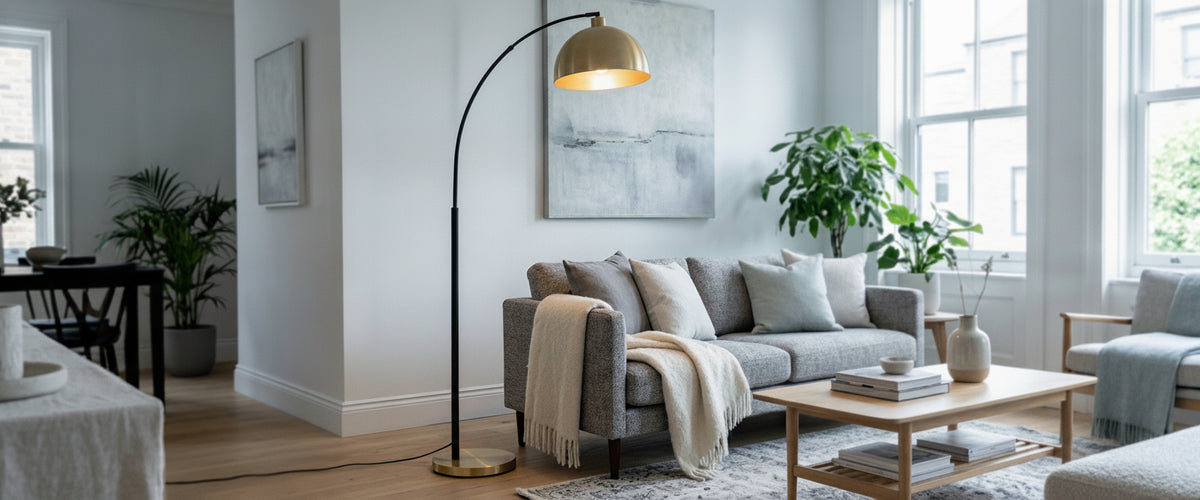

Most two-tone lamps fail in the same place, and it is rarely the black that does the damage. A black gold floor lamp goes wrong when the gold is asked to do too much: a gilded stem, a gilded collar, a gilded foot ring and a gilded shade rim all competing in one silhouette. From three feet away (about a meter) it looks busy. Switch it on and every gold edge flares at once. Get the ratio right and the same black gold floor lamp becomes the most disciplined object in the room.

Quick Answer: What to Get Right First
Ratio: keep gold to roughly a fifth of the visible surface or less. Black should carry the form; gold should punctuate it.
Inner shade finish: a brushed or lightly hammered gold interior throws warm light; a mirror-polished interior throws hotspots.
Silhouette: arc for reading over a sofa or a corner you cannot wire; straight column for symmetry beside a chair or console.
Backdrop: a black and gold floor lamp lands best against mid tones, plaster, deep green, walnut. It disappears against high-gloss black and shouts against cool gray.
Quality signals: weighted base, no rocking, even plating at the joints, cable exit hidden, dimmable driver or a dimmable lamp holder.
Budget: material, scale and finishing quality drive the price of a black gold floor lamp far more than height does, so compare plating and stone rather than dimensions.

How the Black-to-Gold Ratio Decides Statement Versus Visual Noise
Think of gold as punctuation, not text. On the best examples of a floor lamp with gold detailing, the metal appears in one or two places only: the inside of the shade, or a slim collar where the stem meets the shade, or a low base plate that catches reflected light from the floor. Everything else stays matte black, which means the eye reads a single clean shape instead of six bright edges. That restraint is the whole trick.
The rule I use in the studio is a fifth. If more than about 20 percent of what you can see from 10 feet (around 3 meters) away is gold, the black gold floor lamp starts to behave like jewelry and demands a quieter room to sit in. That can be the right call in a formal drawing room with pale walls and very little pattern. In a family sitting room with rugs, art and a busy bookcase, it is the thing that tips the room over. A multi-head piece such as the Leonard 3 Light LED Floor Lamp, Black & Gold holds that discipline by keeping the gold at the heads and collars while the frame and stem stay matte black, so three light sources still read as one vertical line.
Warmth is the second variable people forget when they compare one black gold floor lamp with another. Brushed brass and brushed gold read softer and slightly greener than polished gold, which leans pink under incandescent-style bulbs. If your hardware, faucets or cabinet handles are already brass, choose the softer gold and let the black do the contrast work. Matching gold exactly across different manufacturers is close to impossible, so aim for the same family rather than the same swatch.
Inner Shade Finish and What Switches On When the Bulb Does
Here is the detail that separates a modern gold floor lamp that flatters a room from one that merely photographs well. The interior of the shade is the only part of the lamp that the light source actually touches, so its finish sets the color and the softness of everything below it.
A brushed gold or lightly textured interior scatters light. You get a warm, forgiving wash across an armchair and a gentle amber glow on the shade lip. A mirror-polished interior does the opposite: it behaves like a reflector, concentrating light into a bright disc on the floor and bouncing a visible filament image back at anyone sitting opposite. Painted white interiors are the most neutral of all and the best choice if you read in that seat every evening, though they lose the candlelit quality that draws people to a black gold floor lamp in the first place.
This is also where alabaster changes the conversation. Where a metal shade reflects, alabaster transmits. Light passes through the stone and comes out diffused, veined and warm, with no hard cut-off line. Where the light needs to come through the shade rather than bounce off it, a hybrid piece such as the Stratalux LED Stacked Alabaster Column Floor Lamp, Matt Black splits the job cleanly: the stone does the glowing, the black metal frames it, and the metallic detailing stays limited to the collar and base. That is the calmest route to a black gold floor lamp you can sit next to all evening. You can see the range of that approach across our alabaster lighting collection, where the stone is doing the optical work and metal is only structure.
Arc Gold Floor Lamp Versus Standard Column: Which Silhouette Suits Which Spot
An arc gold floor lamp solves a specific problem: light where you cannot put a base. The weighted foot sits behind or beside the sofa while the head reaches out over the seat, which is exactly what you want when the room has no pendant point in the right place and you would rather not chase cables through a ceiling. Reading light lands on the page instead of the back of your head. For that job, a black and gold floor lamp like the Otvenna Arc Floor Lamp, Brass and Black does more than a tall column pushed into the corner ever will.
The trade-offs are real. An arc needs generous floor clearance behind the seating, it tends to want a heavy base for stability, and it will not tolerate being moved often. In a household with small children or large dogs, a weighted column black gold floor lamp or a tripod is the safer specification. We once shipped a pair of arc lamps to a barn conversion in Cheshire where the client had measured the overhang beautifully and forgotten the swing of the door; the lamps moved to the other side of the sofa a week later and worked perfectly. Measure the arc reach and the walkway, not just the height.
A straight column black gold floor lamp is the architectural option. It reads as a vertical line, works in pairs flanking a fireplace or a pair of chairs, and takes up almost no floor plan. Where an arc draws a curve into a room, a column reinforces the grid. For corner duty, a column with an upward-facing diffuser bounces light off the ceiling and lifts a dark corner without creating a glare source, which suits open-plan spaces where the lamp is visible from the kitchen.
Backdrops and Room Tones That Let a Black and Gold Floor Lamp Land
Black and gold needs something to push against. Against a high-gloss dark wall the silhouette vanishes and only the gold survives, which is the recipe for a black gold floor lamp that looks like a floating bracelet. Against cool pale gray the contrast turns clinical and the gold goes slightly orange.
The backdrops that work reliably: polished plaster and limewash in warm neutrals, deep greens and inky blues with a matte finish, walnut or oak paneling, and pale stone walls with visible texture. Flooring matters as much as the wall. On a mid-oak floor the black foot of a black gold floor lamp anchors nicely; on very dark engineered boards you may want a base with a gold plate so the lamp does not appear to grow out of the ground.
Room by room, a black gold floor lamp earns its place in the sitting room beside a reading chair, in a home office as a secondary light behind the screen line, and in a hotel lounge where it can stand at the end of a banquette. Bedrooms are the one place to be careful. Metal shades throw directional light that can feel hard at night, so I would specify a stone or fabric diffuser there and save the gold interior for the living areas. Browse the wider lighting range if you want to see how the same finish family behaves across pendants, wall lights and table lamps before you commit to a floor piece.
Finish Quality Signals Worth Scrutinising Before You Buy
Gold finishes are where corners get cut, because thin plating photographs identically to good plating. Most of the real cost difference between one black gold floor lamp and another sits in that plating. Shop the high-volume retail sites and you are choosing on image alone; the differences only surface after six months of hands, sunlight and cleaning cloths.
Plating consistency at the joints. Look at where the stem meets the collar. Color shift or a dull band there suggests the piece was plated after assembly rather than component by component.
Lacquer quality. A good lacquer is invisible and even. Orange peel texture, cloudy patches or a slight tackiness are all signs of a rushed finishing line.
Base weight and stability. Press the top of the shade gently. A well-engineered black gold floor lamp resists and returns; a light one rocks on its foot.
Cable management. The flex should exit through a grommeted hole and sit flush against the base, not trail from an open slot.
Shade seam and rim. Run a finger round the inside lip. Sharp edges or a visible overlap seam tell you what the rest of the build is like.
Stone selection, if the piece includes alabaster or marble. Ask whether shades are matched for veining and translucency. Two unmatched pieces in a pair will glow at different intensities.
Serviceability. Can the lamp holder be replaced, or is the LED module sealed? Sealed modules are fine if replacements exist; they are a problem if they do not.
On long-term care, treat the gold on a black gold floor lamp as a soft finish. Dry microfiber, no abrasive creams, no ammonia-based glass cleaner anywhere near the plating. Conservation guidance on historic metalwork says the same thing about gilded and plated surfaces: gentle dusting beats any cleaning product, and the damage usually comes from the cloth rather than the air. The Institute of Conservation is a sensible starting point if you want the detail. Alabaster components need the same restraint: dust dry, never wet the stone, and keep it away from steam.
Bulbs, Dimming and Getting the Colour Temperature Right
The gold interior of a black gold floor lamp wants warm light. At 2700K the metal reads golden and the shade lip glows; at 4000K the same finish turns greenish and cheap. For a metal shade with a reflective interior, choose a bulb with a frosted or opal envelope rather than a clear one, because a clear bulb plus a shiny interior equals a mirrored filament and glare from every seat in the room.
Dimming is not optional on a statement black gold floor lamp. Put the lamp on a dimmable circuit or specify a dimmable driver, and check that the driver and the dimmer are a matched pair. Mismatched LED drivers are the usual cause of flicker and buzz, and retrofitting the right one later is fiddly. For efficiency and dimming compatibility basics, the Energy Saving Trust keeps plain-English guidance on LED performance. Anything involving fixed wiring or a new floor socket should go to a qualified electrician; plug-in lamps are the exception, not the rule.
One last practical note on height. The bottom edge of the shade wants to sit near eye level when you are seated, roughly 43 to 51 inches (1.1 to 1.3 meters) from the floor for most sofas and armchairs. Too high and you see the bulb; too low and the light pools on your lap. If you are choosing between two black gold floor lamps and one lets you adjust the head or the arc angle, that adjustability is usually worth more than any finish upgrade. More on how we think about material and light across the range sits on the Niori homepage, where the alabaster and natural-stone pieces sit alongside the metal ones.