
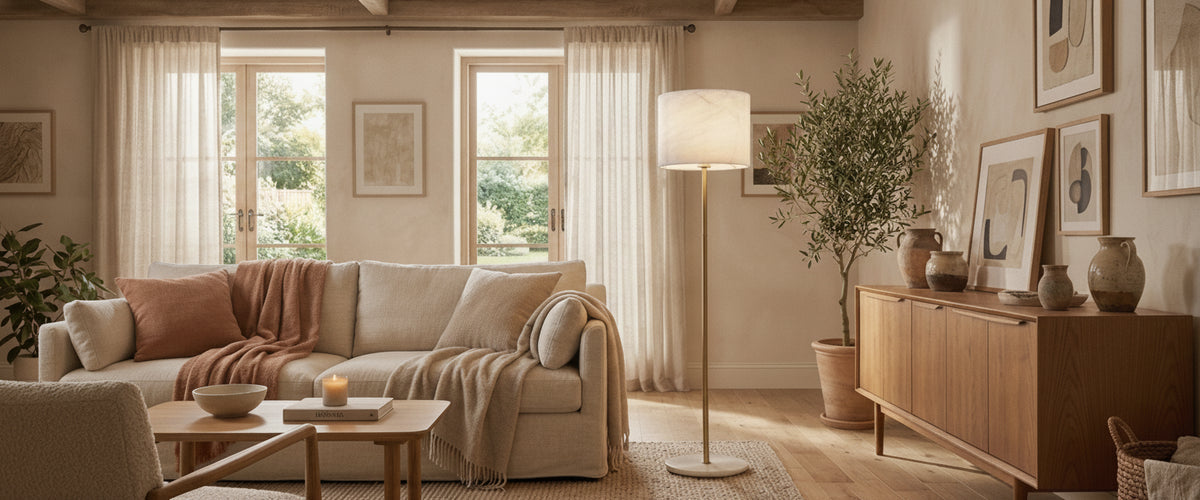

Most floor lamps are a bracket for a bulb. An alabaster traditional floor lamp behaves differently: the stone takes the light in, scatters it inside the crystal structure, and hands it back as a soft glow you can look at directly without squinting. That is the whole argument for buying one. You get usable light in the corner of a room and a quiet, warm object that reads well even when it is switched off.
It is also the reason a traditional alabaster floor lamp goes wrong more often than a fabric-shaded equivalent. Stone has opinions. Thickness, vein density, color temperature and the wall behind it all change the result.

Key Takeaways
Alabaster is a light source, not only a screen. Light travels into the stone and comes back out diffused, which is why an alabaster traditional floor lamp feels calmer than a translucent glass one.
Silhouette decides function. A torchiere bounces light off the ceiling, a shaded lamp gives a reading pool, a totem gives low-level ambience and almost no task light.
Warm bulbs only. Around 2700K with a high color-rendering index keeps the stone creamy; cool white drains it and can look faintly gray or green.
One stone hero per sightline. Alabaster next to onyx next to marble reads confused rather than considered.
Dry cleaning, always. Alabaster is gypsum, soft and water-sensitive, so caring for an alabaster traditional floor lamp is nothing like caring for glass or brass.

Why Alabaster Stops Being a Shade and Becomes the Light Source
Hold a piece of alabaster up to a window and you will see light come through it unevenly, pooling where the stone thins and slowing where veining thickens. That behavior is physical. Alabaster is a fine-grained gypsum, soft enough to carve with hand tools, and light entering it bounces around inside the crystals before it leaves. Conservation guidance from the Victoria and Albert Museum notes how soft and water-soluble the material is, which is the same softness that lets it be worked into thin translucent panels, and the same property that makes a traditional alabaster floor lamp glow from within rather than simply shine.
Practically, that means the illuminated surface of the lamp is large, low in brightness per square inch, and glare-free. Compare it with an opal glass shade, which diffuses but stays visually flat. Alabaster has depth. You see into it. In a living room lit at night, that depth is what stops an alabaster traditional floor lamp in the corner from looking like a floating white blob.
Torchiere, Shade and Totem: Three Silhouettes, Three Different Jobs
The Alabaster Torchiere Floor Lamp
An alabaster torchiere floor lamp holds a shallow stone bowl above head height and throws most of its output upwards. The ceiling does the work, returning a broad wash that lifts the whole room. This is the form to choose in a room with a pale, flat ceiling and high walls: Georgian reception rooms, converted mills, hotel lounges with generous head height. Put a torchiere under a low, dark or heavily beamed ceiling and you lose the bounce; the light stops dead and you are left with a glowing bowl and a gloomy floor. Of the three shapes, this is the one where the traditional alabaster floor lamp depends most on the room it stands in.
The Shaded Lamp
A conventional silhouette with an alabaster floor lamp shade, drum or tapered, splits the light three ways. Some goes down as a reading pool, some up towards the ceiling, and a good proportion leaks sideways through the stone as ambient glow. It is the most versatile of the three and the one most buyers actually want when they search for an alabaster traditional floor lamp. Check the depth of the shade against seated eye level. Too shallow and you see the lamp source when you sit down.
The Alabaster Totem Floor Lamp
An alabaster totem floor lamp, usually a stacked or turned column lit from within, is an ambience piece. It gives almost no directional light, which is exactly why it works. Set one at the end of a hallway, in a dining room corner, or flanking a chimney breast in a pair, and it does the job a wall sconce would do without touching the plaster. We shipped a stacked column lamp to a client refurbishing a Bath flat where the landlord forbade new wall chases; a pair of them replaced the sconces she had given up on, and the scheme read finished. Where the column is going to be seen against a dark wall or paneling, a piece with a darker metal spine such as the Stratalux LED Stacked Alabaster Column Floor Lamp in matte black holds its outline better than a pale metal would. Think of it as the quietest way to own an alabaster traditional floor lamp.
Stone Thickness and Vein Density: The Two Variables That Control Intensity
These are the details a photograph will not tell you, and they decide how an alabaster traditional floor lamp performs far more than the finish on the base does. Thinly cut alabaster is luminous and dramatic, showing every vein in high contrast, but it also shows hotspots where the bulb sits closest. Thicker stone evens the light out, softens veining into a haze, and reads more restrained. Neither is better. A white alabaster floor lamp with pale, sparse veining and a thicker wall will give you a clean, almost plaster-like glow; a honey-toned stone with dense veining cut fine will give you a warmer, more graphic object.
Ask two questions before you buy an alabaster traditional floor lamp. First, is the stone lit by a diffused LED module or a bare point source, because a point source behind thin stone will telegraph itself. Second, is the veining matched across panels on multi-panel shades? Mismatched panels look accidental once the lamp is on. Our own stone is chosen so that veining resolves into a pattern rather than a clash, and you can see the range of tones across the alabaster lighting collection before committing to a particular character of stone.
Where an Alabaster Traditional Floor Lamp Earns Its Place
Living rooms. This is where a traditional alabaster floor lamp does its best work: beside an armchair, behind the arm of a sofa, or in the dead corner most schemes ignore. Alabaster suits rooms with textiles and timber because it adds material interest without pattern. A tall corner with nothing in it can take the full height of something like the Atria LED Large Alabaster Floor Lamp in brushed brass, which fills the vertical rather than hovering awkwardly at sofa-back level.
Bedrooms. A shaded alabaster traditional floor lamp on the far side of the room gives you a light you can leave on low while someone else sleeps. Pair it with a dimmer and it replaces the overhead fitting entirely. Beside a bed or in a narrow alcove, where height would crowd the space, the Atria Small LED Alabaster Floor Lamp keeps the same glow at a proportion the room can carry.
Snugs and studies. Here the reading pool matters, so favor a shaded alabaster traditional floor lamp over a totem, and check the height of the light center against your chair.
Hospitality. Hotel suites, members' clubs and restaurant waiting areas use an alabaster traditional floor lamp to hold a space without furniture. Stone survives being looked at closely, which fabric shades rarely do after a season.
Where does it compete? Next to a picture wall, because the glow pulls attention away from the art. Directly beside a television, where the ambient leak washes the screen. In a small room already carrying marble, patterned wallpaper and a mirrored console, one more reflective material is one too many. An alabaster traditional floor lamp also underperforms in a conservatory or a south-facing room used mainly in daylight, where the stone sits pale and inert for most of the day.
Bulbs, Color Temperature and Dimming That Work With Stone
Alabaster is warm-biased. Feed it cool light and you fight the material. Stay at roughly 2700K, or 2400K if you want candle-adjacent warmth in a bedroom, and insist on a color-rendering index of 90 or better so the veining keeps its subtlety rather than flattening to gray.
Output should be modest. A shaded alabaster traditional floor lamp rarely needs the lumen equivalent of a bright bare bulb; the whole surface is emitting, so a moderate source spread evenly beats a powerful one. Torchieres are the exception, since they are paying a tax to the ceiling and back. For integrated LED versions, check the dimming protocol and match the wall dimmer accordingly, because a trailing-edge dimmer paired with the wrong driver is the usual cause of flicker and buzz. The Lighting Industry Association publishes guidance on LED compatibility worth reading before you specify a whole-room dimming circuit. Anything hardwired, including floor outlets for a lamp in the middle of a room, belongs to a qualified electrician.
Pairing Alabaster With Other Natural Materials
The temptation with natural stone is to repeat it. Resist. One stone hero per sightline is the rule that keeps a scheme legible. If your alabaster traditional floor lamp is the piece doing the talking in a living room, let the other fittings be brass, blackened steel, ceramic or linen. Where you want continuity rather than contrast, match metal finish instead of material: brushed brass on the floor lamp, brushed brass on the picture lights and switch plates.
Marble and onyx are close cousins but behave differently under light; onyx is more theatrical, with stronger banding, and it will out-shout alabaster if both are in the same room. Across a whole house, mixing works well when rooms are separated by a hallway, so the eye resets. If you are building a specification across several rooms, browsing the wider lighting range in one pass makes it easier to keep finishes consistent rather than approving pieces one at a time.
Buyer's Checklist Before You Commit
Measure ceiling height and color if you are considering a torchiere. Pale and flat, yes. Dark or beamed, choose a shaded form.
Sit in the chair the lamp will serve and check where your eye lands relative to the shade edge.
Confirm whether the light source is a diffused module or a point source behind the stone.
Ask about vein matching on multi-panel shades and whether you can see the actual stone for your piece.
Check the base weight and footprint against the traffic in that spot. Stone lamps in family rooms want a low center of gravity.
Match dimmer to driver before installation, not after.
Confirm cable color and length; a black flex across an oak floor undoes a lot of careful work.
Budget honestly. The cost of an alabaster traditional floor lamp tracks stone quality, scale, carving complexity, metalwork and finishing, so ask for a tailored quote rather than assuming a figure.
Living With It: Care and Repair
An alabaster traditional floor lamp asks for dry care. Dust with a soft, dry brush or a clean microfiber cloth, and keep water, glass cleaner and anything alkaline or acidic well away; gypsum will etch, bloom or develop dull patches when wet. Fingerprints on a warm shade are the usual culprit, so handle the metalwork when you move the lamp, not the stone. Keep it out of direct radiator heat and out of hard afternoon sun if you can, since repeated heating and cooling is unkind to any natural stone.
Chips and hairline cracks are repairable, which surprises people. The soft, porous nature of the stone means a conservation-grade adhesive can hold a clean break well, and fills can be tinted to match the surrounding tone. What you should not do is reach for a general-purpose superglue, because the excess wicks into the stone and leaves a permanent dark halo that no amount of polishing removes. Electrical faults are a separate matter entirely and belong to an electrician, not a stone restorer.