
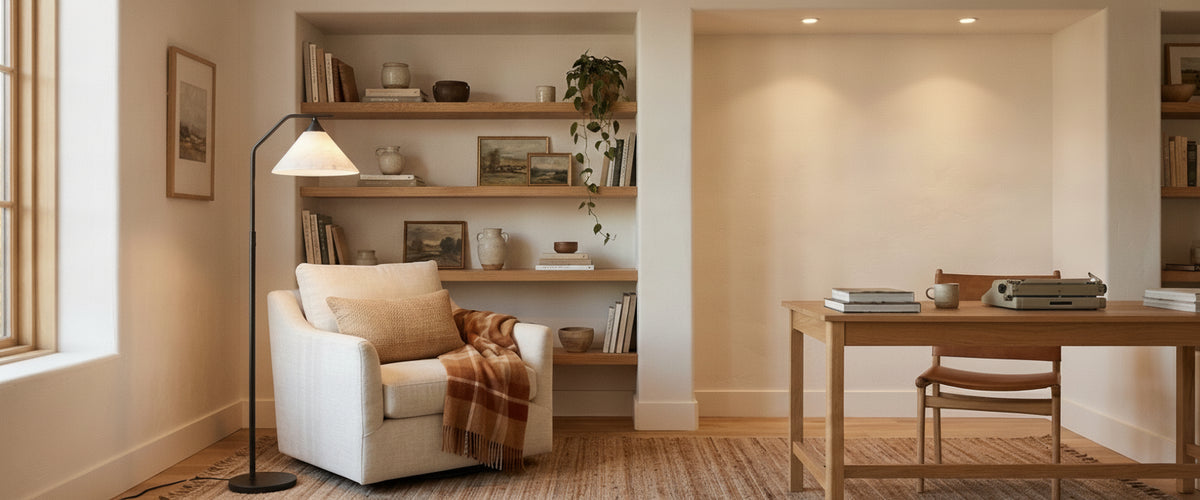

Switch the lamp off and a good imitation will fool almost anyone, including people who buy lighting for a living. Switch it on and the argument ends in about two seconds. That is the honest test for any alabaster glass shade: real stone breaks light up through its own mineral structure, so the glow moves, pools and shifts color across the surface. Pressed or coated glass tends to light up evenly and a little flatly, like a screen rather than a stone. Once you have seen the two side by side, you cannot unsee it.

Key Takeaways
- Natural alabaster transmits light unevenly; molded glass usually transmits it evenly. Judge an alabaster glass shade lit, never unlit.
- Veining that runs through the material is stone. Veining that sits on the surface, or repeats across two shades, is print or mold texture.
- The same 2700K bulb reads warmer and slightly amber behind stone because the mineral filters the cooler end of the spectrum.
- Shade form matters as much as material: bowl uplights wash ceilings, cones focus, cylinders glow in the round.
- Ask suppliers for the mineral name, the wall thickness policy, and whether two shades in a pair will match. Vague answers tell you what you need to know.

Carved Stone and Alabaster-Effect Glass Are Two Different Products
Alabaster is a soft, fine-grained stone, usually gypsum, sometimes a calcite variety that stonemasons also sell under the alabaster name. Its softness is exactly why it has been carved for light for centuries, and exactly why it needs care. The Natural Stone Institute classes gypsum alabaster among the softest decorative stones in commercial use, which means it can be worked thin enough to become translucent by hand.
Alabaster-effect glass is a different animal. It is typically opal or pressed glass given a cloudy, mottled finish, sometimes with a ceramic coating or an applied pattern that mimics veining. Glass pressing is a genuine craft, and the Corning Museum of Glass documents how molds made decorative glass repeatable at scale. Repeatable is the point: a mold produces the same alabaster glass shade over and over, which is a virtue in some products and a giveaway in this one.
Neither material is dishonest. The problem is language. Listings routinely describe an alabaster glass shade without saying whether the noun is "alabaster" or "glass," and buyers assume the more expensive of the two. At Niori we work in genuine alabaster and natural stone alongside glass and brass detailing, and we say which is which, because a designer specifying a hotel lobby needs to know whether twelve shades will match or deliberately vary.
Veining, Density and Thickness Decide How Warm the Light Reads
Three physical properties control what comes out of a stone shade. Veining is the visible one: honey, gray and rust-colored mineral bands that read as dark lines unlit and as glowing rivers lit. Density is the invisible one: tighter stone transmits less light and holds its color, looser stone carries light further and can flare bright in patches. Thickness is the one the maker controls, and it does more work than most buyers expect.
An alabaster glass shade walled at around a quarter inch (6 mm) glows generously and shows every vein. Push toward half an inch (13 mm) and the same stone turns creamy and discreet, with the veining reading as soft shadow rather than a feature. We once made a pair of wall lights for a client in Napa who wanted the veining to read from across a tasting room; going thinner solved it, but it also meant hand-selecting blocks so the pattern did not turn muddy near the fixing points. That is the trade-off nobody mentions on a product page.
Thickness also explains hotspots. A bright disc directly behind the lamp means the wall is thin at that point, the lamp is too close, or both. A well-engineered alabaster floor lamp shades puts distance between the light source and the stone, or uses an opal diffuser inside the stone to spread output before it hits the mineral. A tall, generously scaled piece such as the Atria LED Large Alabaster Floor Lamp has the internal depth to do that; very shallow shades with the lamp pressed close to the stone rarely do.
Why 2700K Reads Differently Behind Stone
Two lamps from the same box, same 2700K rating, same wattage. Put one behind natural alabaster and one behind pressed glass and the stone version comes out warmer, closer to a candle than a bulb. Stone absorbs a slice of the cooler end of the spectrum and lets the amber through, so the perceived color temperature drops noticeably. Opal glass does far less of this; it scatters rather than filters, so 2700K stays 2700K.
Practical consequence for anyone lamping an alabaster glass shade: do not overcorrect. Buyers sometimes chase 2200K lamps for extra warmth behind stone and end up with an orange cast that makes white walls look dirty. Start at 2700K, choose a high color-rendering lamp (CRI 90 or above), and judge it in the room at night rather than in a showroom. Near daylight-balanced downlights, the contrast will make it look warmer still.
Dimming deserves the same discipline. Stone rewards low output because the glow stays legible when the room is dark, but cheap drivers flicker at the bottom of the curve and a glowing shade shows flicker far more obviously than a fabric one. Match the dimmer to the driver, ask whether the fixture is leading or trailing edge, and have a qualified electrician handle the install.
The Craft Signals That Give a Hand-Finished Shade Away
Handle enough of both and you build a checklist without trying. Here is ours for telling a carved alabaster glass shade from a molded one.
- Pattern repetition. Two shades with identical veining came from a mold or a print. Stone from the same block will relate but never twin.
- Edge quality. Hand-finished stone edges have a faint softness under the fingertip and can show fine tool rhythm on the inside face. Molded glass has a crisper, more uniform lip, and sometimes a faint seam line.
- Weight. Stone is heavier than it looks. A large bowl shade that feels light in the hand is telling you something.
- Temperature. Stone stays cool to the touch longer than glass. Old test, still works.
- Back-lighting with a phone. Hold a flashlight to the surface. Stone shows depth, cloudiness and mineral drift beneath the plane. Printed veining sits flat on top.
- Interior finish. Good makers finish the inside as carefully as the outside, because light exposes everything.
Bowl, Cone or Cylinder: Matching Shade Form to Fixture and Room
Material is half the decision. The form of the alabaster glass shade is the other half, and it changes the job the fixture does.
Bowl and Torchiere Forms
An open bowl throws light upward and bounces it off the ceiling, which is why the alabaster torchiere floor lamp keeps coming back into fashion. It lifts a room without glare, works beautifully under 9 to 11 foot (2.7 to 3.4 m) ceilings, and the stone rim glows as a secondary light source. Weak ceilings kill the effect: if the plaster is dark or heavily textured, the bounce disappears and you get a bright ring and a dim room.
Cone and Drum Forms
Cones push light downward and read more classical, which suits an alabaster traditional floor lamp beside a reading chair or a console in a paneled study. In a Texas ranch-style living room we specified one next to a deep armchair; the downward pool covered the book, the stone rim handled the ambient job, and no table lamp was needed at all.
Cylinder and Totem Forms
A full cylinder glows in the round, which is the logic behind the alabaster totem floor lamp: a lit column that acts as sculpture by day and a soft beacon at night. These suit hallway corners, the dead space behind a sofa, and lobbies where you want presence without a pendant. A white alabaster floor lamp in totem form is the safest choice for a minimal interior because the veining stays quiet at low output. Scale is the thing to get right: in a tight corner, a shorter column like the Atria Small LED Alabaster Floor Lamp reads as an object rather than an obstruction, while the full-height version needs a wall or a window reveal to sit against.
Where a scheme calls for several shades that genuinely match rather than relate, opal glass is the more cooperative material, and something like the Volanne Glass Pendant Light in Opal White is closer to the right design language than carved stone.
For room-by-room planning, browse forms together rather than one product at a time; our alabaster lighting collection groups pendants, wall lights, table lamps and floor lamps so you can see how the same material behaves at different scales.
Questions to Ask Before You Buy an Alabaster Glass Shade
Ask these in writing before committing to any alabaster glass shade. Straight answers come back fast; evasive ones take three days and a paragraph of marketing.
- What is the material, by name? "Gypsum alabaster," "calcite alabaster" or "onyx marble" are answers. "Alabaster finish" is not.
- Is the veining in the material or on it? A photograph of the shade lit from behind settles this instantly.
- Will a pair or a set match? With natural stone the honest answer is "they will be related, not identical." That variation is a feature; you just need to know before installation day.
- What is the wall thickness, and is there an internal diffuser? This predicts hotspots better than any spec sheet.
- What lamp is recommended, and what is the maximum wattage? Heat and stone need managing, particularly on enclosed forms.
- Is the fixture dimmable, and with which dimmer type? Ask about the driver, not just the bulb.
- Can the shade be replaced? Stone can chip. Knowing a replacement route exists is worth more than a warranty paragraph.
- How is it packed and shipped? Stone shades travel well when crated properly and badly when they are not.
If you are comparing stone against opal and seeded glass across a whole project, seeing the full lighting range in one place makes the budget conversation easier. Cost tracks material, scale, carving complexity, engineering and finishing rather than any fixed band, so request a tailored quote once the schedule of fixtures is settled.
Care That Keeps an Alabaster Glass Shade Looking Right
Gypsum alabaster is soft and water-sensitive. Dry dust with a soft brush or a dry microfiber cloth. Skip household sprays, vinegar, anything abrasive, and anything described as a stone cleaner unless the maker has confirmed it for gypsum. Avoid bathrooms with heavy steam and unventilated en suites; if you want stone in a wet room, ask about a sealed marble or onyx alternative instead.
Handle by the metal gallery, never by the stone rim, when changing a lamp. And keep one habit: check fixings annually on any heavy stone piece, especially wall lights and pendants over dining tables. A shade that weighs several pounds (a few kilos) deserves a screwdriver check once a year.
Get the material question answered honestly and everything downstream gets easier. A real alabaster glass shade is a piece of stone doing a job that glass can imitate but not match; a molded version is a perfectly good light that should be priced and described as what it is. Knowing which one is heading to your hallway is the whole point.