
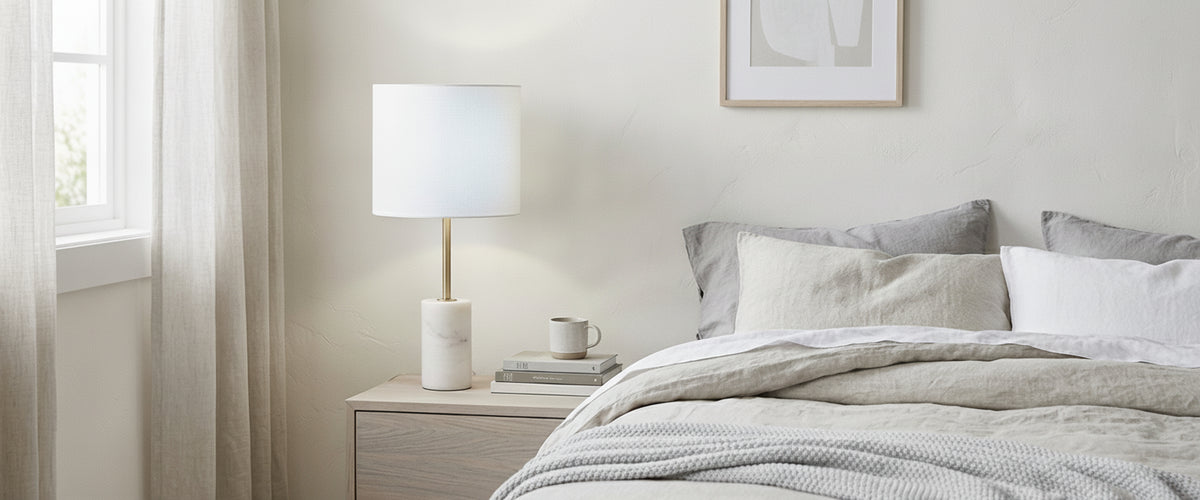

Gold has no fixed colour of its own. It borrows whatever light you point at it, which is why gold bedroom table lamps can read honeyed and quietly expensive at 10pm, then look faintly brassy by nine the next morning. That swing catches out more buyers than scale or style ever does. Get the finish, the proportion and the bulb right and a pair of bedside lamps will hold a room together for years.
At Niori we build most of our lamps around alabaster, marble and onyx, with gold and brass detailing doing the framing work. That combination is instructive, because translucent stone and warm metal behave in opposite ways. Stone softens and holds light. Gold throws it back at you. Understanding that difference is most of the buying decision.

Key Takeaways Before You Buy
- Test the finish in daylight, not just under a showroom bulb. Warm lamplight flatters every gold; north-facing morning light exposes it.
- Brushed gold is the safest bedside choice. It diffuses reflections instead of mirroring the bulb back into your eyeline.
- Proportion is measured against the headboard, not the room. Tall upholstered headboards swallow small lamps.
- Gold bedroom table lamps sit best beside warm neutrals, deep green, ink blue and cream-veined stone. Cool grey and blue-white schemes make the metal look brassy.
- Dimming and colour temperature decide comfort. Aim for 2200K to 2700K, CRI 90 or above, and a dimmable opal bulb.
- Ask what the gold actually is. Plated, PVD and solid living brass age differently and need different cleaning.

Why Gold Shifts From Warm to Brassy Between Lamplight and Daylight
Metallic finishes are reflective surfaces, not painted ones. Under a 2700K bedside bulb, gold picks up amber and reads rich and settled. Under cool overcast daylight through a north-facing window, the same finish leans greenish-yellow, and a cool white wall exaggerates it further. Bedrooms are the one room where you see a lamp in both conditions almost every day, which is why gold bedroom table lamps need a more careful eye than a gold pendant used mainly after dark.
Two practical moves solve most of it. First, judge any sample against your actual wall colour and bedlinen, standing by the window mid-morning. Second, buy gold that is paired with something warm and matt so it never sits alone. An alabaster shade above a brushed gold stem keeps the metal company: the stone holds a creamy warmth in daylight and glows amber at night, so the shift feels deliberate rather than accidental. You can see how that pairing behaves across our alabaster lighting range, where the stone carries the warmth and the metal simply frames it.
Polished, Brushed and Antique Gold: What Each Finish Does to a Bedroom
Almost all gold bedroom table lamps arrive in one of three finishes, and the choice matters more at the bedside than anywhere else in the house.
Polished Gold
Mirror-bright and unapologetic. Polished gold reflects the bulb straight back at you, which is thrilling on a hallway console and less welcome 60cm (24 inches) from your face at bedtime. It suits lacquered furniture and rooms with a formal, dressed feel, but it shows fingerprints faster than any other finish, so it is a poor fit for a table that doubles as a drinks and reading-glasses staging post.
Brushed Gold
The directional grain scatters reflections, so the metal reads as a soft glow rather than a hot point of light. It sits comfortably with linen, wool, oak and matt plaster, and minor marks disappear into the grain. Where a room needs warmth without a bright reflected point at eye level, brushed gold bedroom table lamps such as the Issa 1 Light Table Lamp in brushed gold are the more forgiving choice.
Antique and Aged Gold
Darkened recesses and a slightly clouded surface give antique gold more depth and lower reflectance. It works beautifully in older UK houses, Georgian townhouses and converted barns, where a bright finish can look pasted on. Pair it with patinated bronze hardware or aged mirror and the whole room gains age.
One technical note worth asking about: whether the gold is a plated or PVD finish over brass, or a solid living brass that will patinate. Plated finishes stay visually stable; living brass shifts over years. Neither is better, but knowing which you own tells you how to clean it.
Getting Proportion Right: Headboard Height and Bedside Table Depth
Most bedside lamps fail on scale rather than taste. The reference point is not the room, it is the headboard. A tall upholstered headboard creates a visual wall behind the bed, and a short lamp in front of it looks apologetic. As a rule of thumb, the top of the shade should sit between two thirds of the headboard height and roughly level with its top edge. Much shorter and it disappears; much taller and it starts competing.
Then check the horizontal fit. Measure the depth of your bedside table and make sure the shade does not overhang the front edge, because an overhanging shade throws light into your eyes and gets knocked every time you reach for a glass of water. On narrow tables, slim gold bedroom table lamps with a tight shade diameter work better than a classic drum shade. Where the surface is shallow, a compact cordless piece such as the AI Collaboration Rechargeable LED Table Lamp in gold removes the cable from the equation entirely.
For reading comfort, the bottom edge of the shade wants to sit near eye level when you are propped up against the pillows. Too high and the bulb glares; too low and the light pools on the table instead of the page. If you are choosing gold bedroom table lamps for a guest room where nobody reads in bed, you have more freedom to prioritise sculptural form over that rule.
Colour Combinations Where Gold Anchors the Room
Gold earns its keep beside warm, absorbent colours. Plaster pink, clay, mushroom, ivory and soft camel all give it something to warm against. Deep colours are better still: forest and olive greens, ink blue, oxblood and chocolate brown turn the metal into jewellery rather than trim. Cream-veined marble and honey onyx are natural companions, because the stone already contains the same warm register.
Where gold turns garish is in cool schemes. Blue-grey walls, stark brilliant white and grey-veined Carrara all pull it towards a hard yellow. If that is your palette and you still want gold bedroom table lamps, choose brushed or antique rather than polished, and keep the metal to a smaller proportion of the composition, such as a slender base under a large pale alabaster shade. Mixing gold with nickel or chrome can work, but repeat each metal at least twice so neither reads as a leftover.
A recent project showed how far that goes. A client refurbishing a Bath townhouse main bedroom had chosen a cool pale grey and hated the first polished gold lamps she tried. We swapped to brushed gold bases with alabaster shades, and the warmth in the stone bridged the gap between the metal and the wall colour. Nothing else in the room changed.
Dimming and Bulb Choice: The Two Variables That Decide Comfort
The wrong bulb turns gold bedroom table lamps into glare machines. Three things matter at the bedside. Colour temperature should sit between 2200K and 2700K; anything cooler makes the metal look grey, and cool light in the evening is less restful, which is why the Society of Light and Lighting stresses matching light quality to the task and the time of day. Colour rendering should be CRI 90 or above, so warm metals and natural stone show their real depth. And behind translucent alabaster or onyx the bulb should be opal or frosted, never clear filament, because a clear bulb creates a hotspot that reveals the filament through the stone.
Dimming is the other half. Bedside light should drop to something close to candlelight without flickering or humming. For a plug-in lamp, a good dimmable LED with a trailing-edge plug-in dimmer or a reliable smart bulb will do the job. Where there is no socket behind the bed, a rechargeable lamp with built-in stepped dimming such as the Sunvora Rechargeable Table Lamp in brushed gold solves control and cabling at once, which is why they suit guest rooms and holiday lets. Wall-plate dimming or a rewired bedside circuit is work for a qualified electrician.
A Quick Buying Checklist
Run through this before committing to a pair of gold bedroom table lamps.
- Compare a finish sample or product photo against your wall colour in mid-morning daylight.
- Measure headboard height and bedside table depth before shortlisting anything.
- Decide polished, brushed or antique based on how much reflection you want near your eyeline.
- Check the shade material: translucent alabaster glows, marble stays opaque and directs light up and down.
- Confirm the lamp is dimmable and specify a 2200K to 2700K, CRI 90+, opal bulb.
- Check cable colour and length; a black cable against a pale wall irritates for years.
- Ask whether the gold is plated, PVD or living brass, and buy the pair together, since natural stone varies between batches.
Keeping the Gold and the Stone Looking Right
Gold finishes fail from cleaning, not from use. Skip glass cleaner, ammonia, vinegar and abrasive creams; a dry microfibre cloth, used regularly, is all a lacquered or plated finish needs. Conservation guidance on metals from bodies including the Smithsonian's Museum Conservation Institute is consistent on this: avoid polishes on coated surfaces, because you remove the coating rather than the tarnish.
Alabaster asks for more restraint still. It is a gypsum stone, softer and more water-sensitive than marble, so no damp cloths, no household sprays and no soaking. Dust it with a soft dry brush and keep the lamp away from open windows, humidifiers and en-suite steam. Felt pads under the base protect the stone and the table top. Treated properly, gold bedroom table lamps of this kind are pieces you might rewire once in their life and never replace, which is the case for buying them slowly; the wider lighting collection is worth browsing with the same long view.