
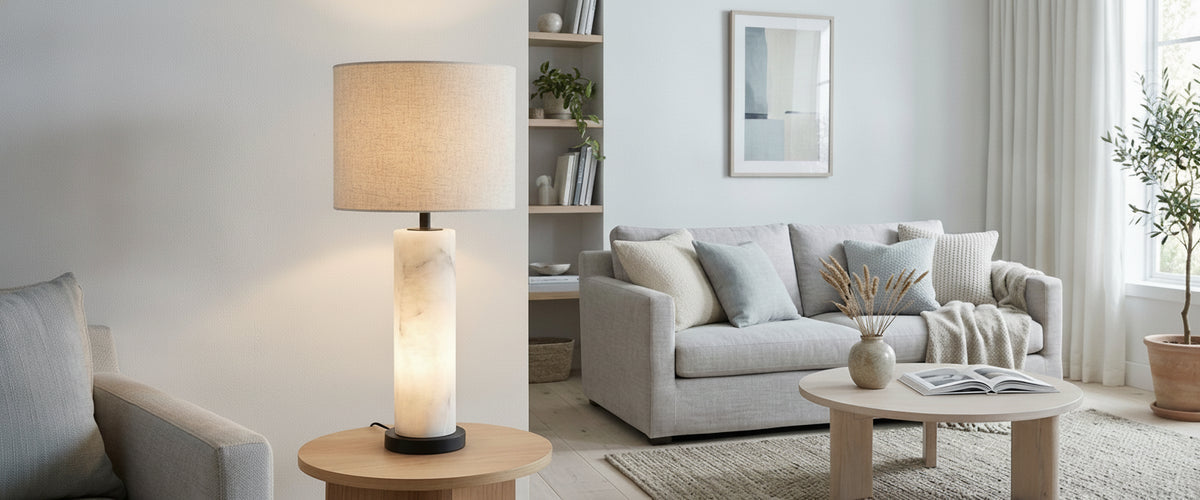

Table lamps living room planning comes down to three numbers. The bottom of the shade wants to sit 100 to 110 cm (39 to 43 in) from the floor, level with your eye line when you are seated. The shade diameter wants to stay inside the table top, around two thirds of its width. And the bulb wants to be warm, 2200K to 2700K, on a dimmer. Get those three right and a pair of lamps will light a sitting room better than any ceiling fitting can, because one overhead fixture flattens faces, lights the floor, and finds every crumb on the cushion. The rest of this guide covers height, shade scale, placement, material pairings, bulbs, and the care that alabaster and natural stone need.
Nine in the evening, the ceiling light goes on, and the room quits. Faces flatten, corners disappear, and the sofa you agonized over sits under a hard downward wash. Look closely at any sitting room you have saved to a mood board and the light is almost never coming from above: it is the living room table lamps, lit at seated height, doing the work a bright disc on the ceiling cannot. Get the numbers right and you stop reaching for the wall switch. Get them wrong and you own a handsome object that lights your knees.

Key Takeaways
The bottom of the shade should sit close to your eye line when you are seated, roughly 100 to 110 cm (39 to 43 in) from the floor.
A table lamps living room scheme usually needs four or five light sources at different heights; two table lamps carry the bulk of the work.
Shade diameter should never overhang the side table it stands on, and the base should read narrower than half the table top.
Warm light between 2200K and 2700K with a color rendering index of 90 or higher makes a room feel lived in; anything cooler reads like an office.
Living room table lamps do not have to match, but they should agree on height, brightness, and warmth.
Alabaster and natural stone bases glow gently from within when lit, which is why stone lamps read as soft rather than as a bright object in the corner.

What Table Lamps Solve That a Ceiling Light Cannot
Overhead light comes from a single point above your head, so it creates shadows under brows, noses, and chins. It also lights the floor more than anything else, which is the least interesting surface in the room. Table lamps invert that. They put light at 100 cm (39 in) or so off the ground, throw it sideways into the walls, and let the ceiling fall away. The result is a room with layers in it: pools of light around the seating, softer middle ground, and shadow at the edges where you do not need to see anything anyway.
There is a practical side too. A living room does at least four jobs in a week: reading, television, conversation with guests, and slumping. Each wants a different light level, and a single overhead circuit cannot do all four. A pair of table lamps on dimmers plus one floor lamp behind a reading chair covers almost every scenario without touching the ceiling switch.
At Niori we build most of our living room table lamps around alabaster, marble, and onyx precisely because these stones handle this job differently from ceramic or metal. Light passing through a few millimeters of alabaster is scattered rather than blocked, so the material itself becomes the diffuser. You get a warm, uneven, slightly honeyed glow with veining visible inside the stone, and no visible filament or hot spot. A ceramic base with an opaque shade gives you two crisp cones of light; a translucent stone base gives you a third, softer source at the same time.
How Tall Should a Living Room Table Lamp Be?
This is the question we are asked most often, and the answer is a relationship rather than a single number.
The Seated Eye Line Test
Sit on your sofa in your usual position. The bottom edge of the lamp shade should land at or just below your eye level, which for most people falls between 100 and 110 cm (39 to 43 in) from the floor. Higher and you stare straight into the bulb. Lower and the lamp lights the table top and your knees but leaves your book in shadow.
Work backwards from there. If your side table is 55 cm (22 in) tall, you need a lamp around 50 to 55 cm (20 to 22 in) overall. On a lower table of 45 cm (18 in), typical next to a deep, low sofa, you want something nearer 60 to 65 cm (24 to 26 in). Deep-seated modern sofas drop your eye line, so measure rather than guess. This is also why two identical lamps can look badly mismatched once they stand on two different tables: the tables, not the lamps, are the problem.
Shade Diameter and Table Size
This is where table lamps living room scale is won or lost. The shade should sit fully within the footprint of the table. If it overhangs the edge, the lamp reads as though it is falling off. A useful working ratio: shade diameter no more than roughly two thirds of the table top width, and the base no wider than half. Console tables behind a sofa are more forgiving in width but less so in depth, so check the depth measurement before you check anything else.
Shade height matters as much as width. A tall, narrow shade throws a narrow column of light; a wide, shallow drum spreads light across the wall and into the room. For a sofa-side lamp you generally want the wider drum. For a console or a corner where the lamp is more object than tool, the narrower silhouette often looks better. Where a table is too shallow to carry a drum without overhang, a low-slung form such as the Bravisse Dome Table Lamp in black keeps the footprint tight and pushes the light down onto the surface rather than out across the room.
Table Lamps Living Room Placement: Where a Pair Earns Its Keep
Symmetry does real work in a sitting room. A matched pair, one either side of a sofa, creates a visual frame, balances the light on both faces of anyone sitting there, and stops the room tipping to one side after dark. If you have the two side tables, use them.
A single lamp works in three situations: on a console behind a sofa where a second would crowd the surface, in a corner beside an armchair as a deliberate reading point, or on a sideboard as a low anchor next to taller objects. Anywhere else, a lone lamp tends to read as forgotten, especially in a wide room where one lit corner exaggerates how dark the other one is.
As for how many, count light sources rather than lamps. A typical table lamps living room layout in a room of 18 to 30 square meters (190 to 320 sq ft) wants four or five separate sources: two table lamps, one floor lamp, and a pair of wall lights or a low-output pendant. Larger open-plan rooms may need six. If you are pulling power from a floor socket for a console lamp, or adding a new socket behind a sofa, use a qualified electrician; that part is not a weekend project. Where the cable run genuinely will not work (an island console, a sideboard mid-wall, a coffee table), a cordless piece such as the Morvenne Rechargeable Table Lamp in brushed aged brass solves the placement problem without new wiring, and can be moved between rooms as the evening shifts.
Material Pairings That Hold Together
Base and shade have to agree on temperature and weight. A few pairings that consistently work:
Alabaster or marble with off-white linen. The linen weave picks up the softness of the stone and keeps the light warm. Pure white shades tend to look clinical against the creamy tones of natural alabaster.
Onyx with antique or brushed brass. The amber and honey bands in onyx sit naturally with warm metal. Chrome fights it.
Dark stone or matt black with parchment or oatmeal. High contrast, but the warm shade keeps the light from going cold.
Ceramic with cotton. A reliable pairing, though flatter than stone; the base is a solid object rather than a light source.
Glass with metal. Crisp and modern, but clear glass shows the flex and the bulb, so plan for a decorative bulb or a fabric-covered cable.
If the room already carries warm metal in the hardware or the fireplace furniture, a base in the same family will settle faster than a contrasting one; the Karvelle Table Lamp in antique brass sits in that warmer register and holds its own next to honey-toned onyx rather than competing with it.
The tell with natural stone is that every base is different. We photograph our alabaster pieces both lit and unlit because the veining that barely shows in daylight can become the most striking thing in the room once the lamp is on. Buyers choosing on the strength of the unlit images regularly tell us the lit ones were the better surprise. If you are comparing bases, browse the alabaster lighting collection and look at how differently each block of stone reads when illuminated.
Color Temperature and Dimming
Numbers matter here more than most people expect. Table lamps living room bulbs should run between 2200K and 2700K. Anything at 3000K and above starts to feel like a kitchen; 4000K belongs in a workshop. Look for a color rendering index of 90 or higher so that wood, textiles, and skin tones stay true, and check that the bulb is dimmable and matched to a compatible dimmer. Most modern LED lamps want a trailing-edge dimmer rather than the old leading-edge type, and mismatching the two is the usual cause of flicker and buzz. The Energy Saving Trust has straightforward guidance on LED performance and dimming compatibility.
Brightness is easy to overshoot. A sofa-side lamp rarely needs more than 400 to 600 lumens; two of those plus a floor lamp gives a comfortably lit space. If you are lighting an alabaster base from inside, go lower still, since the stone glows convincingly at modest output and a bright bulb will bleach out the veining. Warm-dim bulbs, which drop towards candle-like color as you lower the level, suit stone particularly well.
Warmth beats raw output every time: two lamps at 500 lumens and 2400K will always read better than one at 1,000 lumens and 4000K.
Do Table Lamps in a Living Room Have to Match?
No, and a room of perfectly matched lamps can look like a showroom. Table lamps living room pairs do not have to be identical, but they do need to share a logic. Keep the shade bottoms within a few centimeters of the same height, keep the light color identical across every lamp in the room, and let one material or metal finish repeat between them. Two different alabaster bases under the same linen drum shade will read as a considered pair. Two wildly different shades on matching bases will not.
Matched pairs still have their place: flanking a fireplace, on symmetrical side tables, or in a formal reception room where the architecture is already symmetrical. Everywhere else, related rather than identical usually looks better.
The Scale Mistakes That Only Show Up After Delivery
These are the table lamps living room mistakes that come back to us most often, and every one of them is avoidable with a tape measure.
Buying by photograph. Product images have no scale reference. Always read the height and shade diameter, then mark them out.
Ignoring the table height. A lamp that is right in the showroom will be wrong on a table 10 cm (4 in) lower than the one it stood on.
Forgetting the switch. Inline cable switches disappear behind furniture. A base or socket switch you can reach from the sofa is worth planning for.
Underscaling next to a big sofa. A 40 cm (16 in) lamp beside a three-meter (10 ft) sofa looks apologetic. Go bigger than instinct suggests.
Not testing the cable run. Measure from the lamp position to the socket before ordering, not after.
Skipping the mock-up. Stack books to the stated lamp height on the actual table and live with it for an evening.
Living With Alabaster and Stone Lamps
Stone lamps are heavy, which is a virtue on a side table where a light base gets knocked over, but it means the table has to be sound. Check the table top can carry the weight before you place a solid marble or alabaster base on a delicate antique.
Table lamps living room care with stone is simple but specific. Gypsum alabaster is soft and water-sensitive, and conservation practice treats moisture as its main enemy. Dust dry with a soft, lint-free cloth. Skip household sprays, vinegar, and anything abrasive. Keep lamps off windowsills where condensation collects, and wipe spills immediately rather than letting liquid sit on the surface. Sealed marble and onyx are more forgiving but still dislike acidic cleaners.
Done properly, table lamps living room lighting stops being decoration and becomes the thing that makes the room usable after sunset. Get the height right, keep the light warm, put the lamps on dimmers, and let the stone do the diffusing. If you are working out how the layers fit together across a whole scheme, our full lighting range covers the pendants, wall lights, and floor lamps that sit alongside your table lamps.