
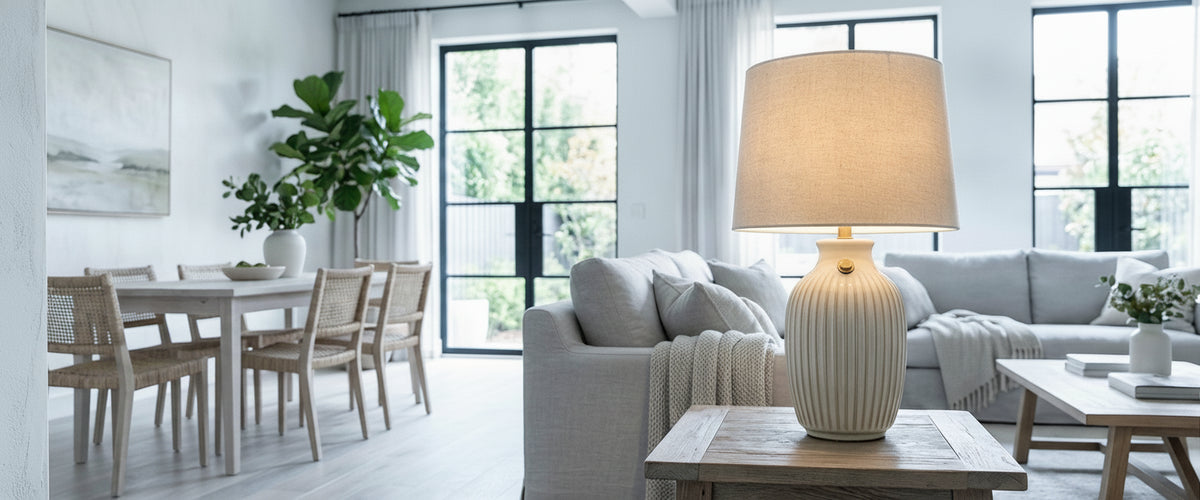

Most people buy ceramic table lamps with the light switched off. They judge the silhouette in a showroom or a product photograph, approve the colour, and only discover months later that the lamp throws a hard white disc onto the ceiling and leaves the rest of the room flat. The shape was never the problem. Clay body, glaze finish and shade pairing set the quality of the glow, and those three decisions happen long before anyone plugs anything in.

Key Takeaways Before You Buy
Five things worth settling before you choose between ceramic table lamps:
- Glaze finish changes the light more than colour does. Matte surfaces absorb and soften spill; high-gloss surfaces bounce it back as small bright highlights.
- A bedside base and a console base want opposite profiles. Narrow and upright for one, broad and low-shouldered for the other.
- Shade choice can undo a beautiful base. Linen and parchment diffuse; tight opaque drums turn the lamp into an uplighter and downlighter with nothing in between.
- Height is calculated from your seated eye-line, not from the table surface alone.
- Craft signals are findable: foot rings, glaze pooling, throwing rings, a properly weighted base and a cord exit that was planned rather than drilled as an afterthought.

How Clay Body and Glaze Shape the Glow
Ceramic behaves nothing like alabaster under light. An alabaster base is translucent, so light travels through the stone and the material itself becomes a lantern. Ceramic, in almost all cases, is opaque. Thin, highly fired porcelain can hold a faint translucency at the rim, a quality that comes from vitrification as much as from thinness. Most earthenware and stoneware ceramic table lamps, though, are solid to the eye. That changes the job description. The base is not the light source; it is the mass that anchors and colours everything around it.
Which makes glaze the deciding factor. A matte or satin glaze on a cream stoneware base will absorb a good portion of the downward spill from the shade and hand it back as a soft, dusty warmth. A high-gloss celadon or oxblood glaze does the opposite, catching the spill in narrow vertical highlights that read almost like wet stone. Neither is better. They simply solve different rooms. Crackle and reactive glazes add a third behaviour, breaking the light into fine speckle that looks alive at low dimmer settings and slightly restless at full output.
Thickness matters too. A heavy, thickly potted earthenware body holds warmth and reads as a solid object in a room; a fine porcelain body reads as an object of precision. If you are mixing ceramic table lamps with stone pieces, that weight distinction is worth thinking about. We regularly ship alabaster and ceramic into the same project, and the ceramic almost always needs to be the grounding, matte element when the stone is doing the glowing.
Bedside and Console Ceramic Table Lamps Want Opposites
A bedside table is usually 40cm to 50cm (16in to 20in) deep with a book, a glass and a phone competing for space. The base needs a narrow footprint and a fairly upright profile so the light source sits high enough to fall onto a page. Bulbous, wide-shouldered ceramic table lamps look generous in a photograph and steal the entire surface in practice.
A console or sideboard flips the logic. You have depth to spare, the lamp is usually seen from across a room rather than at arm's length, and the piece has to hold its own against a mirror or a large picture above it. Here a broad, low-shouldered ceramic form earns its keep: a ribbed terracotta body, a rectangular block base, a ridged stoneware column. Where the wall above needs balancing without a tall silhouette, a squared-off base such as the Block White Ceramic Rectangular Table Lamp at 35cm does the work through visual mass rather than height. The form should cover ground, not reach for the ceiling.
Living room side tables sit between the two. Aim for a base that reads as sculpture when the lamp is off, because a side table lamp spends most of the day unlit and in full view. That is the argument for spending on the base rather than the fitting. Browse the wider lighting range with that test in mind: would you keep the object on the table if it never turned on?
The Shade Pairing Mistake That Ruins Good Ceramic Table Lamps
The most common error we see is a beautifully thrown base under a stiff, opaque, tightly lined drum shade. The base cost real money. The shade sends every lumen straight up and straight down, the sides stay dark, and the room gains two bright pools and no ambient glow. It is the lighting equivalent of buying good wine and serving it in a paper cup.
Natural linen, silk and parchment shades let a percentage of light through the material itself, so the shade glows and the lamp reads as a soft column of light rather than a torch. Match the shade's undertone to the glaze: cool white linen against a warm terracotta body will look mismatched at night, when the bulb's warmth exaggerates the clash. Oatmeal and stone-toned shades are the safe bridge across most glaze colours.
Proportion rules that actually hold up: the shade width should be roughly twice the widest point of the base for rounded forms, and the shade height around two thirds to three quarters of the base height. The bottom edge of the shade should sit low enough to hide the lamp holder and the bulb from a seated viewer. If you can see the bulb from the sofa, the shade is too shallow or the base is too tall.
Matte Versus Glossy: Ceramic Table Lamps in Real Rooms
Against linen and bouclé upholstery, matte earthenware is the natural partner. Both surfaces scatter light, and the effect is quiet and layered. Gloss against heavy textile can look out of place.
Against marble and polished stone, invert it. A honed marble console with a matte ceramic base can feel flat and samey; a glossy stoneware glaze picks up the same specular highlights as the stone and the pairing snaps into focus. This is also where a translucent alabaster piece often wins outright, because the stone glows from within rather than reflecting. If you are weighing ceramic against stone for a hall console, compare them side by side in the alabaster lighting collection before committing.
Against deep painted walls in inky blue, olive or chocolate, gloss ceramic reads as jewellery and matte ceramic can disappear entirely after dark. Pale matte bodies work on dark walls; dark matte bodies rarely do.
Scale and Seated Eye-Line: The Calculation Most Buyers Skip
Sit down on the sofa or the edge of the bed. Measure from the floor to your eye. For a side table lamp, the bottom edge of the shade wants to land at or just below that height so you get light on a book without looking into the bulb. In a typical UK living room with a sofa seat height of around 45cm (18in), that puts total lamp height in the region of 60cm to 75cm (24in to 30in) on a 55cm (22in) table.
Bedside models run a little lower and benefit from a switch you can find in the dark, whether that is an inline rocker, a touch base or a rechargeable model with a dial on the body. Portable rechargeable ceramic table lamps have quietly become the most useful category in the range for dining tables, terraces and hotel bedside tables where there is no socket worth using. Where the surface is shallow and there is no plug within reach, a small cordless piece such as the Nomad Cream Ceramic Rechargeable LED Table Lamp solves the placement problem that a full-height base with a trailing flex never will.
Craft Signals That Separate Considered Ceramic Table Lamps from the Production Line
Turn the lamp over. A thrown or carefully slip-cast base has a finished foot ring, often unglazed and slightly chalky, with a wiped edge rather than a rough one. Look for glaze pooling where the form changes direction; on a ribbed or ridged body the glaze should sit thicker in the valleys and thin across the ridges, which is exactly what gives the surface depth under lamplight. That behaviour is easiest to read on a fluted form like the Ribbed Ceramic Terracotta Table Lamp, where the darker tone in the grooves is glaze thickness rather than printed shading. Perfectly even colour across every contour usually means spray-applied pigment, not glaze.
Check the weight. A base that feels light for its size has been potted thin to save on clay and firing cost, and it will rock every time someone brushes past. Check the cord exit: a planned exit is cut and glazed before firing, with a grommet or a neat rubber bung. A drilled hole with visible chipping is a retrofit. Makers and craft bodies such as the Crafts Council publish useful background on studio ceramics if you want to understand how much handwork sits behind a given price.
One more test from the studio: ask whether the base takes a standard lamp holder and a replaceable cord. We have been called into projects where the bases arrived with sealed, non-serviceable fittings, and within a couple of years the flexes had yellowed with nothing replaceable short of destroying the base. Serviceability is a craft signal too.
Bulbs, Dimming and Wiring
Dimmable LED is the default for ceramic table lamps, but the spec details matter:
- Colour temperature: 2400K to 2700K. Cooler than that and warm glazes turn grey after dark.
- Output: roughly 300 to 500 lumens per lamp in a layered scheme. Brightness should come from having several lamps, not one loud one.
- CRI 90 or above so reactive and celadon glazes keep their depth.
- Dimming: pair dimmable LED lamps with a trailing-edge dimmer, and check the minimum load if you are dimming a single low-wattage bulb.
- Shape: a golf-ball or candle bulb clears narrow shade fittings better than a standard GLS.
- Wiring: plug-in lamps are straightforward, but anything hard-wired or rewired should go to a qualified electrician working to the current IET Wiring Regulations.
Care Checklist for Ceramic Table Lamps
- Dust matte glazes with a dry microfibre cloth. Matte surfaces hold onto oils from fingers, so avoid handling the body when moving the lamp; lift from the base.
- Clean gloss glazes with a barely damp cloth and dry immediately. No abrasive cream, ever.
- Crackle glazes will absorb spills through the crazing. Blot, do not soak.
- Unglazed foot rings can mark polished timber and stone. Add felt pads.
- Check the cord grip and holder annually, particularly on lamps that get moved between rooms.
- Stick to the wattage marked on the lamp holder. Excess heat shortens the life of both the holder and the flex.
Where Ceramic Sits Alongside Stone
Ceramic table lamps and alabaster pieces solve different halves of the same problem. Alabaster gives you a glowing body and genuinely soft, diffused light through the material. Ceramic gives you colour, texture and a grounded object that still looks good unlit at eleven in the morning. In most schemes we work on, the answer is both: a stone or alabaster piece as the hero in the hall or the living room, ceramic bases doing the quieter work at bedside and on the sideboard. If you want a view of how the two materials sit together across a range, the Niori homepage is the fastest way to see stone, ceramic and brass detailing in one place.
Budget on ceramic table lamps varies widely, and for good reason. Hand-thrown bases, multi-fire reactive glazes, larger forms that need slower kiln schedules and properly serviceable electrical components all cost more than a spray-finished cast body. Rather than shopping by headline figure, decide what the lamp has to do in the room and judge the price against that.