
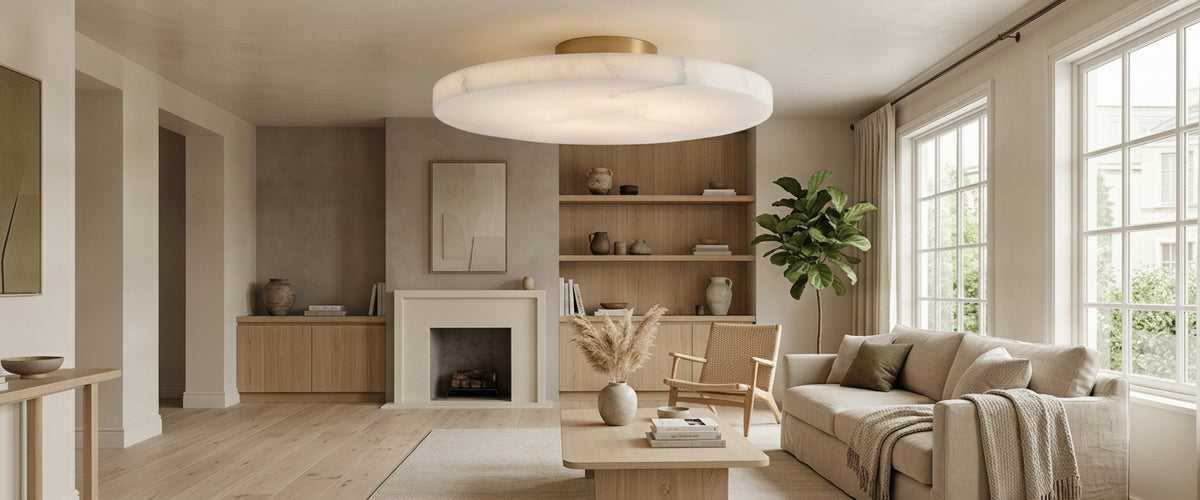

A room can be beautifully furnished and still feel tiring after twenty minutes. More often than not, the ceiling is the culprit. Led ceiling lights are now the default choice in almost every British home, yet the specification sheet that decides whether a fitting flatters your walls or drains them is rarely read before checkout. Wattage and diameter get all the attention when people shop for LED ceiling lights. Colour rendering, driver quality and dimmer compatibility decide how the room actually feels.

LED Ceiling Lights at a Glance
CRI 90+ is the line worth holding. Below it, timber, plaster and fabric look slightly drained.
2700K for bedrooms and living rooms, 3000K for hallways and bathrooms, up to 4000K for task-heavy kitchens. Mixing temperatures across one open-plan floor is the most common misstep we see.
Flush for ceilings under about 2.4m (8ft), semi-flush for 2.4m to 2.9m, pendants above that.
Check the dimmer before you buy, not after. Low-load LED ceiling lights frequently need a trailing-edge dimmer rated for small loads.
IP44 is the practical minimum for a bathroom zone 2 fitting. The rating covers ingress, not humidity resistance of the finish.
Alabaster and natural stone transmit light rather than reflect it, which is why stone LED ceiling lights can feel calmer than a much brighter opal acrylic panel.

CRI, Colour Temperature and Beam Angle: The Three Specs Most Buyers Ignore
Colour rendering index measures how faithfully a light source shows colour against a reference. A CRI of 80 is the commodity standard and it is fine for a garage. In a living room it quietly ruins things: terracotta reads brown, warm greys turn flat, and skin tones go slightly grey around the eyes. The International Commission on Illumination maintains the methodology behind these metrics, and while CRI has known limitations, it remains the most useful single number on the box. For any LED ceiling lights you will sit under daily, treat CRI 90 as the floor and R9 (deep red rendering) as the bonus worth asking about.
Colour temperature is the warmth of the white, measured in kelvin. Beam angle is the one buyers almost never think about. A narrow 24-degree beam creates pools and drama; a 120-degree wash covers a ceiling evenly but can look institutional if the fitting has no diffusing body. That is the trap with plainer LED ceiling lights, and it is where material choice starts to matter more than the diode itself. A translucent alabaster shade widens and softens the output so the source disappears, which is why the semi-flush pieces across our alabaster lighting range read as a glowing surface rather than a bright dot.
Flush, Semi-Flush or Recessed: Match the Format to the Ceiling
Format for LED ceiling lights follows ceiling height and function, in that order.
Flush
Sits tight to the plaster with minimal drop. Flush LED ceiling lights are the right call for ceilings under roughly 2.4m (8ft), for corridors, and for anywhere a door swing or a head might meet them. A Victorian terrace landing is flush territory, no argument. Where the drop has to stay minimal but the coverage still needs to reach wall to wall, a plain white unit such as the Zon White LED Flush Ceiling Light 45W 3000K, 40cm is the sensible workhorse, with the 60cm version taking over once the landing or hallway opens out.
Semi-Flush
Drops a few inches and lets light wash the ceiling as well as the floor. That upward bounce is what stops a room feeling low. Semi-flush LED ceiling lights are the most underused format in British homes and the one that most often solves a 2.4m to 2.9m ceiling where a pendant would crowd the space. An alabaster semi-flush earns its keep here, because the stone glows from every angle rather than only pointing down. On a standard bedroom or modest sitting room ceiling, something at the scale of the Orbis Medium LED Alabaster Semi-Flush Ceiling Light holds proportion better than a large statement piece pushed into a small footprint.
Recessed
Invisible, efficient, and easy to overdo. Grids of downlights create scallops on walls and shadows under the eyes. Use them as supporting light for worktops and wardrobes, then let a decorative ceiling fitting do the emotional work. Recessed units also need fire-rated housings in most domestic ceilings and a competent electrician to install them.
Driver Quality and Flicker: The Invisible Variable Behind a Fatiguing Room
Every LED ceiling light needs a driver to convert mains AC into the constant current the diodes want. Cheap drivers pass through a ripple, and that ripple becomes flicker. Some of it is visible as a shimmer at the edge of vision; much of it is invisible but still measurable, and research into temporal light modulation links that invisible flicker to headaches, eye strain and the stroboscopic effect that makes a moving hand look juddery under a light.
You cannot see driver quality in a product photograph, so ask two questions about the LED ceiling lights on your shortlist before you buy. First, is the driver replaceable, or is it potted into a sealed body that turns the whole fitting into a disposable item? Second, does the manufacturer quote a flicker percentage or state compliance with low-flicker criteria? A brand that knows the answer usually has a driver worth having. In our own studio we run a simple check: record the lit fitting in slow motion on a phone and look for banding rolling across the screen. It is crude, but it separates a good driver from a bad one in ten seconds.
Why LED Ceiling Lights Often Fail on a Trailing-Edge Dimmer
Here is the scenario we field most often by email. A client fits beautiful new LED ceiling lights, turns the dimmer down, and the light either drops out entirely at 30 percent, flickers at the bottom of the range, or buzzes faintly. The fitting is rarely faulty. The mismatch is between a modern low-wattage LED load and a dimmer designed decades ago for 200W of filament.
Leading-edge dimmers, the old resistive type, need a substantial minimum load. Swap five halogen downlights for five 6W LEDs and you may be asking a 60W-minimum dimmer to control 30W. It will misbehave. Trailing-edge dimmers handle capacitive loads far better, and the drivers inside good LED ceiling lights are designed around them. Even then, some circuits need a load correction device (sometimes sold as a dummy load or load resistor) to give the dimmer something to work against. The cleanest fix is usually to change the dimmer to a trailing-edge model rated for low minimum loads, and to keep all fittings on one circuit from the same manufacturer and the same driver type. Mixed drivers on a shared dimmer are a recipe for one lamp flickering while the others behave. Any dimmer or circuit change should be carried out by a qualified electrician working to current wiring regulations.
Room by Room Colour Temperature, from a 4000K Kitchen to a 2700K Bedroom
Kitchen: 3000K to 4000K. Cooler light sharpens contrast at a worktop and keeps white cabinetry crisp. If the kitchen opens into a dining area, stop the 4000K at the worktop and switch your LED ceiling lights to 2700K over the table, or the whole floor will feel like a showroom.
Living room: 2700K, dimmable, layered. Even the best LED ceiling lights will never be enough on their own. A semi-flush at the centre, a floor lamp in the reading corner and a stone table lamp on the console give you three moods from one room.
Bedroom: 2700K or warmer, and dimmable down low. Warm, low-level evening light supports the wind-down before sleep far better than a bright cool ceiling wash.
Bathroom: 3000K reads clean without being clinical, and it is kinder for shaving and make-up than 4000K, which exaggerates blue undertones in skin.
Hallway and stairs: 2700K to 3000K with even coverage. Stairs need uniformity more than brightness; a bright fitting with a dark gap halfway down is worse than a modest one that covers the whole flight.
What the IP Rating on a Bathroom or Kitchen Fitting Actually Guarantees
IP stands for ingress protection, defined under the IEC 60529 standard. The first digit covers solids, the second covers water. IP44 means protected against objects over 1mm and against splashing water from any direction. IP65 adds full dust protection and resistance to low-pressure water jets.
What the IP rating on LED ceiling lights does not tell you is how the finish will age. A rating describes water getting inside the enclosure, not whether a brass ring will tarnish in a steamy family bathroom or whether an unsealed natural stone will absorb moisture over years. In bathroom zone 2, the 0.6m band beyond the area immediately around a bath or shower, IP44 is the usual requirement, and zoning should always be confirmed with your electrician. For alabaster and marble fittings in humid rooms, ask about sealing as well as IP. We seal stone components for exactly this reason, and we will still steer a client away from putting an unsealed decorative stone piece directly above a shower.
Where Alabaster Changes the Equation
Alabaster is a fine-grained gypsum stone that transmits light through its body instead of bouncing it off a surface. Slice it thin, put a warm LED behind it, and you get diffusion no acrylic can imitate: a slightly uneven, honeyed glow with veining that shifts as you move around the room. Onyx does something similar with more dramatic banding; marble is denser and usually works as a base or a partial shade rather than a full diffuser.
That diffusion has a practical consequence for specification. Because the stone spreads output so widely, alabaster LED ceiling lights often need fewer lumens than a comparable opal fitting to make a room feel properly lit. Glare is low, so the eye relaxes. We shipped a pair of large alabaster semi-flush fittings to a barn conversion where the architect had planned nine downlights in the same ceiling; the grid was cut back sharply after the first evening with the stone lit. In open-plan or double-height rooms the same logic scales up, and a piece with the diameter of the Orbis Extra Large LED Alabaster Semi-Flush Ceiling Light can carry a space that would otherwise be carved up by downlights. Browse the wider lighting collection if you want to see how the same stone reads in pendant, wall and table formats before you commit to a ceiling piece.
Buying Checklist for LED Ceiling Lights
Measure ceiling height and choose flush, semi-flush or pendant LED ceiling lights accordingly.
Confirm CRI 90+ and ask about R9 if you have strong reds or warm timber in the room.
Fix colour temperature by room, and keep it consistent within a sightline.
Ask whether the driver is replaceable and whether the LED module is serviceable.
Identify your existing dimmer type before ordering; budget for a trailing-edge replacement if needed.
Check minimum and maximum dimmer load against total circuit wattage.
Verify IP rating against the bathroom zone or kitchen position.
For stone fittings, ask about sealing, veining variation and fixture weight for the ceiling substrate.
Book a qualified electrician for anything involving new circuits, recessed housings or dimmer changes.
Ask for a tailored quote rather than assuming a figure. Cost tracks material, scale, stone selection, metalwork finishing and installation complexity.
Living With Them: Care and Longevity
Integrated LED ceiling lights live or die on heat management and driver access. Keep the fitting clean, because dust on a stone diffuser both dims and yellows the output. Dry-dust alabaster with a soft cloth; never use a proprietary bathroom spray or anything acidic, as gypsum stone is soft and reacts badly to chemical cleaners. If a fitting is on a dimmer, run it at full output occasionally so you notice any early colour drift in the diodes.
Well-specified LED ceiling lights should be a decade-plus purchase, not a three-year one, and the difference between those two outcomes is almost always the driver and the dimmer rather than the diodes themselves. Buy the fitting for how the material handles light, then check the electronics behind it with the same seriousness. If you want help matching format, output and stone to a specific room, ask us from the Niori homepage and send through your ceiling heights and dimmer details; that is usually enough to get a specification right first time.