
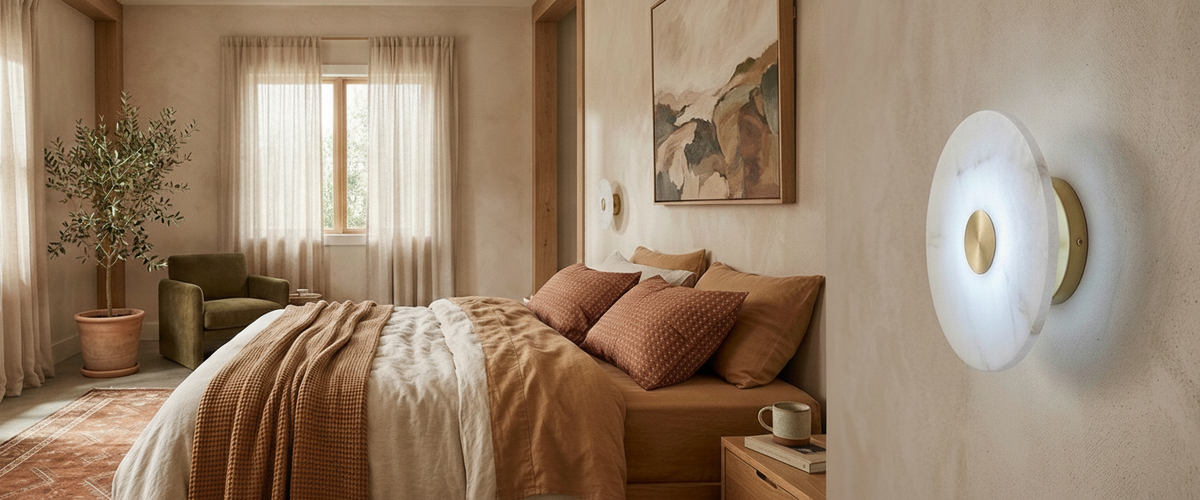

A gold wall sconce lives or dies on one thing: how the finish behaves once you switch it on. The Artika Dorado modern is a case in point. On a product page it reads clean, warm and confident. On the wall, in your actual light, the same fixture can look like brushed brass jewellery or a slightly brassy showroom prop, and the gap between those two outcomes is mostly down to placement, bulb choice and expectation. So before you commit, it helps to know exactly what the Artika Dorado modern is chasing, and where a softer, stone-diffused sconce might serve you better.
We sell alabaster and natural-stone lighting at Niori, so our bias is honest and stated up front. This isn't a takedown. It's the kind of buyer briefing we'd give a client who emailed asking whether a metal gold sconce or an alabaster one suits their hallway.

Artika Dorado Modern: Key Takeaways
- The look: a slim, contemporary gold sconce aimed at minimal and mid-century-leaning interiors.
- The finish risk: gold reads warm and expensive under 2700K light and can look cold or brassy under cooler bulbs.
- Projection matters: a shallow-projection sconce suits tight hallways; a deeper one throws more light but eats circulation space.
- Best rooms: hallways, feature walls, and either side of a bed. Weaker in steamy bathrooms unless rated for it.
- The alternative: if you want glare-free, diffused light rather than a bright point source, alabaster changes the whole feel.

What the Artika Dorado Modern Is Chasing
The design brief behind a piece like this is fairly clear. It wants to read as modern wall sconce lighting with a touch of warmth: a gold-toned metal body, a clean silhouette, and enough presence to work as decor when the light is off. That's a sensible target. Metal sconces in a gold or brass tone have become a shorthand for a considered interior, and a slim vertical form flatters most walls without shouting.
The Artika Dorado modern sits in that category comfortably. What you're buying is hardware-led design, where the metal, not the light, does the visual work. That's a meaningful distinction, because it tells you what the fixture is good at and where it will disappoint.
The Gold Finish Under Real Light
Gold finishes are seductive in photos and unpredictable in rooms. The variable is your bulb. Warm light around 2700K flatters gold, pulling out the honeyed, brushed-brass side of the finish. Push the colour temperature up toward 3500K or 4000K and the same metal can tip toward a hard, brassy shine that looks more showroom than home.
Brushed and satin gold finishes tend to age more gracefully than high-polish ones, because they scatter light rather than bounce it back as a hotspot. If the fixture you're looking at has any polish to it, view it under the warm bulbs you actually plan to use, not the cool ones a shop display often runs. The Lighting Research Center's work on how colour temperature shifts our perception of materials is worth reading if you want the underlying science (lrc.rpi.edu).
This is where stone diverges sharply from metal. Alabaster doesn't reflect a finish back at you; it transmits light through the material itself, so the warmth comes from the glow rather than from a coating that can read hot or cold. If the gold-under-light gamble worries you, that's your first signal that a stone sconce may suit you better.
Scale and Projection: How Far It Stands Off the Wall
Two measurements decide whether a sconce works: its height on the wall and its projection, meaning how far it stands proud of the surface. Projection is the one buyers forget.
A shallow sconce that sits close to the wall, say within 3 to 4 inches (8 to 10 cm), is the safe choice for a corridor where people and elbows pass. A deeper fixture that projects 5 to 6 inches (13 to 15 cm) or more throws light out into the room more generously, which is lovely beside a bed or on a feature wall, but becomes a shin hazard in a narrow hallway.
Check the stated projection against the traffic in the room. As a rough placement rule, mount wall sconces around 60 to 66 inches (152 to 168 cm) from the floor to centre, adjusting up for tall ceilings and down for a bedside reading position. Always confirm the manufacturer's own guidance, since backplate size and lamp position change the ideal height.
Rooms It Flatters and Rooms It Fights
A gold metal sconce like this has clear happy places and a few traps.
Hallways and stairwells: strong. A pair of slim gold sconces down a corridor gives rhythm and warmth, and metal shrugs off the occasional knock better than delicate glass.
Beside a bed: good, with a caveat. If it's a bright, exposed source rather than a diffused one, angle it away from your eyeline or you'll get glare while reading. This is exactly where an alabaster shade earns its place, because stone softens the source into an even wash.
Bathrooms: proceed carefully. A bathroom needs a fixture rated for the moisture zone it sits in, and gold finishes near steam can spot or dull over time. In the UK, bathroom zones and IP ratings are set out clearly by Electrical Safety First, and any bathroom install should be signed off by a qualified electrician (electricalsafetyfirst.org.uk).
Living rooms and feature walls: workable, especially in pairs flanking a fireplace or artwork, provided the projection suits the walkway.
Light Quality and Bulb Behaviour Behind the Shade
Metal sconces usually give you a directional or semi-exposed source, so the bulb you fit matters enormously. For a warm domestic feel, choose a lamp at 2700K with a high colour rendering index (CRI 90 or above) so skin tones and materials look natural. Match the bulb tone across every sconce in the room; a single 4000K lamp in a run of 2700K fixtures announces itself instantly.
Dimming is the other lever. On a dimmable circuit with compatible LED lamps, a bright metal sconce becomes far more livable at night. Confirm the driver and dimmer are matched, because mismatched LED dimming causes flicker and buzz.
Here's the honest contrast. A metal sconce points light; alabaster becomes the light. When you switch on a well-made alabaster piece, the stone glows from within and the veining reads like a signature. If you want that effect, browse our alabaster lighting range and compare the feel side by side with a hardware-led gold sconce. It's the fastest way to work out which camp you're in.
Who Should Buy the Artika Dorado Modern, and Who Shouldn't
Buy it if you want a decorative gold accent that holds its own switched off, you're leaning minimal or mid-century, and you're happy pairing it with a warm, high-CRI bulb. It's a sensible pick for a hallway or a considered feature wall where the metal is part of the styling.
Look elsewhere if your priority is glare-free, diffused light with material character, or if you're lighting a bedside where a hard point source will bother you. In that case a stone or alabaster sconce does a different and, to our eye, more restful job. You can compare formats across our full lighting collection to see how diffused stone reads against directional metal.
A Quick Pre-Purchase Checklist
- View the gold finish under a 2700K bulb, not a cool showroom light.
- Check the projection against the room's foot traffic.
- Confirm it's dimmable and note the recommended lamp type.
- For bathrooms, verify the IP rating and use a qualified electrician.
- Order a spare bulb from the same batch so tone stays consistent.
- Decide honestly: do you want light that points, or light that glows?
On the recurring question of quality, it helps to separate two things. Build quality lives in the finish, the backplate engineering and the wiring. Light quality lives in the bulb and the diffuser. A fixture can be well made and still give you a look you don't love, which is why the finish-under-light test matters more than the spec sheet. If diffused warmth is your goal, a stone piece will feel higher quality in use even where the metalwork on both is sound.
One last practical note from the studio: buyers who send us a photo of the wall, the ceiling height and the bulbs they already own get a far better answer than those who ask in the abstract. Light is contextual. A gold sconce that sings in one hallway sulks in the next.