
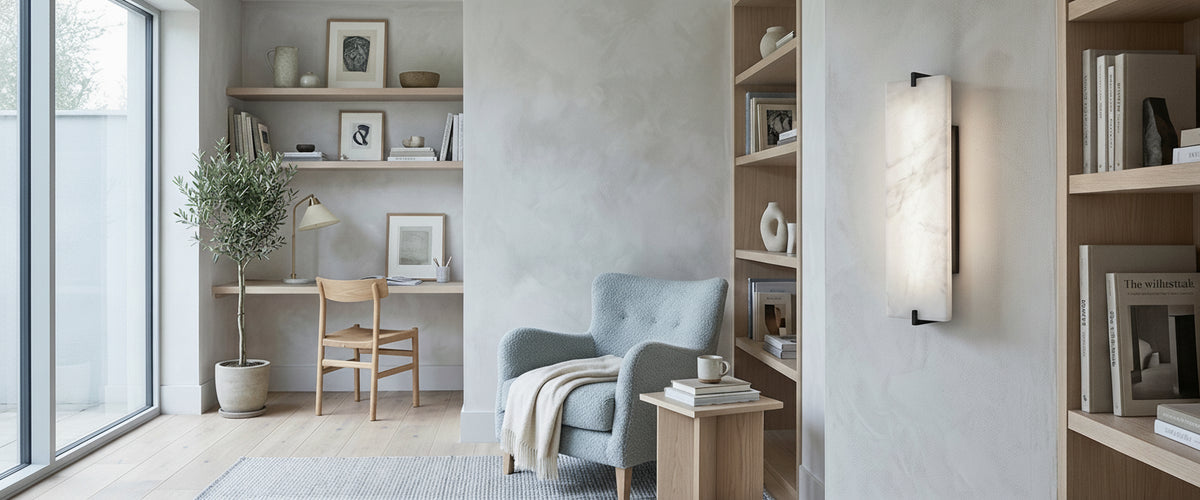

Most Scandinavian wall lights look convincing in daylight and fall apart at nine in the evening. The arm is slim, the finish is quiet, the proportions are polite, and then the bulb goes on and the whole thing throws a hard white disc up the plaster like a security light. The failure is almost never the bracket. It is the shade, and specifically what the light has to travel through before it reaches the room. Get that right and a Scandinavian wall light does the thing it is actually for: holding a low, even pool of warmth on a wall through a long dark evening.

Key Takeaways
The shade material decides everything. Opal glass, alabaster and linen each pool light differently after dark, and with Scandinavian wall lights that difference is visible from across a room.
Finish sets the register. Matte black sharpens, brushed nickel cools, pale oak softens. Choose against the room, not with the trend.
Scandinavian wall lights sit lower. Around 1.4 to 1.5 m (roughly 4 ft 7 in to 4 ft 11 in) suits most living spaces, below where British instinct usually places a wall light.
Home office wall lighting works best off-axis, mounted to one side of the desk so the glow lands on the wall rather than the screen.
Backplate and cable entry reveal build quality faster than any spec sheet.
The lamp matters as much as the shade. 2700K, CRI 90 or above, and a trailing-edge dimmer matched to the specific driver.

Nordic Restraint Lives in the Shade, Not the Arm
The Scandinavian design tradition is often read as a story about form: clean lines, honest joints, no ornament. In lighting, that reading misleads people. Danish and Swedish lighting design grew out of a practical problem, which is that for half the year there is very little daylight and what there is arrives at a low, soft angle. Fixtures were shaped to handle glare and to make artificial light feel like something you could sit under for five hours without squinting. Look at the Danish classics held by Designmuseum Danmark and the pattern is hard to miss: the invention usually sits in the shielding and diffusion, not the silhouette. The Scandinavian wall lights worth buying today still work to that brief.
That history matters when you shop. A minimal steel arm with a bare lamp behind a token ring is a modern bracket wearing a Nordic label. The test for Scandinavian wall lights is simple. Stand ten feet (3 m) away in a dark room and look at the fixture directly. If you can see the filament, or a bright hotspot burning through the shade, the piece has not done the Nordic part of the job.
Opal Glass, Alabaster and Linen: How Each One Pools Light at Night
Three materials dominate Scandinavian wall lights, and they behave nothing alike once the sun goes down.
Alabaster scatters light inside the stone, so the glow carries the veining rather than a flat hotspot.
Opal Glass
Opal glass gives the most even, most predictable output. Light spreads uniformly across the surface, edges stay crisp, and the glow reads slightly cool unless you correct with the bulb. Opal-shaded Scandinavian wall lights suit kitchens, hallways and stair walls where you want clarity rather than atmosphere. The weakness is character. A good opal shade is flawless and identical to the next one, which in a room full of natural textures can look flat.
Alabaster
Alabaster is the one that changes the mood of a wall. Because it is a gypsum stone with real depth, light does not simply pass through it; it scatters inside the material and comes out carrying the veining. You get a warm, uneven, faintly amber pool with soft shadow at the edges, and no two shades match. In a Nordic scheme built on pale oak, wool and white plaster, that internal movement is what stops the room reading sterile. It is also why we keep alabaster at the center of the Niori range and of the Scandinavian wall lights we recommend most often; you can see how the material behaves across different formats in the alabaster lighting collection. Marble and onyx shades follow similar physics with stronger figuring, which suits bolder rooms.
Linen and Fabric
Linen shades throw light up and down rather than through, so the wall does most of the work. The effect is soft and domestic, well suited to bedrooms. The trade-off is longevity and upkeep. Fabric yellows, sags in humid rooms, and shows dust in a way stone and glass do not.
One honest observation from the studio: clients who order alabaster samples for Scandinavian wall lights almost always change their mind about wattage afterwards. Stone diffuses so effectively that the output you thought you needed turns out to be too much.
Where Matte Black, Brushed Nickel and Pale Oak Tip a Sconce into the Wrong Register
Finish is where good intentions go sideways with Scandinavian wall lights. Matte black reads as graphic and slightly industrial. Against white plaster and light timber it can look sharp and deliberate; against gray walls and dark floors it disappears into a smudge and the fixture loses its shape. Brushed nickel is cooler than most people expect on the wall, and next to a warm alabaster shade it can create a small visual argument between the metal and the stone. Antique or unlacquered brass usually sits more comfortably with natural stone because both materials shift tone as light moves across them.
The same logic carries outside, where render and brick give black something to hold its outline against rather than dissolve into, and a piece such as the Helsingor Outdoor Wall Light in Black reads as deliberate rather than heavy on an entrance wall. Pale oak is the trickiest of the interior finishes on Scandinavian wall lights. It is genuinely Nordic and genuinely warm, but it commits the room. Oak details need oak or similarly warm timber elsewhere, otherwise a single pale wooden sconce reads as a holiday-cabin souvenir stuck on a city wall. If your scheme has walnut, painted joinery or dark stone, skip the timber and let the shade carry the softness.
Height and Projection: Hang Lower Than Instinct Suggests
British wiring habits push wall lights high, often at 1.8 m (about 5 ft 11 in) or above, which is a hangover from ceiling-led lighting schemes. Scandinavian wall lights are designed to work near the people using them. In living rooms, sitting rooms and snugs, around 1.4 to 1.5 m (roughly 4 ft 7 in to 4 ft 11 in) from finished floor puts the glow at shoulder height when standing and just above the eye when seated. The pool of light lands where you actually live.
Projection matters just as much, and it is the spec most people skip when they compare Scandinavian wall lights. A shade that sits tight to the wall creates a narrow vertical wash and works in corridors. A deeper projection of a few inches pushes light outward and lights the room rather than just the plaster. Beside a bed, aim for roughly 1.1 to 1.2 m (around 3 ft 7 in to 3 ft 11 in) above floor level so the light falls onto a book rather than onto a face. Flanking a mirror, drop to eye level, about 1.6 m (5 ft 3 in), and pair the sconces either side rather than placing one above; side lighting removes the under-eye shadow that overhead lighting creates.
Home Office Wall Lighting: Where Nordic Sconces Earn Their Keep
Desk lamps eat surface area and ceiling downlights create screen glare. Home office wall lights solve both, and this is where Nordic diffusion earns its reputation. Mount a sconce to one side of the desk, slightly forward of where you sit, at around 1.5 m (4 ft 11 in). The light arrives at an angle, lifts the wall behind the monitor, and cuts the harsh contrast between a bright screen and a dark surround that causes eye fatigue in the evening.
Mounted off-axis, a pair of Scandinavian wall lights lifts the wall behind the screen instead of glaring into it.
For a converted loft office in Bristol we shipped a pair of alabaster Scandinavian wall lights, one either side of a long desk, specifically because the client worked late and hated the white-out from a ceiling panel. The stone kept output low and even, and the wall behind the screen stopped reading as a black hole. If you are comparing formats before committing, the wider lighting collection shows how the same stone reads in pendants and table lamps, which helps when the office doubles as a guest room.
Two rules for home office wall lights. First, put them on their own dimmed circuit so daytime and evening output can differ. Second, avoid anything that throws light forward towards the seated position; uplight and wall wash are your friends here.
The Backplate and Wiring Details That Separate Considered from Catalogue
Turn a Scandinavian wall light over before you buy. The backplate should be solid, machined rather than pressed, and deep enough to conceal a standard back box without a visible gap. Cheap copies use a thin stamped disc that bows slightly when screwed tight, leaving a shadow line against the plaster that no amount of caulk will hide.
Check how the cable enters. A considered piece has a proper grommet or a threaded entry, the internal earth point is clearly marked, and the terminal block is fixed rather than floating loose in the canopy. Look at how the shade attaches too. Stone shades should sit in a lined seat or be held with soft-faced fixings; metal tightening directly against alabaster is how hairline cracks start.
Once a fixture has to handle weather as well as wiring, the rating leads the decision before the styling does. On an exposed threshold an IP54 fitting such as the Helsinki Outdoor Wall Light in Graphite is the right register, with the sealed body and gasketed entry that a sheltered indoor sconce never needs. Where the light also has to do a job nobody wants to switch manually in the dark, a sensor version like the Klampenborg Outdoor Wall Light with PIR answers the side door or bin store better than a second switched circuit would.
Scandinavian wall lights need a wired supply, so this is a job for a qualified electrician working to the current UK regulations, particularly in bathrooms where zone and IP ratings apply. Electrical Safety First publishes clear consumer guidance on using registered installers.
The One Room Where Scandinavian Wall Lights Read Cold
Bathrooms. Specifically, bathrooms finished in pale porcelain, white grout and chrome. Every surface is hard and reflective, there is no textile to absorb bounce, and a minimal Nordic sconce with a cool shade turns the whole space into something clinical. The restraint that feels calm in a sitting room feels like a changing cubicle here.
The fix is material, not fixture type. Scandinavian wall lights with alabaster, honed marble or a warm-toned stone shade bring back the depth that tile removes, and a warmer color temperature does the rest. Add texture elsewhere, whether that is timber, a stone basin or a linen blind, so the light has something soft to land on.
Bulbs and Dimming
Color temperature: 2700K for living rooms and bedrooms. 2200K to 2400K if you want candle warmth behind stone. Avoid anything above 3000K in a Nordic scheme; it kills the warmth instantly.
Color rendering: CRI 90 or above. Alabaster veining looks muddy under poor-rendering lamps.
Output: stone diffuses hard, so start lower than you think and adjust. Two modest Scandinavian wall lights beat one bright one.
Dimming: match a trailing-edge dimmer to the specific driver or lamp. Mismatched pairings cause flicker and buzz, and stone shades amplify any hum sitting against a solid wall.
Bulb shape: in a translucent shade, use a frosted or opal lamp. A clear bulb prints its own outline through the stone.
A Quick Buying Checklist
Decide the job your Scandinavian wall lights have to do first: reading light, wall wash, or atmosphere only.
Choose the shade material for how it behaves at night, then choose the metal.
Confirm mounting height against seated eye level, not against a standard.
Check projection suits the corridor width or furniture layout.
Inspect the backplate depth, cable entry and shade fixing method.
Ask about IP rating for bathrooms and any covered outdoor use.
Plan the dimming circuit before the electrician first fixes.
Order a sample of any stone shade and look at it lit before you commit.
Keeping Stone Shades Looking Right
Alabaster and marble are porous and softer than glass, so stone-shaded Scandinavian wall lights ask for a lighter touch than metal ones. Dust with a dry microfiber cloth, never a damp one loaded with household cleaner, and keep solvents and acidic sprays away entirely; even a splash of limescale remover will etch a honed surface. If a shade picks up a greasy mark in a kitchen, a barely damp cloth followed immediately by a dry one is the limit of what it needs. Wipe unlacquered brass rather than polishing it, so the patina builds evenly.
Well-specified Scandinavian wall lights should get better with time, not worse. The stone deepens slightly, the brass settles, and the quality of the evening light stays exactly where you set it. That is the whole point of the tradition, and it is worth spending your attention on the shade rather than the silhouette. You can browse formats and finishes across the Niori range when you are ready to compare in detail.