
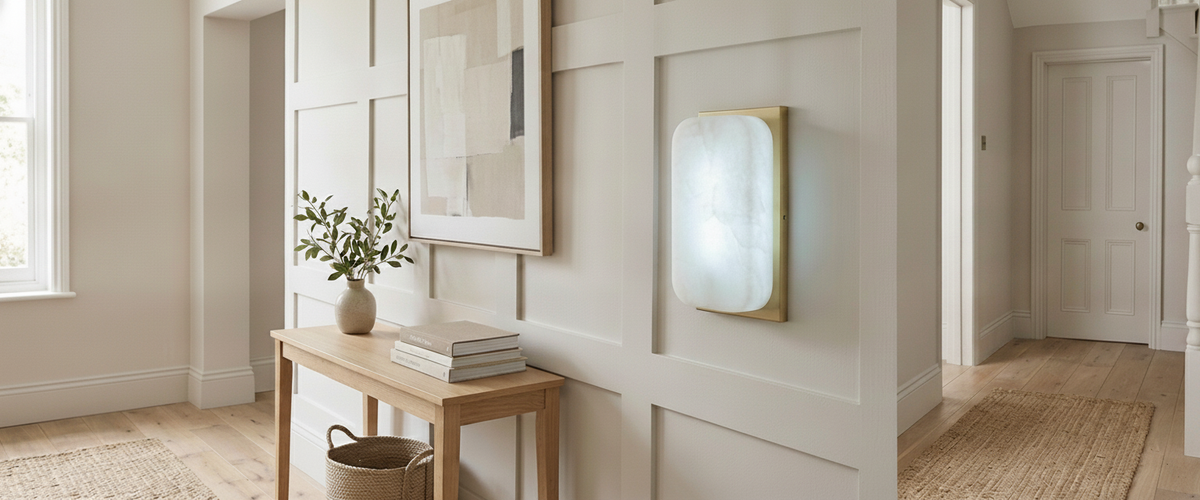

Half the wall lights sold as "transitional" are really just a modern fixture with a decorative backplate bolted on. A true alabaster transitional wall light earns the label a different way. It sits between crisp contemporary geometry and softer classical proportion, and the stone does the mediating. Get the block, the carving, and the finish right and the sconce works in a Georgian hallway or a glass-walled kitchen extension without looking like it wandered in from another house.
That flexibility is exactly why designers reach for an alabaster transitional wall light. But the same qualities that make alabaster forgiving in a scheme make it demanding to make well. A brief on how these pieces come together helps you buy with your eyes open.

At a Glance
What "transitional" means here: clean lines with a hint of traditional profile, so the sconce bridges old and new interiors.
Why alabaster: it transmits a warm, low-glare glow that neither a pure modern nor a period fixture matches.
Biggest cost drivers: slab quality, carving complexity, backplate and arm work, and the wiring or dimming spec.
Before you buy: ask about veining, wall thickness, fixings, and whether the stone is sealed.

What "Transitional" Actually Asks of a Stone Sconce
Transitional design lives on restraint. It borrows the symmetry and gentle curves of classic lighting, then strips the ornament back until the shape reads calm. For an alabaster transitional wall light that means a form that could hang beside panelled joinery or plain plaster and belong to both.
Alabaster suits that brief because it carries proportion without shouting. A softly rounded rectangle or a shallow shell shape reads traditional in a period room and sculptural in a modern one. The stone stays neutral while the light does the talking. That is a harder trick than it sounds; push the carving too ornate and it tips period, strip it too flat and it tips cold. The best examples of an alabaster transitional wall light hold the middle. Geometry is part of that balance too: a rounded form such as the Essence Round Wall Light 75cm leans softer and more classical, while a squared profile like the Essence Square Wall Light 75cm reads a touch more contemporary against the same wall. You can see how that plays out across our alabaster lighting range, where the same material reads differently depending on how sharp or soft the edges are cut.
Choosing the Block: How Veining Decides Which Slab Becomes a Light
Every alabaster transitional wall light starts as an argument about veining. Alabaster is a form of gypsum, and its cloudy bands and mineral streaks are natural, so no two blocks are alike. The Natural Stone Institute notes that gypsum alabaster is soft enough to carve by hand yet translucent enough to glow when lit from behind, which is precisely what makes it a lighting stone rather than a cladding one (naturalstoneinstitute.org).
For a wall light, the maker is looking for a slab where the veining flatters even light. Heavy dark banding can throw shadows across the face when the fixture is on, which reads as a stain rather than a feature. Gentle, evenly spread cloud tends to glow best. A block is also checked for hidden fissures; a crack you cannot see dry becomes obvious once light passes through it. Studio experience here is blunt: we have set aside handsome-looking blocks because a single fault line ran straight across where the wall plate would sit. Better to lose the stone than ship an alabaster transitional wall light that glows unevenly for years.
Thickness matters too. Cut the face too thin and it glows brightly but feels fragile and can look washed out. Leave it thicker and the glow deepens, the veining reads richer, and the piece gains weight. A generous face on an alabaster transitional wall light can add a kilo (about 2.2 lb) or so over a thin one, which then feeds back into the fixings and backplate spec.
The Carving Calls That Shift Both Glow and Price
Once a block is chosen, the carving decides how the sconce behaves as a light. A flat, plane-cut face gives an even, contemporary wash. A gently dished or curved face bends the light and creates a soft gradient across the surface, warmer at the center, cooler at the edges. Chamfered or stepped edges catch highlights and read more traditional.
Each of these is a labor decision, not just a style one. Hand-finishing a curved face takes longer than surfacing a flat one, and softer stone can chip if the tool is pushed, so the work is slow and unforgiving. Complexity is one of the main reasons two similar-looking versions of an alabaster transitional wall light can be priced quite differently. Rather than quote figures, the honest answer is that budget tracks slab quality, carving time, metalwork, and finishing; the sensible move is to request a tailored quote once you know the size and form you want.
Backplate, Arm, and Finish: Where Craft Meets the Wall
The stone gets the attention, but the backplate and any arm decide whether the sconce looks resolved. On a transitional piece the metalwork usually stays quiet: a slim brass or bronze backplate, a short arm, or a flush mount that lets the stone sit close to the wall. Brass is the classic partner because its warmth agrees with the amber glow; a brushed or aged finish leans traditional, a polished one leans modern. Where a wall calls for more presence without tipping ornate, a larger flush form such as the Essence Round Wall Light 115cm holds scale while keeping the metalwork restrained.
Fit is where craft shows. The stone and the metal expand at different rates and carry different tolerances, so the join has to allow a little movement without rattling or cracking. A good maker beds the stone rather than clamping it hard. Ask how the alabaster is held on your alabaster transitional wall light; if the answer is vague, that is a signal. You can compare backplate and arm styles across the broader lighting collection to see which metal treatments read transitional versus fully modern.
Wiring and Dimming Choices Makers Weigh Before Assembly
Inside every alabaster transitional wall light is a decision about how the bulb sits relative to the face. Too close and you get a bright hot spot burning through it. Too far and the glow goes flat. The gap, the reflector, and the lamp all get chosen together so the light spreads evenly across the surface.
For a warm, even glow, a low-wattage LED in the 2700K to 3000K range usually suits the material best; higher color temperatures fight the stone's natural amber. Dimming is where buyers most often trip up. A dimmable driver has to be matched to the wall dimmer, and a mismatch shows as flicker or a lamp that will not fade below a certain point. If dimming matters to you, say so before the piece is built so the correct driver goes in. On the electrical side, treat installation as a job for a qualified electrician; the UK's Electrical Safety First offers clear guidance on why fixed wiring is not a DIY task (electricalsafetyfirst.org.uk).
A Quick Placement and Spec Checklist
Height: mount hallway and living-room sconces around 150 to 168 cm to center, adjusting for ceiling height.
Pairs: flanking a mirror or bed, keep the pair symmetrical and let the glow overlap gently rather than leaving a dark gap.
Color temperature: 2700K to 3000K for warmth; avoid anything cooler on this stone.
Dimming: confirm driver and dimmer compatibility before assembly.
Wet areas: for bathrooms, check the IP rating and zone with your electrician before you specify.
Red Flags to Raise Before You Commit Your Money
A few questions separate a considered purchase from a regret. Ask whether the stone on your alabaster transitional wall light is genuine alabaster or a resin lookalike; resin will not glow with the same depth and tends to yellow. Ask if the face is sealed, since unsealed gypsum is porous and marks easily, which matters near kitchens and bathrooms.
Push on the fixings. A heavy stone face on a flimsy backplate is a long-term problem, especially on plasterboard. Ask what the piece weighs and what wall type it suits. Query the veining shown in photos versus what you will receive; because every slab differs, a reputable maker will explain the natural variation rather than promise an identical match. And ask about lead time and repairs. Alabaster can be re-polished and small chips eased, so a maker who supports the piece after delivery is one worth trusting.
Do that homework and an alabaster transitional wall light rewards it for years. The glow softens a room the way plain downlights never will, the material quietly bridges styles, and the piece ages into the wall rather than dating on it. That is the whole point of buying an alabaster transitional wall light in stone rather than pressed metal or moulded resin.