
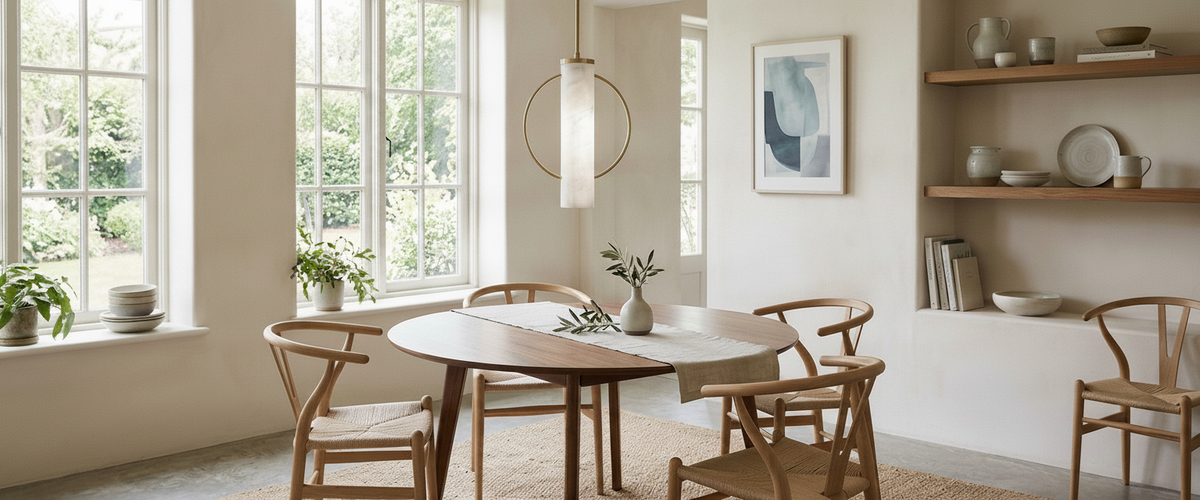

Mid-century interiors run on discipline: low horizontal lines, honest materials, and very little decoration doing the emotional work. That restraint is what makes them handsome, and also what can leave them feeling a little clinical after dark. This is where an alabaster mid century approach earns its place, because a veined stone shade throws a warm, diffused glow that steel, chrome and clear glass simply cannot produce. The trick is knowing how much stone a lean fixture can carry before the whole look tips into something heavier than the period intended.
We have shipped alabaster mid century pieces into plenty of period-leaning homes, and the pattern is consistent. Buyers love the light quality straight away. What surprises them is how much the proportion and the surrounding materials decide whether the stone reads as a considered update or a mismatch. So this piece is about placement and pairing, not just product.

Key Takeaways for an Alabaster Mid-Century Scheme
An alabaster mid century scheme supplies the warmth a hard-edged palette lacks after sunset.
Keep stone thin and the fixture lean; bulk is the enemy of the silhouette.
Transitional wall lights are the easiest entry point for bridging old and new.
Pair the glow with teak, walnut or plaster rather than more cold metal.
Use warm LEDs on a dimmer so the stone glows rather than glares.
The styling risk is theming; one or two stone moments beat a room full of them.

What the Mid-Century Silhouette Asks of a Soft, Veined Material
The mid-century vocabulary is all about a light frame: slim brass stems, tapered legs, thin metal shades, glass globes held on the smallest possible fitting. Those forms look weightless. Drop a heavy slab of stone into that language and the eye reads the fixture as top-heavy, which is exactly the wrong signal for a period built on visual lift.
An alabaster mid century piece works with the silhouette when it is cut thin enough to glow and shaped to echo the era's geometry. A shallow disc, a slim cylinder, a gently domed shade: these sit comfortably against period furniture. What you want to avoid is a chunky boulder-like form that fights the frame it hangs from. Because alabaster is a natural stone, every piece varies in translucency and grain, so a thinner cut also lets more of that internal veining show once the lamp is lit.
Why Alabaster Warms a Mid-Century Room That Steel and Glass Leave Cold
Chrome, smoked glass and blackened steel are precise and a little unforgiving. In daylight they look sharp. At night they reflect and glint rather than glow, so a room dressed entirely in hard materials can feel like it lost its heartbeat once the sun goes. Alabaster does the opposite. Light passes through the stone and comes out softened and gold-toned, closer to candlelight than to fixture output.
That quality is not decorative fluff; it changes how a space feels to sit in. Translucent stones like alabaster have been prized for exactly this since antiquity, valued for the way they carry light through the material itself rather than bouncing it off a surface, a property noted in museum descriptions of ancient alabaster vessels at the British Museum. In a modern alabaster mid century scheme that translates into one warm anchor in a cool room. You can browse the full spread of shapes across the alabaster lighting range to see how the same stone behaves as a pendant versus a wall light.
Scale and Proportion: Keeping Stone From Bulking Up a Lean Fixture
Proportion is where most alabaster mid century pairings go right or wrong. A stone shade needs enough mass to glow evenly, but too much and it dominates a delicate frame. Work to the fixture, not the room.
A quick sizing method
Pendants over a dining table: aim for a shade roughly one-third to one-half the table width, hung about 30 to 36 inches (76 to 91 cm) above the surface. A slim alabaster drum reads better here than a deep globe.
Wall lights in a hallway: keep the projection modest, around 4 to 6 inches (10 to 15 cm) from the wall, so the piece hugs the plane the way period sconces did.
Table lamps on a low console: a compact stone base with a slim profile suits the lower furniture heights of the era better than a tall column.
One studio lesson worth passing on: buyers often oversize the pendant because the stone photographs beautifully at scale. In the room, on a lean brass stem, that same alabaster mid century piece can look like it is straining the fixture. When in doubt, go a size down and let the glow do the talking.
Transitional Wall Lights: Where the Alabaster Look Bridges Old and New
If you want one easy way into this style, start with an alabaster transitional wall lights. Transitional pieces borrow the clean geometry of mid-century design but soften the edges just enough to sit in a contemporary home, and the veined stone is the material that makes that bridge feel natural. A slim rectangular sconce or a rounded stone shade on a discreet metal backplate flatters both a genuine period room and a newer build reaching for that warmth.
Wall lights also solve a practical problem. Mid-century rooms tend to have low furniture and open sightlines, so floor space is precious and you do not always want a lamp on every surface. Mounting the glow at wall height keeps the horizontals clean while still layering light where you need it, either side of a bed, flanking a fireplace, or lining a hallway. Because an alabaster mid century wall light sits close to the eye, the veining in the stone becomes a feature rather than a detail you only notice up close.
Any wall fitting should be installed by a qualified electrician, particularly where you are replacing older wiring in a period property. It is worth confirming the fixture suits your wall type and box before you commit to placement.
Backdrop Pairings: Teak, Walnut and Plaster Against a Glowing Stone Shade
An alabaster mid century shade looks its best against warm, matte, natural surfaces rather than cold reflective ones. That is the single most useful pairing rule for this style.
Teak and walnut are the obvious partners. Their honey and chocolate tones pick up the gold in a lit stone shade, so it reads as part of a family rather than a stranger dropped into the room. A pendant hung above a walnut dining table, or a wall light against a teak-panelled feature wall, gives you that harmony instantly. Plaster and lime-washed walls do something similar; their soft chalky texture catches the diffused light and spreads it gently, which suits the material far better than a high-gloss painted surface that fights the glow with its own sheen.
Where you do use metal, and mid-century loves a bit of brass, keep it warm-toned and let it act as jewellery rather than structure. A slim brass stem or backplate ties the fixture to period hardware without adding coldness. For a wider look at how stone pairs across fixture types, the full lighting range shows the same principle running through pendants, table lamps and floor lamps.
The Styling Trap: When the Mix Reads Dated Instead of Deliberate
The failure mode is theming. Buy every fixture in the same stone-and-brass combination, add the era's furniture in matching finishes, and the room stops looking curated and starts looking like a showroom set from the wrong decade. Alabaster mid century done well is a mix, not a costume.
Restraint is the fix. Let the stone be the one soft, warm gesture in a room that is otherwise crisp. One glowing pendant or a pair of wall lights against clean plaster does more than four stone fixtures competing for attention. Vary your shapes too; if the pendant is a drum, a matching drum sconce beside it can look flat, whereas a rounded wall light adds contrast while keeping the material story consistent.
Watch the colour temperature as well. Alabaster glows warm by nature, so a cool bulb behind it produces an odd greyish cast that undoes the whole point of an alabaster mid century look. Stick to warm LEDs and put them on a dimmer, which lets the stone move from a soft evening glow to a brighter working light without ever going harsh.
A Short Buyer's Checklist
Choose a thin, geometric stone shade that echoes mid-century forms rather than a heavy block.
Size to the fixture and the furniture height, not to how the piece looks in a photograph.
Start with a transitional wall light if you want the lowest-risk entry to the alabaster mid century style.
Pair the glow with teak, walnut or plaster; keep metal warm and minimal.
Use warm, dimmable LEDs and avoid cool white behind the stone.
Limit yourself to one or two alabaster moments per room to keep it deliberate.
Book a qualified electrician for any hardwired wall or ceiling installation.
Niori works exclusively in alabaster and natural stone, so the light quality that suits an alabaster mid century room is the whole point of what we make. Get the proportion and the pairing right, and a single glowing shade can carry the warmth an entire lean, hard-edged scheme has been missing.