
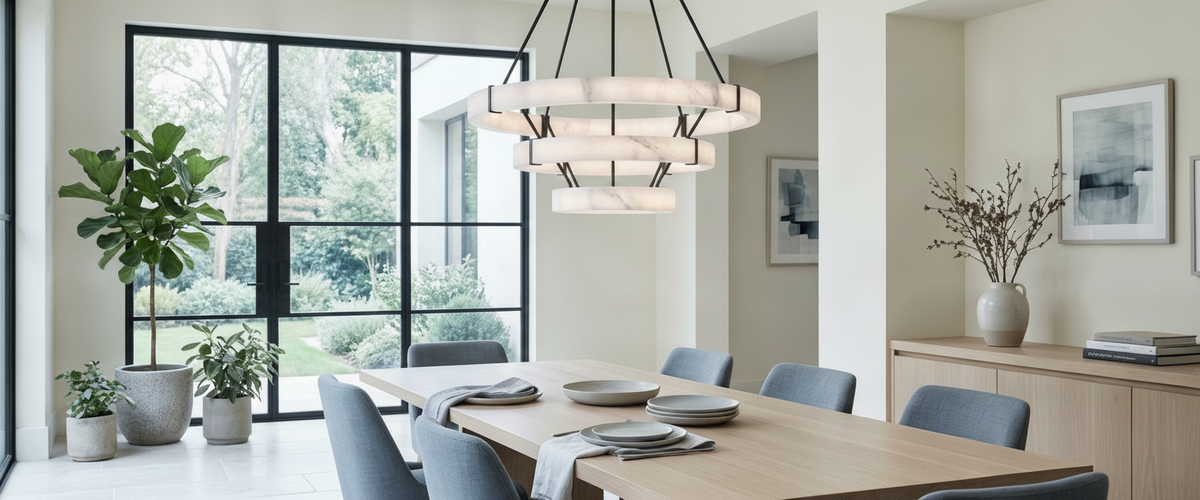

A modern alabaster chandelier gives itself away in the first few seconds, if you know where to look. The stone is cut into cleaner planes, the metalwork sits closer to the ceiling, and the whole fitting reads as one confident shape rather than a cluster of separate arms. A period piece behaves differently. It carries weight, small irregularities, and often a slightly uneven glow where the alabaster has thickened or thinned over decades. Both can be beautiful. But they ask different things of you as a buyer, and confusing one for the other is how people overpay.
This guide walks through the tells, the round form, buying antique without regret, matching either style to your ceiling, and getting the light temperature right so the stone stays warm rather than washed grey. Whether you lean toward a modern alabaster chandelier or a hand-carved original, the same principles apply.

Key Takeaways
A modern alabaster chandelier favours bold single forms and hidden LED sources; period pieces show arms, patina, and hand-cut variation.
An alabaster chandelier round in plan spreads light evenly across a table because the ring has no dark end.
Any antique should be rewired before it goes up, however good the patina looks.
Ceiling height decides scale more than the room's footprint does.
Warm dimmable LEDs (around 2400 to 2700K) keep alabaster honey-toned instead of clinical.

What Marks a Modern Alabaster Chandelier, and What Marks a Period Piece
Start with the silhouette. A modern alabaster chandelier tends to be one strong gesture: a disc, a ring, a stacked column, a set of layered arms reading as a single sculptural mass. The stone is usually cut thin and even so the LED behind it glows without hot spots. You rarely see visible bulbs. You often see brushed brass, matt black, or polished chrome doing quiet structural work rather than showing off. Where you want the arms to register as one deliberate form rather than a spray of separate elements, something like the Aurelian LED Layered Arms Alabaster Chandelier shows how matt black holds the geometry together without competing with the stone.
A period alabaster chandelier is chattier. Expect a central bowl or several radiating arms, cast metal fittings with real weight, and stone that varies in thickness so the light pools unevenly. That unevenness is not a fault; it is the fingerprint of hand carving. The material has been used decoratively since antiquity, prized because it transmits light while staying opaque enough to hide the source, a quality the Metropolitan Museum of Art notes across its ancient and medieval stone collections.
The quickest test: look at how the stone meets the metal. A modern alabaster chandelier hides the join. Older work usually shows a collar, a screw thread, or a fixing that was meant to be seen and serviced.
The Round Form: Why a Circle of Stone Spreads Light So Evenly
An alabaster chandelier round in plan solves a problem that arm-based designs never quite crack. A ring has no dark end. Set one over a dining table and the light lands on every seat with roughly the same warmth, so nobody eats in shadow while the host glows. A linear or arm fitting always favours the centre and leaves the ends cooler.
The round form also flatters the material. Because alabaster's veining runs in soft, cloud-like drifts, a continuous circle lets the pattern move around the fitting without a hard interruption. On a long refectory table, a single ring over the centre does more even work than a run of three pendants, and it reads as one clean object rather than a sequence. For a table that needs that continuous, even wash, a radial modern alabaster chandelier such as the Elvaris LED Radial design spreads the glow outward from a warm brushed-brass core rather than pooling it in the middle.
If you want to compare round designs against linear and layered forms, the full range of shapes sits in the alabaster lighting collection.
Buying Antique: Patina Worth Keeping, Repairs to Expect, Rewiring You Can't Skip
An antique alabaster chandelier can be a genuine find, but read it like a surveyor, not a romantic. Some ageing adds value. Some hides a repair bill.
Patina worth keeping: a warm, slightly amber cast to the stone; soft wear on high points of the metalwork; minor surface crazing that catches light. These are the marks of age that no factory can fake convincingly, and they set an antique alabaster chandelier apart from a fresh copy.
Repairs to expect: chipped edges on the alabaster, loose arm joints, a stone panel that has been glued and shows a milky seam. Small chips can be lived with or professionally filled. A cracked structural section is a different matter, because alabaster is soft and a stressed panel can fail under its own weight.
Rewiring you cannot skip: old fabric-covered flex, brittle insulation, and period lamp holders are a fire risk. Any antique fitting going into a modern home should be rewired by a qualified electrician and brought up to current standards. Guidance from Electrical Safety First is clear that aged wiring is one of the most common avoidable hazards. Treat the rewire as non-negotiable, not optional.
Matching Style to Ceiling Height and Room Proportion
Ceiling height governs the choice more than floor area does. A dramatic multi-tier period piece needs headroom to read properly; hang it under a low ceiling and it looks trapped. A flat disc or shallow ring, by contrast, earns its place in a room with limited height because it delivers the alabaster glow without stealing vertical space. This is often where a modern alabaster chandelier wins outright.
Where a room does have the drop to carry a taller fitting, a multi-light suspension such as the Luxoria 10 Light Alabaster Chandelier uses that vertical space to build presence, its polished chrome keeping the white stone crisp rather than heavy.
Some working rules from the studio:
Over a dining table: leave roughly 30 to 36 inches (76 to 91 cm) between the tabletop and the base of the fitting, adjusting up for taller ceilings.
In an entrance hall or stairwell: a tall period-style piece can hang lower and become the focal point, provided the lowest point clears head height on the stairs.
Diameter to room: a common starting point is to add the room's length and width in feet and treat that sum in inches as a sensible fitting diameter. A 14 by 16 foot room suggests something around 30 inches (76 cm) across.
Proportion also runs sideways. A slim round fitting can look lost above a heavy oak table, while a substantial layered chandelier can overwhelm a delicate glass one. Match visual weight, not just size.
Bulb and Dimming Choices That Keep the Stone Warm
Alabaster is a warm material, and the wrong bulb undoes everything the stone is trying to do. Cool white light turns honey-coloured veining a flat grey and makes the whole fitting look synthetic.
What we recommend across both a modern alabaster chandelier and a period one:
Colour temperature: stay between 2400K and 2700K. This keeps the stone amber and the glow candle-like rather than clinical.
Dimmability: insist on it. Alabaster looks best dimmed to a soft evening level, and the ability to drop the output is what turns a dining chandelier from functional to atmospheric.
CRI: choose lamps at 90 or above so skin tones and table settings read true.
Driver and dimmer pairing: for integrated LED pieces, check the driver is compatible with your dimmer. Mismatches cause flicker at low levels, which ruins the effect.
For a modern alabaster chandelier with integrated LED, the source is fixed, so the specification matters at the point of purchase. For a rewired antique taking replaceable bulbs, you have more freedom later, but choose your first set carefully so guests never see a stripe of cool light through the stone.
How to Spot Pastiche Dressed as Heritage
Plenty of new fittings are styled to look old, and there is nothing wrong with that until someone prices it as a genuine antique. Watch for these tells:
Too-perfect stone: uniform thickness and machine-even veining across every panel usually means recent CNC cutting, not hand work.
Modern wiring hiding under old-looking metal: a fitting with fresh PVC flex and current lamp holders was not made a century ago, whatever the finish suggests.
Consistent, deliberate "distressing": real wear is random and sits where hands and cloths touch. Even, all-over ageing is a paint effect.
No provenance and vague dating: a genuine period piece usually comes with some history. "Antique-style" is a fair description; "antique" without any story is a flag.
None of this rules out buying a beautifully made modern alabaster chandelier in a heritage spirit. The point is to pay the right price for what it actually is. If your instinct is a clean modern look anyway, browse the wider lighting range and judge craftsmanship on its own terms rather than through a fake patina.
A Short Buyer's Checklist
Decide modern or period first; it changes ceiling clearance, wiring, and price expectations.
For even table light, favour a round form over arms.
Rewire any antique before installation, using a qualified electrician.
Match fitting scale to ceiling height, then check visual weight against the furniture below.
Specify 2400 to 2700K, dimmable, CRI 90-plus.
Interrogate anything sold as antique for real provenance and honest wear.
Get those six right and an alabaster chandelier, modern or old, will do exactly what the material promises: throw a soft, warm light that makes a room feel considered rather than merely lit.