
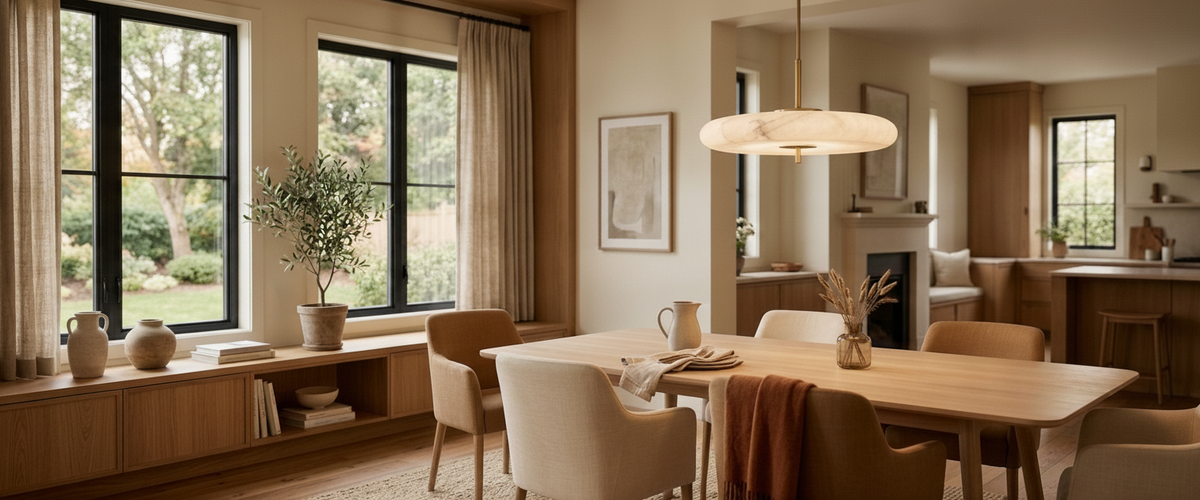

A carved alabaster pendant can read as warm candlelight or as a flat, clinical wash, and often the only thing standing between those two outcomes is the dimmer behind the wall. Get the fade right and the stone's veining glows from within; get it wrong and you fight buzz, flicker, and a fixture that refuses to drop below half brightness. That is the real reason a smart light switch dimmer is worth thinking about, and it deserves more care than most people give it.
We ship a lot of translucent stone into homes where the owner has already installed smart controls, and the same questions about a smart light switch dimmer come up again and again. So before you buy anything, here is the short version.
A well-matched dimmer lets alabaster fade evenly to a warm, low glow.

Key Takeaways
A quality trailing-edge smart light switch dimmer matters more for smooth low-end fading than any app feature.
Match the control to the LED driver in your fitting, not the other way round.
Smart bulbs and wall dimmers usually do not mix; pick one control method per circuit.
Buzz and flicker at the bottom of the dial are a compatibility problem, not a fault in the stone.
Fitting one of these is an electrician's job, not a weekend project.

What a Smart Dimmer Changes Over a Plain Trailing-Edge Fade
A good trailing-edge dimmer already gives you a smooth, low-flicker fade suited to LED loads. The word "smart" adds control layers on top of that: an app, voice commands, schedules, and scenes that recall a fixed brightness at the tap of a phone. What a smart light switch dimmer does not automatically add is a better fade. If the underlying dimming circuit is poor, connecting it to Wi-Fi just lets you trigger a bad result remotely.
For alabaster and onyx, the fade quality is everything. These materials transmit light rather than bounce it off a diffuser, so the eye reads even small stutters in the current as visible shimmer inside the stone. A smart light switch dimmer earns its place when it combines proper trailing-edge dimming with the convenience of recalling a set brightness, say the low, honeyed level you want a dining pendant to hold every evening without hunting for it on the dial.
App, Voice, and Scenes: Which Controls You Will Actually Use
Most people buy a smart light switch dimmer for the app and end up living on the physical switch. That is worth knowing before you spend. In practice the controls that stick are scenes and schedules; the ones that fade away are fiddly app menus you have to open every time. Set a handful of scenes for a run of alabaster wall lights along a hallway, arrival, evening, and a near-off nightlight level, and you rarely touch the app again. The switch on the wall still works normally, which is the point.
Voice control is genuinely useful for whole-room fades when your hands are full, less so for precise settings. If a fitting is the visual centre of a room, a table lamp on a console or a chandelier over a dining table, you want a repeatable scene rather than a shouted percentage. Decide which of your fixtures deserve a named scene and which are happy on a plain manual dial. Not every light needs a smart light switch dimmer. Browse the range at alabaster lighting and you will see that the pieces you fuss over most, statement pendants and sculptural table lamps, are the ones that reward a saved setting.
Matching the Switch to the LED Drivers Behind Your Fittings
This is where most dimming problems are born. Every LED fitting has a driver, and the driver determines what kind of dimming it accepts. Some drivers are mains-dimmable and expect a trailing-edge signal; others are not dimmable at all and will flicker or fail if you try. Fitting a smart light switch dimmer to a non-dimmable driver is the single most common mistake we see.
An in-fixture module sits close to the driver for a cleaner low-end fade.
Before you choose a smart light switch dimmer, note the driver type in each fitting on the circuit and its minimum load. A single alabaster wall light may draw only a few watts, and some units have a minimum load below which they behave badly. Where the fitting has room in the canopy or ceiling void, a compact in-fixture unit such as the 74mm Wi-Fi Bluetooth Smart LED Controller Dimmer 16A can sit close to the driver and give a cleaner low-end result than a wall plate several metres away. For a mains-side install on a slightly larger canopy, the Wi-Fi Bluetooth LED Smart Controller 78mm Mains Dimmer covers the same job at a wider diameter. The Institution of Engineering and Technology publishes sensible guidance on the technical side (theiet.org).
Can You Use Smart Bulbs With a Dimmer Switch?
Generally, no, and this trips people up constantly. Smart bulbs already contain their own dimming electronics. Put them on a wall dimmer and you get two devices fighting for control, which shows up as flicker, buzz, or bulbs that drop offline. The rule of thumb: if you want smart bulbs, keep the wall switch as a plain on/off (or a smart on/off that never dims) and dim from the app. If you want a smart light switch dimmer on the wall, use standard dimmable LED bulbs behind it. Pick one control method per circuit and stick to it.
Chasing Out Buzz and Flicker at the Bottom of the Dial
The bottom quarter of the dial is where a cheap smart light switch dimmer embarrasses itself, and it is exactly the range you want for atmospheric alabaster light. If a fitting hums, whines, or shimmers as you fade it down, run through this list before blaming the stone:
Confirm the dimmer type. Trailing-edge suits most modern LED drivers; leading-edge often buzzes with them.
Check the minimum load. Too few watts on the circuit is a classic cause of flicker at low levels.
Match brands where you can. Some driver and dimmer pairings are simply happier together; a quick compatibility check saves grief.
Set a minimum brightness. Many smart dimmers let an electrician trim the low end so the light never drops into its unstable zone.
Rule out mixed loads. Do not share a circuit between a stone fitting and something wildly different in wattage.
Solve it at the low end and you get the effect these fittings are made for: a soft, even internal glow that holds steady rather than pulsing. That is the difference between a stone shade that looks lit from within and one that looks like it is struggling.
Wiring a Kasa Smart Dimmer Switch Kit and Other Retrofits
People search for how to wire a Kasa smart dimmer switch kit expecting a tidy DIY answer, so here is the honest one. The physical steps look simple in a video: isolate the circuit, note the existing connections, transfer line, load, and neutral, and mount the new plate. The reality is that a smart light switch dimmer usually needs a neutral wire at the switch box, and older homes often do not have one. Wire count, back-box depth, and whether the circuit is a two-way arrangement all change the job.
Mains electrical work carries real risk and, in the UK, sits under Part P of the Building Regulations for good reason. Have a qualified electrician do the install and test it; guidance from Electrical Safety First is worth reading if you want to understand what a compliant job looks like (electricalsafetyfirst.org.uk). A specialist stone fitting is not the place to learn on the job, and a botched dimmer can damage the driver you are trying to protect.
Reading Whether Your Home Genuinely Needs One
Not every room earns a smart light switch dimmer, and part of being a good buyer is knowing where to stop. A single alabaster reading lamp beside a chair is better served by an inline dimmer or simply a warm, low-wattage bulb; adding Wi-Fi to it solves a problem you do not have. Where smart control pays off is in rooms with several fittings you want to move as one: a kitchen and dining zone, an open-plan living space with pendants and wall lights, a hallway that changes mood from morning to night.
Ask yourself three plain questions. Do you regularly want more than one brightness in this room? Do you want the same setting to return without adjustment? Will more than one fitting fade together? If the answer to at least two is yes, a smart light switch dimmer is a sound buy. If not, spend the money on the fitting instead. You can compare fixture types across the full lighting collection and decide which pieces are worth wiring for scenes.
The stone does the heavy lifting; the control just needs to let it. Choose a trailing-edge smart light switch dimmer matched to your drivers, keep smart bulbs and wall dimmers apart, set the low end properly, and let an electrician sign off the wiring. Do that and an alabaster fitting fades the way it should: quietly, evenly, and warm all the way down.