
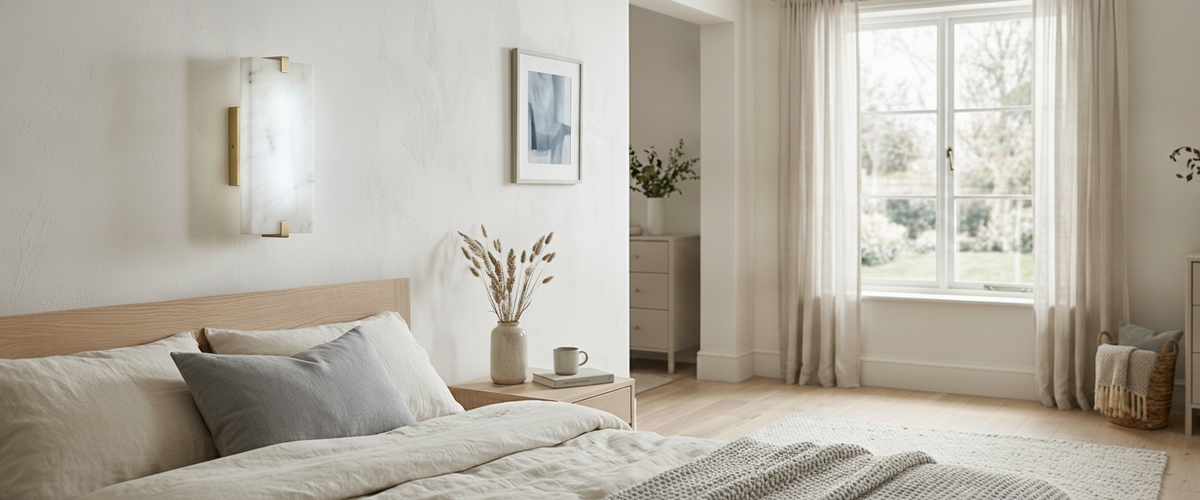

Hang a wall sconce lighting six inches too high and the whole wall looks off, even if you can't say why. Placement does more heavy lifting than the fixture itself. Get the height, scale and backdrop right and a modest wall sconce light reads as deliberate; get them wrong and an expensive pair looks like an afterthought bolted on at the last minute. This guide covers the decisions that actually change how a wall sconce light reads, from mounting height to bulb warmth, with the material-specific notes that matter when you're working with alabaster and natural stone.

Key Takeaways
Mount most interior wall sconce lights so the centre sits roughly 60 to 66 inches (152 to 168 cm) from the floor, then adjust for sightlines and furniture.
Scale to the wall and the fixtures around it, not to the room's square footage.
Alabaster and stone sconces glow rather than glare, so they suit eye-level positions where a bare bulb would be unkind.
Warm, dimmable bulbs (2700K or below) bring out veining and keep the light flattering.
A dark or textured backdrop makes a translucent stone shade sing; a bright white wall flattens it.

What a Wall Sconce Light Actually Looks Like in Different Rooms
The word sconce covers a lot of ground. In a hallway a wall sconce light might be a slim uplight washing the ceiling; flanking a bathroom mirror it becomes a pair of soft vertical glows; in a living room it can be a sculptural piece that draws the eye whether or not it's switched on. What ties good examples together is that the fixture suits the job the wall is doing.
Alabaster changes this equation. Because the stone is translucent, the shade itself becomes the light source, spreading a warm honeyed glow instead of casting a hard beam. That soft diffusion is why we so often place a stone wall sconce light where people sit or stand close by. A carved alabaster wall light beside a bed reads as calm at eye level, where a glossy metal fixture with an exposed lamp would feel harsh. You can see the range of these forms across our alabaster lighting collection, from flat-backed plates to gently domed shades.
Scale, Mounting Height and Sightlines
Three measurements decide whether a wall sconce light looks planted or floating. Start with height. For general interior fixtures, aim for the centre at around 60 to 66 inches (152 to 168 cm) off the finished floor. That range keeps the light source near eye level for a standing adult, which is exactly where diffused stone shines and where a naked bulb would blind. Drop lower in a seated area such as a snug, and go higher only when the ceiling is genuinely tall.
Bathroom vanity fixtures are the exception. Mount a pair either side of the mirror at roughly 60 to 66 inches, spaced 28 to 40 inches (71 to 102 cm) apart depending on mirror width, so light falls onto the face from both sides rather than casting a shadow from above.
Scale is where most people slip. A wall sconce light should relate to the wall panel it sits on and to the furniture beneath it, not to the whole room. A grand stone plate looks lost on a narrow pier and overbearing above a slim console. Where a wall needs a tall vertical presence to hold its own beside joinery or a full-height door, a piece such as the Essence Round Wall Light 115cm, Brass reads as intentional rather than lost. Hold a paper template on the wall before you drill; it takes five minutes and saves a botched fixing. Sightlines are the third factor. Walk the route people actually take through the space and check the fixture isn't glaring straight into an approaching eyeline or hidden behind an open door.
Room-by-Room Placement
Hallways and Stairs
Long corridors reward rhythm. Space a run of sconces evenly, usually 8 to 10 feet (2.4 to 3 m) apart, so the light reads as a deliberate sequence rather than random pools. On a staircase, follow the pitch of the stairs rather than a level line, keeping each fixture at a consistent height above its nearest tread. Alabaster suits this setting because the glow guides you without the flare you'd get from a clear glass shade at close range.
Bedrooms
Swing-arm or fixed sconces flanking the headboard free up bedside tables and put readable light where you want it. Mount each wall sconce light 30 to 36 inches (76 to 91 cm) above the mattress, adjusting for headboard height. A pair of soft stone shades here turns down the visual temperature of the room at night, which matters more than most people expect; poor evening lighting genuinely disrupts sleep, and warmer, dimmer light supports the body's wind-down, as the Sleep Foundation notes.
Living Rooms and Dining Rooms
Here a wall sconce light is often decorative first and functional second. Flank a fireplace, a piece of art, or a run of shelving to frame it. In dining rooms, wall sconce lighting on a dimmer lets you drop the overhead pendant and lean on a lower, warmer wash for evening meals. Browse the wider lighting range if you're building a scheme where the sconces need to speak to pendants and table lamps in the same material family.
Outdoors
Outdoor wall lights follow different rules. Weather rating comes first: look for an IP44 minimum for a sheltered wall, higher if the fixture is fully exposed. Up-down designs throw light along the wall face and are a reliable choice for framing a front door or garden entrance; where you want that grazing effect on brick or render, a fixture like the Rex Up Down Outdoor Wall Light, Grey gives you the vertical spill rather than a flat wash. Solid stone-effect and metal sconces handle the elements far better than a translucent interior alabaster wall sconce light, which belongs indoors. For a sheltered porch that needs a warm E27 glow at a modest wattage, something like the Outdoor Wall Light E27 IP44 10W Max, Graphite sits closer to the right scale than a large lantern. For outdoor wall lighting flanking a door, mount the fixtures at around 66 to 72 inches (168 to 183 cm) so the glow catches faces and house numbers rather than the tops of heads. Always have outdoor and mains wiring done by a qualified electrician; guidance from Electrical Safety First is a sensible starting point before any work begins.
Bulb Choice, Dimming and Backdrop
The fixture sets the shape; the bulb sets the mood. For an alabaster or stone wall sconce light, warm colour temperature is non-negotiable. Stay at 2700K or below so the stone's cream and amber tones read as intended rather than being bleached gray by cooler light. Choose a lamp that shows off veining rather than fighting it, and keep the wattage modest; these shades are designed to glow gently, not to floodlight a room.
Put every decorative wall sconce light on a dimmer. The ability to drop a wall of light from working brightness to a low evening wash is what makes a scheme feel considered. Confirm your chosen bulb is dimmable and that the dimmer is rated for LED loads, or you'll get flicker and buzz.
Backdrop and contrast decide impact. A translucent stone shade against a pale, brightly lit wall loses its drama because there's nothing for the glow to stand out from. Set the same fixture against a deeper plaster, a panelled surface, or a textured stone wall and it comes alive. If you can't change a light wall with lighting this delicate, lean harder on the dimmer so the sconce is clearly brighter than its surroundings after dark.
Common Placement Mistakes
Mounting too high. The most frequent error we see in project photos. A wall sconce light floating near the picture rail loses its connection to the furniture and the person using the room.
Ignoring symmetry. Paired sconces that aren't level, or spaced unevenly around a mirror or fireplace, undo an otherwise careful room. Measure from a fixed reference, not by eye.
Wrong bulb temperature. A crisp white lamp inside a warm stone shade is a mismatch you'll notice every evening.
No dimmer. A decorative wall sconce light stuck at full brightness has one setting and one mood.
Overscaling on a narrow wall. A big fixture cramped onto a slim pier looks stuffed in. Template first.
Using interior alabaster outside. Translucent stone and weather don't mix; keep alabaster indoors and choose properly rated outdoor wall lights for exposed positions.
We once shipped a pair of alabaster sconces to a client renovating a hallway in a Georgian terrace. Their first instinct was to centre them on the wall vertically, which put them well above head height. Dropping the fixings to just under eye level transformed the space; the glow from each wall sconce light finally reached the console table and the artwork below, and the hall stopped feeling like a corridor. Placement, not the fixture, made the difference.