

The chandelier over your dining table works harder than any other light in the house. It sits near eye level when you sit down, it throws light onto faces and food, and it becomes the thing people look at while they wait for the main course. Get a dining room table chandeliers wrong and no amount of good furniture rescues the room. Get it right and the whole table warms up. What most buyers never see is how much of that outcome is settled in the workshop, weeks before the dining room table chandelier ever meets a ceiling.
At Niori we carve alabaster and natural-stone lighting, so I want to walk you through the decisions that actually move the needle: the stone itself, the way it is cut, how it is wired, and what should make you pause before signing off on a dining room table chandelier.
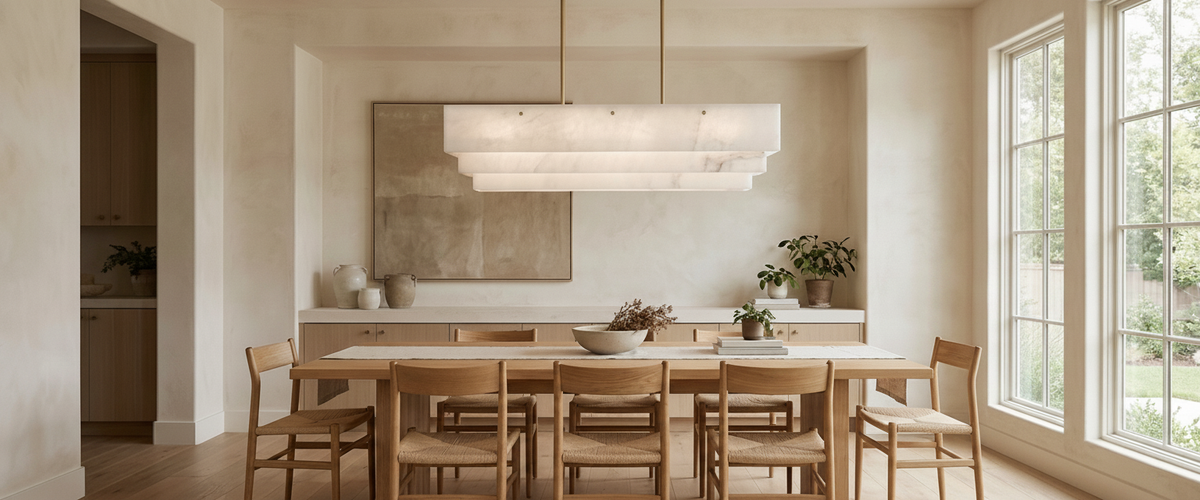
An alabaster fixture filters light through stone for a candle-like wash over the table.

Key Takeaways
Size: add the length and width of your table in inches, halve that number, and you get a rough diameter in inches for the fixture. For a linear piece, aim for around two-thirds the table length.
Height: hang the bottom of the dining room table chandelier roughly 30 to 36 inches (76 to 91 cm) above the tabletop in a standard-ceiling room.
Stone matters most: veining, translucency, and thickness decide how the light reads. No two alabaster pieces glow the same way.
Dimming: warm LED plus a compatible dimmer is what makes a stone chandelier feel like candlelight rather than a ceiling fixture.
Budget: cost tracks material, scale, carving complexity, wiring, and finishing rather than any fixed price band. Ask for a tailored quote.

What Lighting Makers Actually Think About First
Before anyone touches stone, the first questions are about the room and the table. How long is the table? Is it round, oval, or a long rectangle? How high is the ceiling? A dining room table chandelier is a spatial decision as much as a design one, and a beautiful piece hung at the wrong height reads as a mistake every single time.
The second question is light quality. Alabaster does something glass cannot: it filters light through mineral rather than bouncing it off a surface. The stone glows from within, softening shadows on faces and giving the table a candle-like wash. That warm, diffused character is the whole reason to choose stone for a dining room table chandelier, and it drives every later decision about thickness and finish. You can see the range of that effect across our alabaster lighting collection.
The third question is weight and fixing. Stone is heavy. A carved alabaster fixture can run to several pounds per panel, and the ceiling rose, chain or rod, and joist behind it all have to carry that safely. This is where a real maker separates from a drop-shipper: the load is calculated before the piece is quoted, not discovered on install day.
Craft Decisions That Change the Final Result and the Price
People assume price comes down to size. Size is part of it, but the choices that swing a quote on a dining room table chandelier are usually less obvious.
Carving complexity. A simple cylinder or a clean linear bar is faster to shape than fluted ribs, scalloped edges, or a tiered form. Every extra plane is hand-worked, and hand-work is hours.
Panel count and joinery. A six-light dining room table chandelier built from individually carved stone shades is a very different object from a single turned bowl. Where a round table calls for a multi-armed piece, something like the Dynamite 6 Light Chandelier in Brass shows how six separate carved shades read as one balanced fixture rather than a cluster of parts. More parts means more matching, more wiring, and more chances for a veining mismatch that has to be recut.
Six separately carved shades read as one balanced piece over a round table.
Metalwork. Brass frames, arms, and canopies are finished by hand. Polished, brushed, or blackened brass each takes its own process, and the metal choice sets the tone of the whole piece as much as the stone does. A blackened frame like the one on the Dynamite 6 Light Chandelier in Black pushes the piece toward a quieter, more contemporary table, while brass leans warmer and more classical.
Wiring and control. Whether you want a single circuit or dimmable zones, and whether the driver sits in the canopy or remotely, changes the internal build. It is worth deciding this early because retrofitting a dimmable driver into a finished dining room table chandelier later is a job you do not want.
None of this maps to a tidy price band. Budget depends on material, scale, carving, engineering, and finishing, so the honest answer is to request a tailored quote against your actual table and ceiling rather than trust a round number online.
Why Stone Selection and Veining Make or Break the Glow
Here is the part buyers underestimate. Two alabaster fixtures of identical shape can light a room completely differently, because the stone is a natural material and every block carries its own veining, density, and translucency.
Alabaster is a fine-grained form of gypsum, prized since antiquity precisely because it passes light. The Roman world used thin alabaster sheets as window glazing before clear glass was common, and its soft translucency is still the stone's defining property (see the Getty Conservation Institute for material background). That same quality is what you are buying in a stone dining room table chandelier now.
Where the veins run matters. Fine, cloudy veining scatters light evenly and gives that warm wash people want over a table. Heavy dark seams can block light in patches and throw hard shadows onto the tabletop, which reads as a flaw when the piece is lit at night. A good maker orients each panel so the grain works with the light rather than against it, and rejects slabs that will glow unevenly.
Thickness is the other lever. Thin stone glows bright and lively but shows every vein and needs careful handling. Thicker stone reads calmer and more solid but demands more lumens behind it. Deciding the balance is part of the design conversation, not an afterthought. Over a long rectangular table, a linear dining room table chandelier such as the Essence Linear Pendant Light in Brass handles this differently again, spreading a low even band of light across the full run of the table rather than concentrating it at a single point. If you want to compare how different fixture types handle this, browse the full lighting range to see stone worked at pendant, chandelier, and wall scale.
Workshop Process, Start to Finish
The sequence for building a dining room table chandelier is fairly consistent across serious workshops:
Stone selection. Slabs are chosen and inspected for veining, cracks, and translucency. Weak stone is set aside now, not later.
Carving and shaping. The form is roughed out, then refined by hand. This is where fluting, curves, and edges are cut.
Finishing. Surfaces are smoothed and sealed. A honed finish keeps the matte softness of the stone; a polished finish adds a subtle sheen.
Metalwork. Brass or bronze frames are made and finished to match, then dry-fitted to the stone.
Wiring. Lamp holders, drivers, and any dimming are installed and tested. This should meet current wiring regulations, and installation on your ceiling should always be done by a qualified electrician.
Assembly and testing. The finished piece is lit and inspected before it is packed for shipping.
We once shipped a linear alabaster dining room table chandelier to a client with a ten-foot walnut table and a low, beamed ceiling. The standard 36 inches of clearance would have left the stone grazing a sightline across the room. We shortened the drop and specified a warmer LED to compensate for the closer hang. That is the kind of judgement that happens before manufacture, not after.
How High and How Big: The Numbers Buyers Ask For
Two questions come up more than any others, so here are clean answers.
How high above the table? Aim for the bottom of the fixture to sit roughly 30 to 36 inches (76 to 91 cm) above the tabletop. Lower makes the light intimate and stops glare in the eyes; higher opens the room but can feel disconnected. Add a little height for every foot of ceiling above the standard 8 feet.
What size? For a round or square fixture, a common starting point is to add the table's length and width in inches, then take a diameter in inches close to half that total. For a linear dining room table chandelier over a long table, size the fixture to about two-thirds of the table length so it anchors the setting without overhanging the seats.
These are starting points, not laws. A double-height room, an oversized table, or a bold single-statement piece all change the answer, which is why we talk it through rather than hand over a chart.
Honest Red Flags to Ask About Before You Commit
A few questions separate a considered dining room table chandelier purchase from a regret.
"Is the stone genuine alabaster or a resin composite?" Composites can mimic the look but never quite the glow. Ask directly.
"How is it fixed, and what does it weigh?" If the maker cannot tell you the weight and the fixing method, that is a problem for a heavy overhead piece.
"Is it dimmable, and with which drivers?" Stone lighting lives or dies on warm, dimmable light. Confirm compatibility before you order, not after.
"Can I see the actual stone or veining pattern?" Natural stone varies. A good maker expects this question and can describe how your piece will read.
"Who installs it?" The answer should always include a qualified electrician for the ceiling connection.
A dining room table chandelier is one of the few lights you will look at every day, at close range, for years. Ask the awkward questions early. The maker who answers them plainly is usually the one worth buying your dining room table chandelier from.