
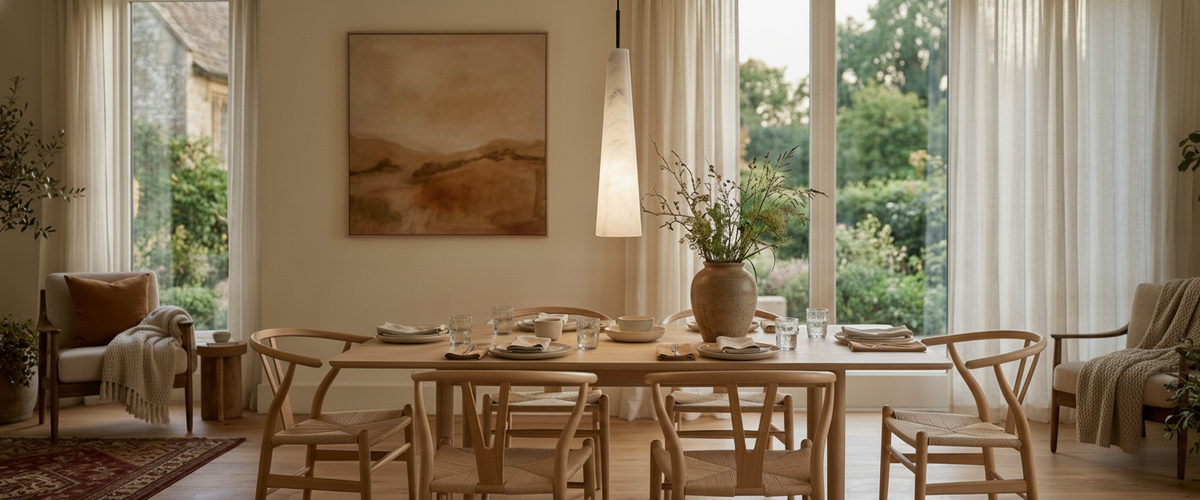

A clean alabaster light shade sounds like the easy option. No ornament to hide behind, no carving to distract the eye. That is exactly why it is the hardest thing to get right. When there is nothing decorative to look at, every edge, seam and vein is on full show, and the quality of the stone has to carry the whole piece. Get it wrong and a clean alabaster light shade reads as sterile or, worse, cheap. Get it right and it becomes the quietest confident thing in the room.
We have shipped enough restrained pieces to design clients across the UK to know where the line sits, and it is not where most buyers expect.
A well-cut shade reveals quiet movement across the surface when lit.

Key Takeaways
"Clean" should mean well-cut and honest, not featureless. Flat white stone with no figure often looks synthetic.
Edges and seams tell you more about quality than the front face. Check them first.
A clean alabaster light shade needs a warmer bulb, roughly 2400K to 2700K, or it can look clinical.
Calm, mid-tone walls flatter a minimal shade. Busy patterned walls swallow it.
To care for one of these shades, use a dry soft cloth and avoid water and sprays.

What "Clean" Really Means in an Alabaster Shade
The word gets used two ways, and they are worth separating. One meaning is visual: a shade with simple geometry, no fussy detail, a calm surface. The other is literal: a piece free of dust, fingerprints and grime. Buyers usually search for the first and end up worrying about the second. Both matter, and we will cover both.
On the visual side, a genuinely clean alabaster light shade is restrained by design, not empty. There is a difference. Restraint means the maker trusted the stone and the proportions to do the work. Empty means the stone had nothing to say and the form does not rescue it. When you look at a good clean alabaster light shade, your eye should settle and stay. When you look at a weak one, it slides off.
Alabaster is a soft, translucent stone that has been carved for light and sculpture for centuries; the Victoria and Albert Museum holds carved pieces that show how long makers have relied on its glow. That translucency is the entire point of the material. A minimal design lets it read clearly, without competing detail.
The Line Between Minimal and Cheap
This is where money shows itself. On an ornate fixture, a rough seam hides in the pattern. On a clean alabaster light shade there is nowhere to hide, so the cut has to be honest.
Start with the edges. Run your eye, and if you can, your finger, along the rim of the shade. A quality piece has an even, slightly softened edge with consistent thickness all the way round. A cheaper one thins out unevenly, chips at the corners, or shows tool chatter where the stone was rushed. Thickness matters for another reason too: too thin and the light blows out to a harsh white, too thick and the glow goes muddy. A well-judged piece sits in between and lights evenly. A rectangular form such as the Bianco Alabaster Table Lamp makes the point clearly, because its flat faces leave the edge and thickness entirely exposed.
Then look at the seams. Larger shades are often built from more than one piece of stone, and on a plain design the join line is fully visible. The best work matches the veining across the seam so the eye reads it as continuous. Lazy work slaps two mismatched pieces together and hopes you will not notice. You will.
Because pricing on natural stone depends on the block, the cut, the engineering and the finishing, there is no single figure that tells you whether a shade is good. Judge the piece in front of you and ask for a tailored quote rather than assuming a low number means a bargain. You can compare cuts and forms across our alabaster lighting range to train your eye before you commit.
Why a Plain Shade Needs a Warmer Bulb
An unadorned shade is unforgiving about light temperature. With no carving to break up the surface, a cool or neutral bulb turns the stone flat and clinical, the way a hospital corridor feels. The warmth is what stops a clean alabaster light shade from looking sterile.
A warm bulb around 2400K to 2700K brings out the honey and cream tones in the stone.
We steer buyers toward a colour temperature of roughly 2400K to 2700K for plain shades. That warm range brings out the honey and cream tones in the stone and makes the translucency feel alive rather than backlit. The Chartered Institution of Building Services Engineers publishes guidance on lighting quality that is worth a read if you want to understand why colour temperature changes the mood of a space so sharply.
A few practical notes. Choose a bulb with a high colour rendering index, ideally CRI 90 or above, so the stone's natural colour reads true. Put the fixture on a dimmer where you can; a clean alabaster light shade at full brightness in a small room can feel like a floodlight, while the same shade dimmed to a low glow becomes the reason people relax in the room. Always ask a qualified electrician to handle any hardwired installation or dimmer wiring.
Backdrops That Flatter a Plain Shade
A restrained piece needs a backdrop that lets it breathe. The classic mistake is hanging a quiet shade against a loud wall and wondering why it disappeared.
Calm, mid-tone walls flatter a minimal design best. Warm plaster, soft greige, muted olive, a deep matte green: these give the pale stone something to sit against so its glow reads clearly. Textured but low-contrast surfaces, like limewash or a fine linen wallpaper, also work because they echo the stone's soft quality without shouting.
Busy walls swallow a clean alabaster light shade whole. Bold patterned paper, high-gloss surfaces, or a gallery wall packed with frames all pull the eye away, and the piece becomes just another object in a crowded field. If your walls are doing a lot of work already, that is the moment to consider a shade with more sculptural presence rather than a clean one. Match the shade to the room, not the other way round.
Reading Veining on a Clean Shade
Here is the counterintuitive part. A clean alabaster light shade should not be dead white. The most beautiful plain pieces carry subtle figure: faint veining, a drift of warmer tone, a soft cloud where the stone thins. When lit, that figure comes forward and gives the surface depth. It is the reason a real alabaster shade never looks like moulded plastic.
Dead white, perfectly uniform stone is usually a warning sign. Either it has been over-processed, or it is not natural alabaster at all. Faux shades, often resin or acrylic, tend toward that flat uniformity because there is no genuine crystalline structure catching the light. That said, a well-made faux piece such as the Brecken 2 Light Pendant shows how the look can be carried in high-traffic or budget-sensitive projects, even if it will not give you the living glow of a real clean alabaster light shade.
When you are assessing a plain shade, ask to see it lit. Unlit, all alabaster looks similar. Lit, the good pieces reveal quiet movement across the surface and the weak ones show their flatness. If a supplier will only show you an unlit product photo, treat that as a question worth pressing.
Where a Restrained Shade Belongs, and Where It Undersells the Room
A clean alabaster light shade earns its keep in spaces that already have architecture or where you want the light to recede. A bedside table lamp is a natural home; the plain form keeps the room restful and the warm glow suits winding down, which the Sleep Foundation notes is helped by lower, warmer light in the evening. A minimal wall light along a hallway, a simple pendant over a kitchen island, a pair of understated table lamps flanking a sofa: these are all cases where a quiet piece is exactly right.
It undersells the room when the space is calling for a centrepiece. A double-height entrance hall, a formal dining room, a hotel lobby: these want presence. Hang a small plain pendant in a grand void and the room reads unfinished. That is when a sculptural chandelier or a larger, more shaped fixture makes sense. Browse the wider lighting collection if you are weighing a statement piece against a restrained one.
How to Keep an Alabaster Shade Clean
The literal meaning of clean matters just as much, because alabaster is porous and soft. It does not behave like glass. Treat it the way you would a fine stone surface, not a window.
Dust regularly with a dry, soft cloth. A microfibre or lint-free cloth lifts dust without scratching. This is the single most important habit; dust is what dulls the glow.
Keep water and sprays away. Alabaster is water-sensitive and can mark or cloud if it gets wet. Never use household cleaning sprays, glass cleaner or damp wipes.
For fingerprints, use a barely damp cloth and dry immediately. If you must, use a cloth wrung out until almost dry, wipe gently, then dry the spot at once. Do not soak it.
Skip solvents and abrasives. No alcohol, no acetone, no scouring pads. They strip any sealant and can etch the surface.
Let bulbs cool before handling. Fit LED bulbs, which run cool, and always switch off and let the fixture cool before dusting near it.
The Natural Stone Institute offers general guidance on caring for soft, porous stone that reinforces the same principle: dry cleaning first, minimal moisture, no harsh chemicals. Handled this way, a clean alabaster light shade will keep its glow for decades.
The takeaway is simple. A clean alabaster light shade is a commitment to the quality of the stone, because the stone has nowhere to hide. Choose one with an honest cut, subtle figure and a warm bulb, place it against a calm backdrop, and dust it with a dry cloth. Do that and the piece will look considered rather than plain, which is the whole point.