
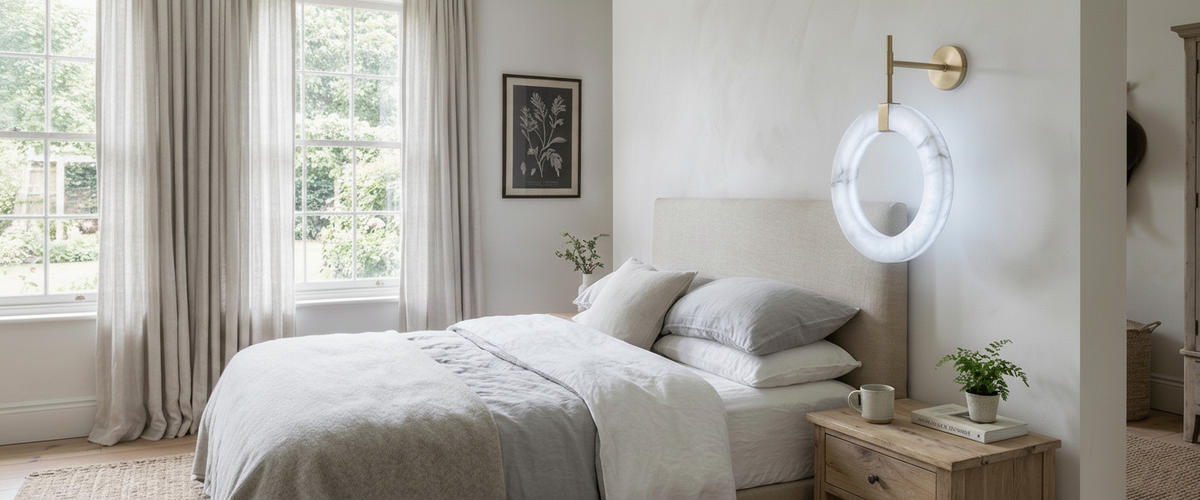

A bedside table loses about half its surface the moment a lamp lands on it. Add a book, a glass of water, a phone on charge, and reading glasses, and you are shuffling things around in the dark just to set the alarm. That is the case for wall mounted bedside lighting: they lift the light source off the surface, put the glow where you actually read, and leave the nightstand for the things that belong there.
Done well, a pair of bedside mounted wall lights does more than tidy up. It changes how the room reads at night, especially when the shade is carved alabaster or another natural stone that softens the beam before it reaches a sleeping face. That is why wall mounted bedside lights keep showing up in bedrooms where every inch counts.

Key Takeaways
Height: aim for the bulb or shade centre roughly 24 to 30 inches (60 to 76 cm) above the mattress top, adjusted to how you sit up.
Reach: the switch should fall under a relaxed hand while you are lying down, not stretched across the bed.
Beam target: light should land on the page, not in your eyes or your partner's.
Wiring: hardwired looks cleanest; plug-in is faster and reversible for renters.
Shade: alabaster and stone diffuse a close beam beautifully, so the light feels calm rather than clinical.

What Mounting to the Wall Actually Clears
The obvious win with wall mounted bedside lights is space. A slim wall light frees the whole top of the nightstand, which matters most in smaller bedrooms and city flats where the table is barely wider than a paperback. The less obvious win is cable clutter. A table lamp trails a lead down to a socket; a well-planned fixture hides its supply inside the wall or runs a single discreet drop.
There is a design benefit too. Bedside lights wall mounted at a matched height create a clean, symmetrical frame around the bed, which reads as considered rather than assembled from whatever was to hand. If you are pairing your wall mounted bedside lights with a stone pendant or a low-glow ceiling fixture, browse the wider lighting range to keep the finishes talking to each other.
Reading Height and Reach: Where the Beam Should Land
The single most common complaint we hear about wall mounted bedside lights is glare. It almost always comes down to height. Mount the fixture too high and the beam skims across your eyeline; too low and it pools uselessly on the duvet. As a working rule, set the centre of the light source around 24 to 30 inches (60 to 76 cm) above the top of the mattress, measured with the bed made. Sit up against your headboard and check that the brightest part of the beam falls where an open book would sit, roughly across your chest and lap.
Reach is the other half of the equation. You want the switch or pull to fall under a relaxed hand, close to the front edge of the nightstand, so you can turn it off without leaning across the bed or waking a partner. If two people read at different times, independent switching on each side is worth insisting on.
A quick placement checklist
Measure from the finished mattress height, not the floor.
Position the fixture slightly forward of the headboard so light clears any tall pillows.
Keep the pair symmetrical: same height, same distance from the bed centre.
Test the switch reach while actually lying down, not standing beside the bed.
Leave clearance so the shade or arm does not clip the headboard when the bed shifts.
Swing-Arm Versus Fixed: Which Earns Its Place
A swing-arm light pulls the beam out over the bed and lets you angle it onto a page, then push it back flat against the wall when you are done. For a dedicated reader, that adjustability is hard to beat. It also forgives an imperfect mounting position, because you can fine-tune reach after the fact.
A fixed wall light is simpler, cleaner, and usually the stronger choice when the fixture is decorative in its own right. This is where alabaster and stone shine. A carved alabaster fitting throws a soft downward and ambient glow that is more about atmosphere than task reading, so a fixed mount that sits close to the wall makes sense. Where the aim is a compact, low-glare presence beside the pillow rather than a wide feature, a piece such as the Look LED Square Wall Light 30cm 3000K in black sits flush and quiet against the wall. If your bedtime routine is scrolling and winding down rather than reading a hardback, fixed is often the better pick. Match the choice to the habit, not the trend.
Plug-In or Hardwired: The Trade-Off Nobody Flags
Hardwired fixtures give you the cleanest result. No visible cable, no socket dependency, and switching that can be wired into the wall or the bedside itself. The catch is that hardwiring means opening the wall, running a supply, and work that should be carried out by a qualified electrician in line with current wiring regulations. Guidance from Electrical Safety First is worth reading before you commit to any fixed installation.
Plug-in wall mounted bedside lights are the pragmatic answer for renters and anyone who does not want to disturb plaster. You mount the fixture, run a cord to the nearest socket, and add an inline switch. The compromise is a visible cable, though a discreet cable channel painted to match the wall keeps it tidy. Plan the socket position before you drill; the most elegant plug-in job is the one where the cord drops straight into a socket hidden behind the nightstand.
How to install bedside wall lights, in short
Confirm your final height and reach by mocking up the position with painter's tape.
Check the wall behind for pipes and cables before drilling.
For hardwired fixtures, arrange a qualified electrician to run the supply and fit switching.
For plug-in, mount the bracket into a solid fixing or the correct wall plug for your wall type.
Fit the shade last, and test the beam angle while lying down before finalising.
Stone and Alabaster Shades That Soften a Close Beam
Light behaves differently a few inches from your face than it does across a room. Any harshness is amplified, which is why the shade material matters more for wall mounted bedside lights than almost anywhere else in the home. Alabaster is a natural gypsum stone with a fine translucency; light passes through it and comes out warm, diffuse, and slightly golden, with the mineral veining catching a faint glow. The result is a beam that reads as calm rather than sharp, even a foot from a pillow.
Niori is an alabaster and natural-stone lighting brand, and this is exactly the setting we designed those materials for. A stone shade takes the edge off an LED that would otherwise feel clinical up close, and because each piece of alabaster is cut from a unique block, no two shades scatter light in quite the same way. Where the wall behind the bed can carry a larger presence and you want the glow to double as a feature, a rounded form such as the Essence Round Wall Light 75cm in brass reads more as sculpture than task light. You can see the fuller range of carved shades across our alabaster lighting collection. One client renovating a coastal bedroom had given up on table lamps entirely; the brief was simple, a soft wash they could read by without lighting the whole room, and their alabaster bedside lights did the softening for us.
Marble and onyx work on the same principle with more drama; onyx in particular carries bold banding that becomes visible only when lit. For a bedside application, though, subtlety usually wins. You are lighting a face and a page, not staging a feature wall.
Wiring the Pair to Match, and Switching You Can Reach Half-Asleep
Two lights framing a bed should behave as a set. That means the same bulb, the same colour temperature, and ideally the same dimming behaviour on both sides. For the bedroom, a warm colour temperature around 2700K suits winding down; the cooler daylight tones useful in a kitchen feel wrong against a pillow. If you plan to dim, confirm the bulb and any driver are genuinely dimmable and pair them with a compatible dimmer, because a mismatch is the usual cause of flicker and buzz.
On switching, independent control on each side is the detail people notice every night with wall mounted bedside lights. A discreet rocker or pull within reach beats a wall switch by the door for a bedside fixture, since the whole point is to turn it off without getting up. If you are wiring for a couple, ask the electrician to split the two sides so one reader can stay lit while the other sleeps.
Making the Buying Decision
Work through it in order. First, decide reading habit versus ambience, which settles swing-arm against fixed. Second, decide hardwired against plug-in based on whether you own the wall and can involve an electrician. Third, choose the shade material for the light quality you want close to your face, where alabaster and natural stone genuinely earn their place. Fourth, lock in colour temperature and dimming so the pair of wall mounted bedside lights behaves as one.
Budget depends on material, scale, whether the piece is swing-arm or fixed, and the engineering and finishing behind it, so the honest answer is to request a tailored quote rather than assume a figure. Get the height, the reach, and the shade right, and wall hung bedside lights stop being a compromise and become the part of the bedroom you reach for without thinking.