
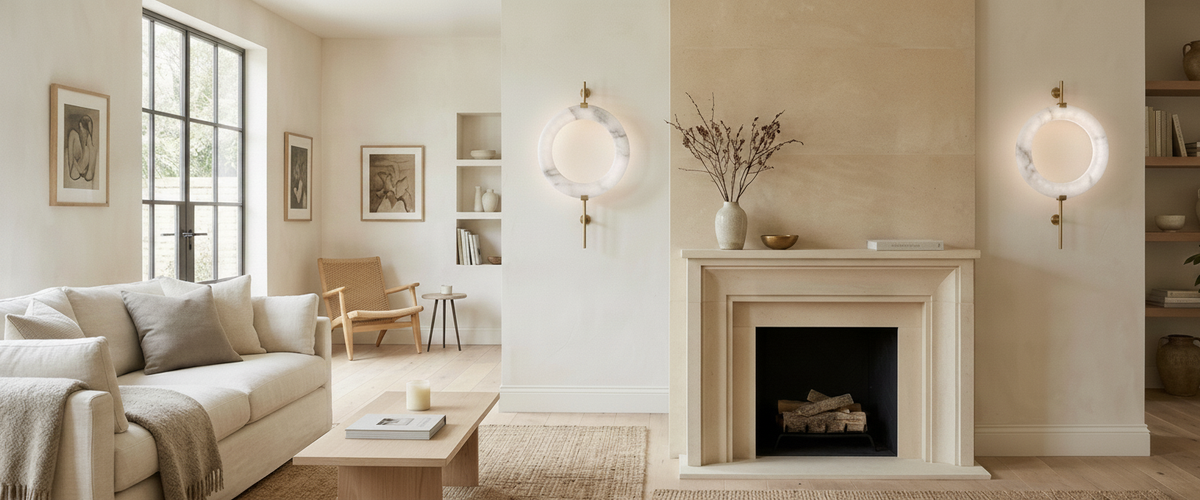

Wall lights in the living room put illumination exactly where the eye wants it, at the level of the art and the sofa, without a single lead trailing across the rug. Table lamps eat surface. Floor lamps eat floor. The moment you tally up how much space gets quietly surrendered to lighting you have to walk around, wall lights living room schemes start to make sense. Done in alabaster, wall lights living room pieces also do something a downlight never will: they glow rather than glare.
At Niori we work almost entirely in alabaster and natural stone, so this guide to wall lights living room planning is written from that bias. The stone is not decoration bolted onto a lamp; it is the diffuser. That changes how you place your wall lights living room schemes, and it is why the material earns its keep.

Key Takeaways
Mount most wall lights in the living room so the fixture centre sits roughly 60 to 66 inches (152 to 168 cm) from the floor, adjusting for seated sightlines.
Alabaster and onyx diffuse light through the material itself, so the glow is soft even close to the eye.
Flank a fireplace or artwork symmetrically and keep the light low in output but warm in color.
Put every wall lights living room fixture on a dimmer; the evening brightness you want is far lower than daytime.
Cutting a new sconce into a finished wall is electrician's work, not a weekend job.

The Case for Sconces: Reclaiming Space You Didn't Know You'd Lost
Walk into a typical room and count the lamps. A pair on the console, one on the side table, a floor lamp behind the reading chair. Each one occupies a footprint and needs a socket within reach. Living room wall lights lift that whole job up onto vertical surfaces you were not using anyway, which frees the console for objects and the side table for a drink.
There is a second, quieter benefit. Light at wall height fills the middle of the room rather than the ceiling or the floor, and that middle band is where you actually look. Good wall lights in the living room beside the sofa light a book without a lamp base competing for the armrest. Alabaster does the diffusing, so you get a broad, forgiving pool instead of a hard hotspot. You can browse the full range of stone fixtures across our alabaster lighting collection to see how the material behaves at different scales.
Mounting Height and Spacing That Flatter a Sofa
The single most common mistake we see in photographs customers send us is a wall light hung too high. It ends up lighting the ceiling and leaving the seating in shadow. For most living room wall lights, aim to have the centre of the fixture around 60 to 66 inches (152 to 168 cm) above the floor. That keeps the brightest part of the light near eye level for someone standing, and above the glare line for someone seated. This wall light height suits most seating plans.
Two exceptions matter. If a wall light in the living room flanks a sofa where people lean back to read, drop it a little so the light falls onto the page rather than the top of the head. If it flanks a tall chimney breast or a large canvas, you can lift it to keep proportion with the wall, then rely on a dimmer to soften the higher output.
For spacing across a long wall, keep pairs of wall lights living room symmetrical around whatever they frame and leave enough gap that the pools of light overlap gently rather than merging into one flat wash. On a standard 8 to 10 foot (2.4 to 3 m) wall stretch, two wall lights in the living room roughly 6 to 7 feet (1.8 to 2.1 m) apart usually reads as considered rather than crowded. When you plan wall lights living room layouts beside a sofa and want a neat, proportionate pair rather than a single statement, a compact fixture such as the Essence Square Wall Light 75cm, Brass sits comfortably without crowding the seating.
Uplight, Downlight, or Diffuse Stone: Matching the Throw to the Wall
How a fixture throws its beam decides the whole mood, and it is the detail buyers skip most often when choosing wall lights living room styles.
Uplight wall lights wash the wall and ceiling above them. They make a room feel taller and calmer, and they hide a multitude of sins on an uneven wall by grazing it with soft light. Good for period rooms with cornicing you want to show off.
Downlight sconces throw a cone toward the floor. They are more directional, better for a reading spot or for grazing a textured stone wall to bring out its relief. They also risk a harsh scallop on a plain painted wall, so pair them with warm output.
Diffuse alabaster is the middle path, and the one we lean on for wall lights living room schemes. A carved alabaster disc or panel lights up as a whole, so the source is the glowing stone rather than a bright bulb behind it. That means far less glare when the fixture sits at eye level, which is exactly where wall lights in the living room live. Where a plain wall needs an even, glare-free glow rather than a hard scallop, a round diffusing piece such as the Essence Round Wall Light 115cm, Brass lights up as a whole surface, so the stone becomes the source rather than a shade hiding a lamp.
Flanking a Fireplace or Artwork Without Flattening It
A fireplace is the natural anchor for a pair of wall lights living room fixtures, and it is where symmetry pays off. When you are flanking a fireplace, match the height of both fixtures to the mantel or to a line just above it, and keep them equidistant from the centre. The goal is a balanced frame, not a spotlight on the hearth.
Artwork is trickier. A fixture that is too bright, or aimed straight at a canvas, will flatten the paint and wash out the depth an artist worked hard to build. Galleries light works at low, controlled levels for good reason; the National Gallery keeps sensitive works under carefully limited light to protect them and preserve how they read. In a home, the practical lesson is restraint: use warm, dimmed wall lights in the living room to the side of a picture rather than a bright beam across it, and let the light frame the piece instead of interrogating it.
When customers ask how many ceiling lights a feature wall needs, the honest answer is usually fewer than they think. If a stone wall or a run of art is the focus, two well-placed wall lights in the living room plus one or two carefully aimed ceiling fittings will do more than a grid of downlights that flattens everything into a uniform glow.
Warm Bulbs and Dimming for the Evening the Room Is Actually Used
Living rooms earn their keep after dark, so specify your wall lights living room scheme for the evening, not the showroom. Choose bulbs around 2700K, or a touch lower at 2400K if you want the amber warmth that suits stone. Cooler light makes alabaster look gray and clinical, which defeats the point of buying stone in the first place.
Put every wall light in the living room on a dimmer. The brightness that feels right at 7pm with the curtains open is roughly double what you want at 10pm with a film on. Warm dimming keeps the tone amber as you drop the level. Use a compatible LED and a trailing-edge dimmer for smooth, flicker-free control; the Lighting Industry Association publishes helpful guidance on matching dimmers to LED loads. Get this pairing wrong and even the best wall lights living room buyers can find will buzz or step through their range like a staircase.
Color rendering matters with natural materials too. Look for a CRI of 90 or above so the veining in alabaster and the warmth of a brass detail read true rather than muddy. This is easy to overlook when you fixate on the shape of your wall lights in the living room and forget the bulb inside.
Quick Buyer's Checklist
Fixture centre around 60 to 66 inches (152 to 168 cm) unless flanking tall art or a chimney breast.
Symmetrical pairs of living room wall lights around a fireplace or picture; overlap the light pools gently.
Match throw to the wall: uplight to calm, downlight to graze, diffuse stone for eye-level comfort.
2700K or warmer, CRI 90+, on a trailing-edge dimmer.
Confirm the mounting surface and back box before you fall for a fixture.
How to Decorate a Living Room With Light Grey Walls
Light gray walls are one of the friendliest backdrops for stone lighting. Gray has no strong color cast to fight, so the warm glow of alabaster reads clean against it. Lean into the contrast: warm wall lights in the living room on a cool gray wall make the room feel layered rather than flat. A pair of alabaster living room wall lights adds that warmth without shouting. Add a brass detail on the fixture to bridge the two temperatures, and keep textiles in the same warm-neutral family so the light has something to bounce off. Avoid pairing cool gray walls with cool white bulbs; the room tips toward the look of a dentist's waiting room.
Wiring a New Sconce Into a Finished Wall
Adding a light to a room that already has plaster, paint, and no cable in the wall is where costs and complications live. You are chasing a channel for the cable, fitting a back box, making good the plaster, and then repainting. On a solid masonry wall that is genuine work; on a stud wall you at least have voids to run through, but you still need to find the studs and route safely. This is the fiddly side of wiring a sconce that catalog photos never show. Plan it before you commit to any wall lights living room layout.
This is electrician's territory. Adding a new circuit or a new point in certain rooms falls under Part P of the Building Regulations, and a qualified electrician will certify the work and test it. Guidance from Electrical Safety First is a sensible starting point before you touch a wall. The fee an electrician charges buys you a fitting that will not work loose, a cable that will not overheat, and paperwork you will want if you ever sell the house.
One practical tip from the studio: decide your final furniture layout before the cable goes in, because getting your wall lights living room placement right depends on where people actually sit. We have shipped beautiful pairs of living room wall lights to clients who then moved the sofa a foot to the left and found the reading light now sits behind someone's shoulder. Mark the wall, sit on the actual sofa, hold a torch at the proposed height, and only then commit to your wall lights in the living room.
Choosing the Right Stone Wall Light
Start with the job the light has to do, then pick the form. A large disc reads as a soft moon and suits a big blank wall or a chimney breast; a smaller square sits neatly in a pair beside a sofa. Round shapes feel quieter and more architectural; square edges hold their own against panelling and strong horizontal lines. Brass detailing warms the piece and ties it to hardware elsewhere in the room, which is why so many living room wall lights read best with a warm metal accent. A well-chosen stone wall light carries the room on its own, and it is the piece most buyers of wall lights in the living room remember first.
If you are weighing wall lights living room options against a broader scheme, it helps to see them alongside pendants and floor pieces in the same material family. Our full lighting collection shows how alabaster behaves across fixture types, which makes it easier to keep a room coherent rather than assembling odd pieces one at a time.
Budget for living room wall lights depends on material, scale, complexity, engineering, and finishing rather than any single headline figure, so the sensible route is to request a tailored quote once you know the size and quantity of wall lights living room pieces you need.