
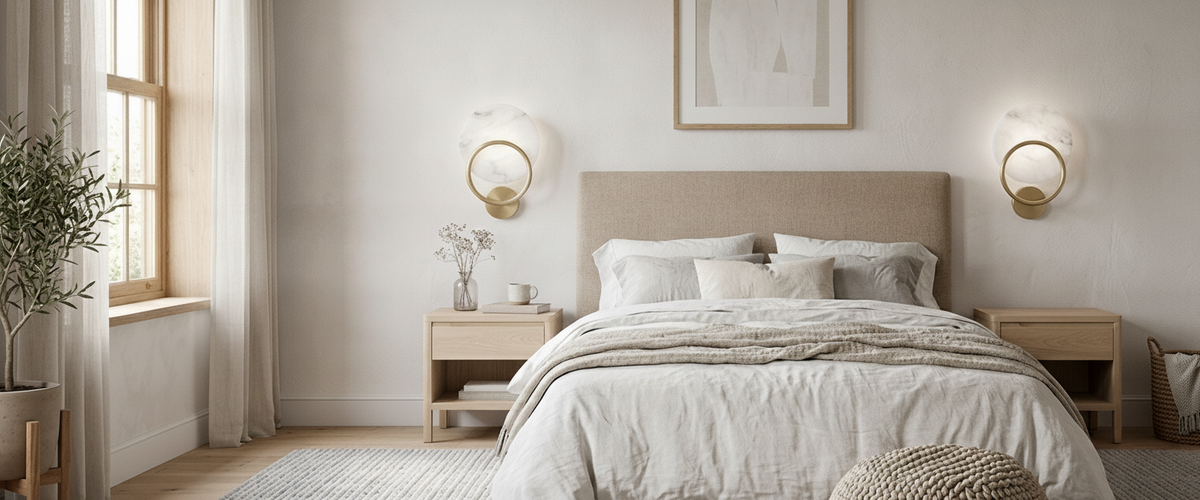

To place a bedroom wall light well, center the wall light fixture roughly 30 to 36 inches above the mattress and mount it so light falls over your outer shoulder onto the page, not behind your head. A badly placed sconce is the fixture you notice every single night. It glares when you sit up, it hides behind your shoulder when you lie down, and it drops shadow onto exactly the part of the page you're trying to read. Getting a wall light fixture bedroom setup right is less about the piece itself and more about where it sits relative to your head, your pillow, and the switch you reach for half asleep. The rules are simple once someone tells you them.
At Niori we make alabaster and natural-stone lighting, and bedrooms are where our wall lights earn their keep. Stone diffuses light instead of firing it in a hard beam, so a well-placed wall light fixture in the bedroom reads as a soft pool rather than a spotlight. That forgiving quality only helps, though, if the fixture is at the right height and on the right side.
A symmetrical pair of bedroom wall light fixtures either side of the headboard is the classic arrangement.

Quick Answer: Bedroom Wall Light Placement at a Glance
Before the detail, here is how a wall light fixture bedroom layout should behave at a glance:
Height: center the fixture roughly 30 to 36 inches (76 to 91 cm) above the mattress top, adjusted for how you sit up to read.
Position: mount so light falls over your outer shoulder onto the page, not behind your head.
Pairs: match the height and horizontal distance from the headboard center on both sides.
Switching: put a switch within arm's reach of the pillow, ideally at the fixture or on a bedside plate.
Bulbs: warm white, around 2700K, on a dimmer for reading and winding down.

Flanking the Headboard: Getting the Pair Symmetrical and Level
A matched pair of wall lights either side of the bed is the classic move, and it lives or dies on symmetry. Measure from the center line of the headboard, not from the nearest wall or a wardrobe, because rooms are rarely square and eyeballing it will leave the pair looking crooked. Most people set each bedroom wall light fixture 24 to 30 inches (61 to 76 cm) out from the center, which puts the light just past the pillow edge.
Get the two heights identical. The eye is unforgiving about a horizontal pair that isn't level, far more than it is about the exact height off the floor. Mark both mounting points, then run a spirit level or a laser line between them before you drill anything. If your bedside tables differ in height, resist the urge to correct by raising one wall light fixture in the bedroom; keep the lights level and let the tables be the odd ones out.
An alabaster wall light fixture in the bedroom rewards this care because the glow is symmetrical too. When both stone shades are lit at the same height, the veining catches the light in a mirrored way across the bed, and the whole wall settles. Where a room can carry a generous silhouette, a pair such as the Essence Round Wall Light 115cm, Brass reads as a mirrored gesture across the bed, while a smaller headboard tends to suit the 75cm version without crowding the pillows. You can also compare the full range of shapes in our alabaster lighting collection.
Mounting Height That Works Sitting Up and Lying Down
The most common question we get from clients is how high to fit a bedroom wall light fixture, and the honest answer is that it depends on your body. Light needs to clear the top of your head when you're propped against the headboard reading, then still spill downward onto a book held at chest height. As a starting point, the center of the light source wants to sit around 30 to 36 inches (76 to 91 cm) above the mattress surface.
Sit up in bed with a book before you commit. Have someone hold a lamp or a phone torch at the proposed height and check two things: does the light clear your head, and does it land on the page rather than on your lap? Taller people and tall upholstered headboards push the number up; low platform beds pull it down. A bedroom wall light fixture that throws light downward, like many of our stone sconces, can sit a touch lower because the useful light comes out of the bottom of the shade.
Test the height of your wall light fixture in the bedroom with a book in hand before you drill, checking the light clears your head and lands on the page.
One studio lesson worth passing on: we shipped a pair to a couple with a very deep buttoned headboard, and the first mock-up put the lights too low, so the padding swallowed half the glow. We moved them up by four inches (about 10 cm) and the reading pool doubled. Deep headboards eat light. Account for them when you set a wall light fixture in the bedroom.
One Wall Light or Two: What a Single Sconce Does to a Shared Bed
A single wall light fixture in the bedroom over a double bed is a design choice, not a compromise, but you need to know what it does. One sconce lights one side well and leaves the other in relative shadow, which is fine for a guest room or a single sleeper but frustrating for two readers. If you share the bed and both read, fit a pair of bedroom wall light fixtures. If the room is small and you want one clean gesture, place the single light centered above the headboard and treat it as ambient rather than task lighting.
For a shared bed, independent switching matters more than the fixture count. Two lights on one switch means one person's reading keeps the other awake. Wire each side separately, or choose a wall light fixture for the bedroom with an integrated switch on the body so each partner controls their own pool of light.
Lighting a Dressing Corner or Mirror Instead of the Bed
Not every bedroom wall light fixture belongs by the pillow. A dressing corner, a full-length mirror, or a reading chair all take a sconce beautifully, and the placement rules change. For a mirror you want the light beside it or above it at eye level so it lights your face evenly rather than casting shadow down from overhead. Flanking a mirror with a matched pair, mounted around 60 to 66 inches (152 to 168 cm) from the floor, gives the flattering cross-light that a single overhead point never manages.
Alabaster is a strong choice here because stone light is close to the soft, even quality you want on skin. A hard directional bulb exaggerates every line and shadow; a diffused stone shade wraps the face. Where you want a crisper, more contemporary line against a mirror, a compact wall light fixture like the Look LED Square Wall Light 30cm 3000K, Black gives a defined edge and a fixed warm output that suits a dressing corner. If you're lighting a dressing table rather than the bed, keep the color temperature warm and steady and skip anything that flickers or shifts.
Switch Placement So You're Not Crossing the Room in the Dark
Reaching for a light switch by the door when you're already in bed is the design failure nobody photographs. Plan switching before the wiring goes in. The best setups give you a two-way switch so the main light works from both the door and the bedside, plus independent control of each wall light fixture in the bedroom within arm's reach of the pillow.
Three practical options work well. An integrated rocker or pull-cord switch on the fixture body keeps everything at the source. A wall plate beside the headboard groups the controls neatly. A smart bulb or switch lets you dim and turn off from a bedside phone or a small remote, which suits renters who can't rewire. Whichever you choose, test it in the dark with your eyes half shut, because that's the condition you'll actually use it in.
The Placement Mistakes That Leave Shadows Where You Read
Most reading-light complaints come down to the same handful of errors. Work through this list before you fit a bedroom wall light fixture:
Too far behind the head: if the fixture sits behind your shoulder, your own body blocks the page. Bring it forward, toward the pillow edge.
Too high: a light set at picture-rail height washes the wall and leaves the book dim. Lower it into the reading zone.
Mismatched pair: uneven heights across the bed read as sloppy even when everything else is considered.
Wrong beam direction: an uplight looks handsome but does nothing for reading. Choose a downward or diffused throw for task use.
No dimmer: full brightness for winding down is jarring. A dimmed warm bulb helps the body settle, and evening light that stays warm and low supports natural sleep rhythms, something sleep researchers have consistently linked to better rest.
Cool bulbs: anything above 3000K feels clinical at night. Stick to warm white around 2700K.
Bulbs, Dimming, and Getting the Wiring Done Safely
Stone loves a warm bulb. For a bedroom wall light fixture, choose LED lamps around 2700K with a high color-rendering index (CRI 90 or above) so the veining in alabaster or onyx reads true rather than washed out. Confirm the bulb and any driver are dimmable, and match them to a compatible dimmer; a mismatch is what causes flicker and buzz at low levels.
Installing a wall light fixture in the bedroom almost always means running a wire into a masonry or stud wall, which is work for a qualified electrician. Fixed wiring should meet the current wiring regulations, and getting a professional to make the connection is both safer and, for most homes, a legal expectation for that kind of work. Ask your installer to confirm the switching layout on site before first fix, because moving a cable after plastering is a job nobody enjoys.
If you're weighing sizes, shapes, and finishes across rooms, our full lighting collection shows how alabaster and natural stone behave as pendants, table lamps, and wall lights, which helps when you want the bedroom wall light fixture to speak to the rest of the house. Pricing depends on material, scale, engineering, and finishing, so for a specific piece it's worth requesting a tailored quote rather than guessing.
A Quick Word on Fairy Lights and Seasonal String
Plenty of bedrooms mix a permanent wall light fixture in the bedroom with softer seasonal decoration. To hang fairy lights, string lights, or Christmas lights on a bedroom wall without damaging paint or plaster, use removable adhesive clips or hooks rated for the weight, and run the strand along a picture rail or the headboard edge rather than pinning it. Keep any transformer accessible and unplug string lights overnight. They're a lovely accent, but treat them as decoration layered on top of a proper wall light fixture in the bedroom you can actually read by.