
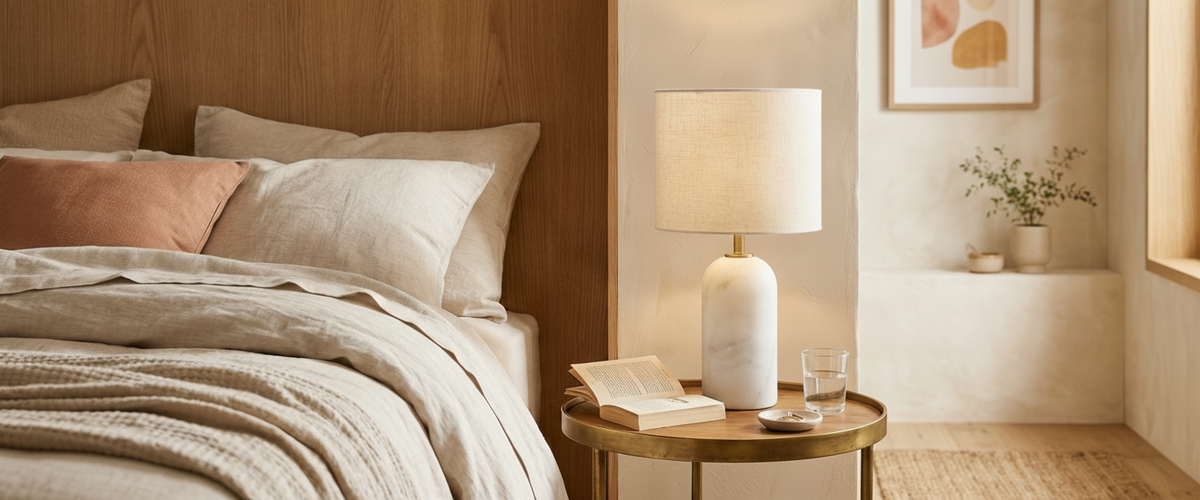

A small bedside table fails the moment you reach for the light at 2am and knock your water across the floor. Tight bedrooms in a London flat or a New York apartment rarely leave room for the generous nightstand the catalogues love to shoot. A small bedside table has to earn every square inch, and the lamp sitting on it has to feel chosen rather than squeezed in. Get the proportions right and the whole corner reads calm; get them wrong and even a beautiful alabaster lamp looks stranded on a ledge.
Niori works in alabaster and natural stone, so we see this problem from the lamp side first. A carved stone base wants a stable, level surface and a bit of breathing room around it. Below is how we talk clients through the fit of a small bedside table, from surface area to mattress height to the shape that survives a narrow gap between the bed and the wall.
A compact bedside table sized for a lamp, a book and a glass of water.

Key Takeaways for a Small Bedside Table
Allow at least a foot square (roughly 30cm) of clear top for a lamp, a book and a glass, plus a little breathing space.
Set the tabletop close to your mattress height so the lamp switch falls to hand and the light lands where you read.
Round tops soften a tight gap and remove sharp corners; square tops give more usable surface in the same footprint.
A drawer or lower shelf hides charging cables and clutter that a bare table cannot.
Lamp and table should share proportion; a chunky stone base needs a small bedside table with visual weight to match.

How Much Surface a Lamp, a Book and a Glass Really Need
People underestimate how quickly a bedside surface fills. A table lamp base takes up more room than you expect once you add clearance so a warm shade is not brushing the wall or a stack of paperbacks. Reading glasses, a phone on charge, a small carafe: the pile grows overnight.
As a working minimum, look for a small bedside table with a top of around 12 by 12 inches (roughly 30 by 30cm). That gives a compact lamp its own zone and still leaves space for a mug and a book laid flat. Go smaller than about 10 inches (25cm) across and the lamp starts to dominate, which is fine only if you keep the surface deliberately bare. On a nightstand this tight, a low round base such as the Essence Round Table Lamp, Black claims less depth than a tall statement lamp and leaves the glass of water somewhere safe to sit. When a client tells us they read in bed every night, we push for the larger footprint every time; the reading lamp needs room to sit without crowding the essentials beside it.

Matching Table Height to Mattress Height So the Light Lands Right
Height is the setting most people ignore, and it is the one that changes how the lamp feels in use. Aim to have the tabletop within a couple of inches of the top of your mattress. Level with the mattress, or very slightly above, is the sweet spot. Too low and you are reaching down for the switch and squinting up into the bulb; too high and the table looms over the pillow.
This matters more with tall mattresses. A deep pillow-top or a divan with a thick topper can sit far higher than a standard bed, which quietly strands a low small bedside table. Measure from the floor to the top of your made bed before you buy anything. Then choose a small bedside table that brings the lamp switch to roughly the height of your shoulder when you are lying down. That single measurement does more for comfort than any styling trick.
Round Versus Square Tops in a Tight Bedside Gap
The gap between a bed and a wall, or between twin beds, decides shape as much as taste. A round top removes the corner you would otherwise catch with your hip every morning, and it reads softer in a small room. The trade is usable area: a 14-inch (35cm) circle holds noticeably less than a 14-inch square.
Round tops soften a narrow gap; square tops give more usable surface.
Square and rectangular tops win when you need the surface to work hard. They tuck flush against a wall, sit neatly beside a headboard, and give a flat edge for a book to rest against. Niori's own bedside pairings lean this way for a reason. The Essence lamps come in both a round and a square form, which lets you echo or contrast the table shape on purpose rather than by accident. Against a flat wall where the base can sit square to the edge, the Essence Square Table Lamp, Black uses the corner space a round base would leave empty. A round lamp lost in the middle of a large square top, by contrast, usually just looks marooned.
Drawers, Shelves and the Case for Hiding the Cable Clutter
A bare nightstand looks serene in a photograph and chaotic in real life. Charging cables, an eye mask, a spare charger, medication: it all needs somewhere to go. A single shallow drawer in a small bedside table keeps the top clear and pulls the cable trail out of sight, which flatters any lamp sitting above it.
An open lower shelf is the compromise when a drawer pushes the footprint too wide. It holds books vertically and frees the top surface entirely for the lamp and the essentials. If you are running a lamp cable plus a phone charger, route both down the same back leg and secure them with a small clip so the flex does not swing into view. Have a qualified electrician deal with any fixed wiring or wall outlets; a plug-in bedside lamp itself is simple, but anything behind the wall is not a job to improvise.
Materials That Hold Up to a Lamp Base and a Morning Coffee
A small bedside table lives a rougher life than its looks suggest. Hot mugs, spilled water, the constant scrape of a lamp base being nudged an inch to the left. Sealed stone and solid timber both cope well; a good marble or natural-stone top wipes clean and shrugs off heat, though it wants a proper sealant to resist rings from coffee and wine.
Natural stone is porous by nature, so sealing matters more than people assume. The Getty Conservation Institute has long documented how untreated calcite stones like alabaster mark and stain from everyday liquids, which is exactly why a bedside stone surface needs care. Wipe spills quickly, use a coaster, and avoid harsh cleaners. The same logic applies to the alabaster in your lamp base: a soft dry cloth and the occasional gentle wipe keep the stone reading clean and letting light through. You can see how that translucency behaves across the range on the alabaster lighting collection.
Pairing the Table Proportion to the Lamp So Neither Looks Stranded
This is where most bedside setups go slightly wrong. A delicate lamp on a heavy chunk of table looks like an afterthought; a substantial stone lamp on a spindly small bedside table looks precarious. Match visual weight. A carved alabaster base with real presence wants a table that can hold its own beneath it, ideally one where the lamp occupies no more than about a third of the top's depth.
As a rough proportion rule, the lamp height from table to top of shade should sit somewhere around the height of the table itself, give or take. That keeps the pair feeling like one composition. When two people share a room, the tables can differ in size to suit the space on each side, but keep the lamps in the same family so the light reads even across the bed. A well-chosen small bedside table on each side keeps the balance without matching them exactly. Browse the wider lighting range if you want to test how a single design looks in both a compact and a fuller form.
A Quick Buyer's Checklist
Measure floor to made-mattress height, then aim for a tabletop within two inches of it.
Confirm at least a foot square of clear top on your small bedside table, more if you read in bed nightly.
Choose round for a tight gap and safety from corners; square for maximum usable surface.
Prioritize a drawer or shelf if cables and small items pile up.
Match the lamp's visual weight and height to the table so neither looks stranded.
Seal any stone top and treat an alabaster base gently for the long haul.
Sizing a small bedside table well is quiet work that pays off every single evening. Nail the height, the surface and the shape, then let a warm, diffused alabaster lamp do the rest.