
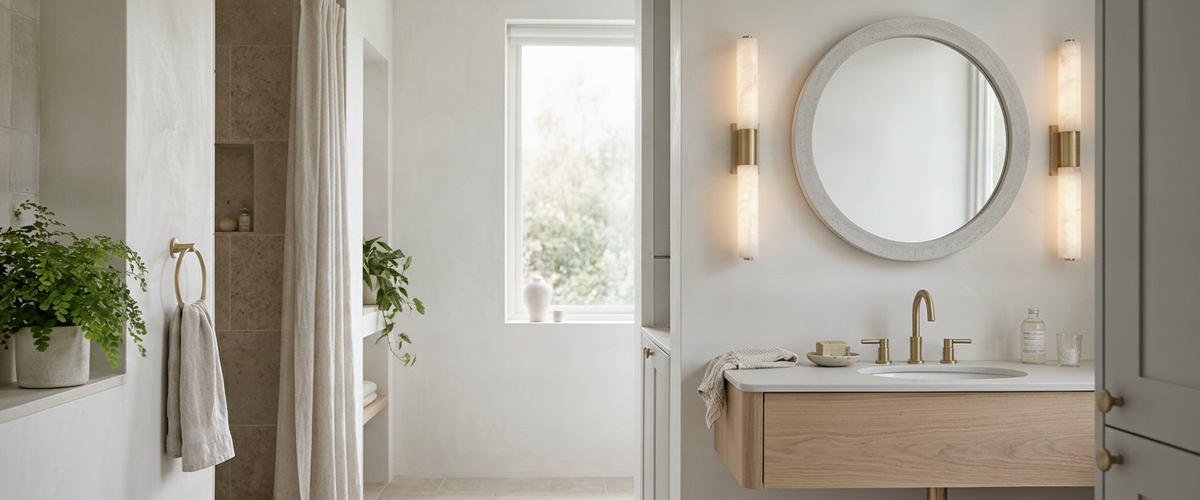

A hard, flat modern wall is exactly where an alabaster contemporary wall light earns its keep. Plaster, microcement and painted plasterboard reflect nothing warm; they hold a room at arm's length. Push light through a slab of translucent stone and the whole surface softens, because the alabaster glows from within rather than throwing a hard beam across the paint. That single quality is why designers keep specifying an alabaster contemporary wall light in otherwise sparse, minimalist interiors.
Get the placement wrong, though, and even a beautifully made fixture looks like an accessory someone screwed on at the end. This guide is about the decisions that separate the two outcomes.

Key Takeaways
A contemporary alabaster sconce leans on clean geometry and quiet veining; transitional versions keep softer curves and more visible metalwork.
Mount the light so the brightest part sits near eye level when seated or standing, not high overhead.
Pairs flanking a bed, mirror or fireplace read as design intent; a single off-centre sconce usually reads as an afterthought.
Match metal finish and stone veining to your palette before you fall in love with a shape.
Budget depends on material, scale and engineering, so request a tailored quote rather than assuming a price band.

Contemporary Versus Transitional Alabaster: The Tell Most Buyers Miss
Both styles use the same material, so the difference is in the drawing, not the stone. A clean-lined alabaster contemporary wall light tends toward a single crisp form: a flat disc, a sharp rectangle, a slim vertical bar. Edges are precise, the metalwork is minimal and often hidden, and the veining is chosen to stay calm rather than dramatic. An alabaster transitional wall light, by contrast, keeps one foot in classic detailing: a softened backplate, a gentle curve to the stone, a little more visible brass. It sits happily in a room that mixes old and new.
The tell most buyers miss is the backplate and the stem. Look at how the fixture meets the wall. If the mount is a slim, near-invisible plate and the stone appears to float, you are looking at an alabaster contemporary wall light. If there is a shaped arm, a decorative canopy or a lantern silhouette, that is transitional. When the geometry needs to stay disciplined against a clean wall, a form like the Essence Round Wall Light 75cm, Brass shows how a single circular disc reads as intention rather than ornament. Neither approach is better; they solve different rooms. Our own alabaster lighting range covers both ends, and the fastest way to choose is to hold the fixture against a photo of your actual wall.
How a Clean-Lined Alabaster Sconce Softens Hard Modern Surfaces
Alabaster is a form of gypsum, prized for centuries because light passes through it. The Victoria and Albert Museum holds carved alabaster pieces that show how craftsmen exploited that translucency long before electric light existed. A modern sconce does the same job with an LED behind it: the stone scatters the light, so instead of a bright point you get a warm, even wash across the wall.
That matters in a minimalist room. Concrete, large-format porcelain, brushed plaster and matte-painted walls all absorb or bounce light in ways that can feel clinical. An alabaster contemporary wall light introduces a gradient. The wall goes from lit to shadow gently, and the veining picks up a faint glow that a glass or metal fixture never delivers. On one warehouse conversion we shipped to, a pair of flat alabaster discs turned a bare gray feature wall from cold to inviting without adding a single soft furnishing.
Mounting Height and Spacing So the Glow Sits at Eye Level
The most common fault we see in photographs is a sconce mounted too high, where it lights the ceiling and leaves faces in shadow. As a working rule, aim for the center of the light around 60 to 66 inches (152 to 168 cm) from the finished floor in a hallway or living space, so the glow reads at standing eye level. Beside a bed, drop it lower, roughly 30 to 36 inches (76 to 91 cm) above the mattress, so it pools light onto a book rather than the headboard.
Spacing follows the same logic. For a pair of alabaster contemporary wall lights flanking a mirror or bed, keep them symmetrical about the center line and around 36 to 40 inches (91 to 102 cm) apart for a standard double. Along a corridor, space repeating sconces evenly and resist the urge to squeeze in one more; three well-spaced lights beat four crowded ones. Where a larger wall can carry more presence, a taller form such as the Essence Round Wall Light 115cm, Brass holds the space better than a compact disc that would look lost. Always confirm the position against furniture and switch heights before the electrician chases the wall, and use a qualified electrician for the wiring itself.
Flanking a Bed, a Mirror or a Fireplace: Where Pairs Read Intentional
Symmetry is the quickest route to a room that looks designed rather than assembled. A matched pair of alabaster contemporary wall lights either side of a bed frames the headboard and doubles as reading light, freeing the bedside table. Around a bathroom or dressing mirror, side-mounted pairs light the face evenly and kill the harsh top shadow you get from a single overhead fixture. Either side of a fireplace, they anchor the chimney breast and give the whole wall a reason to exist after dark.
A single alabaster contemporary wall light can work, but only when it answers something in the room: centered over a console, aligned with the edge of artwork, marking the turn of a stair. Where the architecture is more angular and a rectilinear form suits the geometry better, the Essence Square Wall Light 75cm, Brass gives you the same quiet mounting language in a squared silhouette. Placed randomly on a large blank wall with nothing near it, one sconce looks stranded. If in doubt, buy the pair. You can browse the wider lighting collection to see how matched fixtures repeat a form across a scheme.
Matching Metalwork and Stone Veining to a Minimalist Palette
Two variables decide whether an alabaster contemporary wall light disappears into a palette or fights it: the metal finish and the veining. In a warm minimalist scheme with oak, cream plaster and linen, brass sits naturally against alabaster's honeyed tone. In a cooler gray-and-charcoal room, brushed nickel, blackened steel or graphite reads cleaner and stops the fixture from looking gilded.
Veining is the subtler call. Alabaster is a natural stone, so no two slabs match; the Natural Stone Institute notes that variation is inherent to the material, not a flaw. For a modern alabaster contemporary wall light, choose pieces with fine, quiet veining that glows softly rather than dramatic swirls that pull focus. Save the bolder veining for a transitional room where it can play against other pattern. When you order, ask whether the supplier can favor a calmer or busier slab; a good maker will work with you on this.
The Mistakes That Make a Contemporary Sconce Look Bolted On
Most failures come down to a handful of avoidable errors. Run through this checklist before you commit:
Wrong height. Too high and it lights the ceiling. Anchor the glow near eye level for the way the room is used.
Cool, flat bulbs. Alabaster wants warm light. Aim for around 2700K to 3000K and put the circuit on a dimmer so the stone can glow softly at night.
Mismatched metal. Brass in a cool gray room, or nickel in a warm oak room, jars. Match the finish to your dominant metals.
Single sconce marooned on a big wall. Either pair it or align it to something. Never leave it floating.
Ignoring the switch plan. A beautiful alabaster contemporary wall light controlled only by a distant wall switch is a daily annoyance. Plan two-way switching or a smart control early.
Chasing drama in the stone. Loud veining in a minimalist room reads busy. Keep it quiet and let the light do the work.
Care So the Glow Lasts
Alabaster is softer than marble and slightly porous, so treat it gently. Dust with a dry, soft cloth and avoid water, vinegar or any acidic cleaner, which can etch the surface over time. Keep an alabaster contemporary wall light away from splashing zones in bathrooms unless the fixture is rated for it, and let a warm LED run cool rather than a hot halogen that can dry the stone. Handled kindly, a good alabaster contemporary wall light holds its soft, lit-from-within look for years. If you want to see the full spread of forms and finishes before deciding, start at the Niori homepage and work into the wall lights from there.