
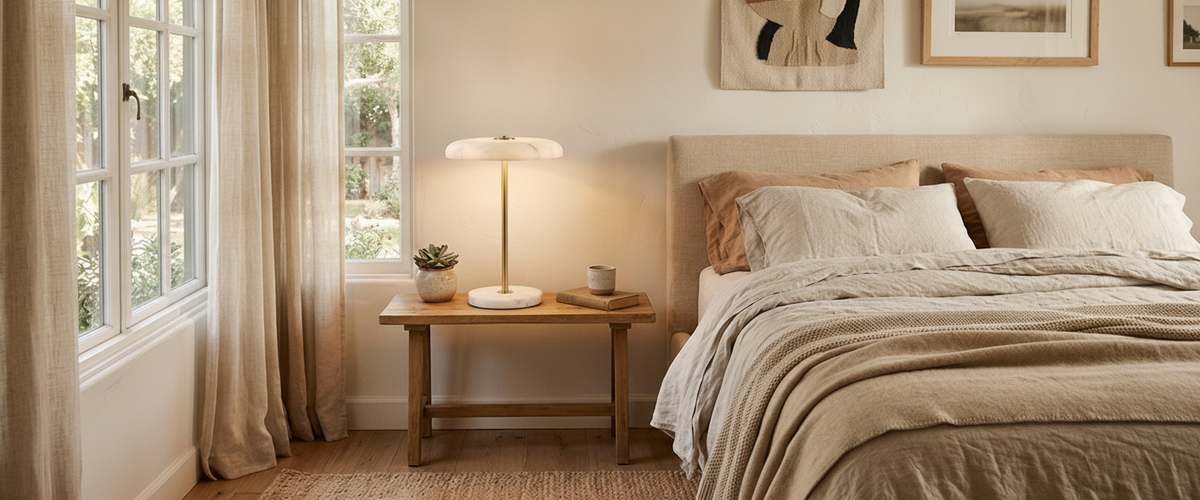

Most bedside lighting goes wrong before the lamp is even switched on. People fall for a shape in a showroom, carry it home, and only then discover the base swallows half the nightstand or the shade blazes straight into their eyes when they lie down. Good table lamps for bedside use start from the surface they sit on, not the other way round. Get the relationship between lamp and table right and the rest, warmth, glare, reading light, mostly sorts itself out.
At Niori we build alabaster and natural-stone lighting, so we spend a lot of time thinking about how a lamp reads at close range in a quiet room. A bedside is the most intimate spot in the house for a light. It sits inches from your face for the last waking hour of the day, which is exactly why the soft, diffused glow of carved stone makes table lamps for bedside use so easy to live with.

Key Takeaways for Bedside Lamp Sizing
Measure the nightstand first. The base should take up no more than about a third of the surface depth.
Aim for the bottom of the shade to sit roughly level with your shoulder when you're upright in bed, so the bulb stays hidden when you lie down.
A total lamp height of around 24 to 27 inches (61 to 69 cm) suits most standard beds and nightstands.
Table lamps for bedside use in a pair don't have to be identical twins, but they should share height and visual weight.
Warm, dimmable light matters more at the bedside than raw brightness. Alabaster diffuses it naturally.

Why the Table Dictates the Lamp, Not the Other Way Round
A bedside table sets three limits: how much surface space the lamp's base can occupy, how tall the whole thing can be before it looks top-heavy, and how the materials sit next to your bed frame and linens. Fight those limits and the lamp will always look borrowed from another room.
Start with a tape measure. Note the depth and width of the surface, then the height of the tabletop from the floor and, separately, the height of your mattress. Those last two numbers are what people forget, and they're the ones that decide whether table lamps for bedside use let you read comfortably or leave you squinting past a hot bulb every night.
Once you know the table, the lamp brief writes itself. A deep, generous nightstand can carry a rounded stone body with presence. A shallow shelf or a narrow drawer unit needs something far more restrained. Browse the wider niori lighting range with those measurements in hand rather than falling for a silhouette in isolation.

Skinny Bedside Tables: Slim Bases That Don't Crowd the Surface
Narrow nightstands are everywhere now, partly because city bedrooms keep shrinking, partly because a skinny bedside table looks clean against a low modern bed. The catch is that a slim table gives you almost no room for a wide lamp foot, a phone, a glass of water and a book.
For a skinny bedside table lamps, look for a tall, columnar base or a compact footprint that reads vertical rather than sprawling. The best table lamps for bedside use on a slender top throw light upward and outward without eating the surface, and the stone's translucency means even a narrow body glows rather than sitting there as a dark shape. Keep the base diameter under about 5 inches (13 cm) on the tightest tables. Where the room needs a tidy vertical footprint, a compact form such as the Essence Round Table Lamp in Black leaves space for the things that actually live on a nightstand.
One studio lesson worth passing on: on very shallow tables, weight matters as much as width. A light lamp on a narrow top tips easily when a cable is tugged. Stone bases solve this quietly, because the material gives you a low centre of gravity without a wide foot, which is why so many table lamps for bedside use in stone stay put where lighter designs wobble.
Small Bedside Table Lamps: Scaling the Shade So It Reads Balanced
Small bedside table lamps fail most often at the shade, not the base. People buy a neat little body then top it with a shade that's either mean and stubby or comically oversized. As a rough guide, the shade width should sit close to the height of the base, and the shade height should be around two thirds of the base height. Those proportions keep the whole thing looking deliberate.
If you prefer the stone to do the work, a shadeless alabaster form removes the guesswork entirely. A carved dome or drum in alabaster is its own diffuser, glowing evenly across the surface with no separate shade to balance. That's a large part of why our table lamps for bedside use suit compact bedrooms; the light is soft at the source, so you don't need bulk to tame it. The full alabaster lighting collection is a good place to see how carved stone behaves at small scale.
Modern Bedside Pairings: Metal, Stone and Glass on the Right Table
Bedside table modern lamps live or die on how their materials meet the table underneath. A black metal base looks sharp on pale oak or a lacquered surface and gets lost against dark walnut. Alabaster and marble read beautifully against warm timber and matte painted finishes, because the stone's veining picks up ambient colour instead of fighting it.
A few pairings that consistently work for table lamps for bedside use:
Alabaster on warm wood: the classic. Stone's cream tones sit naturally against oak or ash, and the lamp glows like a small hearth at night.
Blackened metal and stone on a pale table: the contrast keeps a minimalist scheme from going flat. A dark metal stem with a stone element reads modern without looking cold.
Glass and brass on marble tops: reflective materials can double up on a stone-topped nightstand, but keep one element quiet so the surface doesn't turn busy.
Silhouette pulls its weight here as well. On a bed with clean, square-edged joinery, a piece like the Essence Square Table Lamp in Black echoes the angular geometry, where a rounded body would soften it. The mistake we see most in modern bedrooms is matching everything, lamp, frame, hardware, all in the same finish. A little tension between the lamp and the table makes both look chosen rather than bundled.
Getting Shade Height Right Relative to the Mattress
This is the detail that separates table lamps for bedside use you love from ones you merely tolerate. The bottom edge of the shade, or the top of a shadeless stone form, should sit roughly at eye level or a touch below when you're sitting up against the headboard. That hides the bulb from your lying-down sightline and keeps light pooling on your book rather than flooding your partner's side.
Mattress heights vary, so a taller mattress and a low nightstand throw the numbers off. If your bed sits high, you may need a lamp closer to 27 or 28 inches (69 to 71 cm). If the nightstand is tall and the bed low, drop the lamp height accordingly. The relationship between shade and mattress matters more than any single measurement in a catalogue.
Warm light helps here too. A bedside bulb around 2700K, run through a dimmer, gives you readable light early and a low amber glow before sleep. Alabaster softens whatever bulb sits behind it, which is why table lamps for bedside use in stone flatter a bedroom in a way bare glass never quite manages. You can read more on the science of light and rest through the Sleep Foundation.
One Table, Two Lamps: When Symmetry Is Worth It
A matched pair either side of the bed is the calmest look in interiors, and it earns its keep in a shared bedroom where both people want their own reading light. Symmetry signals order, and the eye relaxes into it. Running two table lamps for bedside use as a set does a lot of that work on its own.
Do nightstand lamps have to match, though? No. What they need to share is height and visual weight. Two lamps of the same height in complementary but not identical finishes can look more considered than a literal pair, especially in a room that already leans eclectic. If one nightstand is larger, you can run different bases at the same height and let the shades or stone forms tie them together.
For a genuine pair, buy both at once from the same batch. Natural stone varies from piece to piece, which is part of its appeal, but two alabaster table lamps for bedside use chosen together will read as siblings rather than strangers.
A Quick Bedside Buying Checklist
Measure nightstand depth, width, tabletop height and mattress height before you shop.
Keep the base footprint to about a third of the surface, less on skinny tables.
Target a total height around 24 to 27 inches (61 to 69 cm), adjusted for your bed.
Check the bulb hides from your lying-down sightline.
Choose a warm, dimmable bulb; alabaster diffuses it best.
Buy pairs of table lamps for bedside use together for consistent stone; match height and weight, not necessarily the exact design.
Have any hardwired fittings installed by a qualified electrician.
Caring for Stone at the Bedside
Table lamps for bedside use get handled constantly, so care matters. Dust alabaster and marble with a soft dry cloth and keep water and household sprays away from the surface, since natural stone is porous and can mark. Wipe fingerprints off promptly and your lamp will look as good in ten years as it does on day one.