
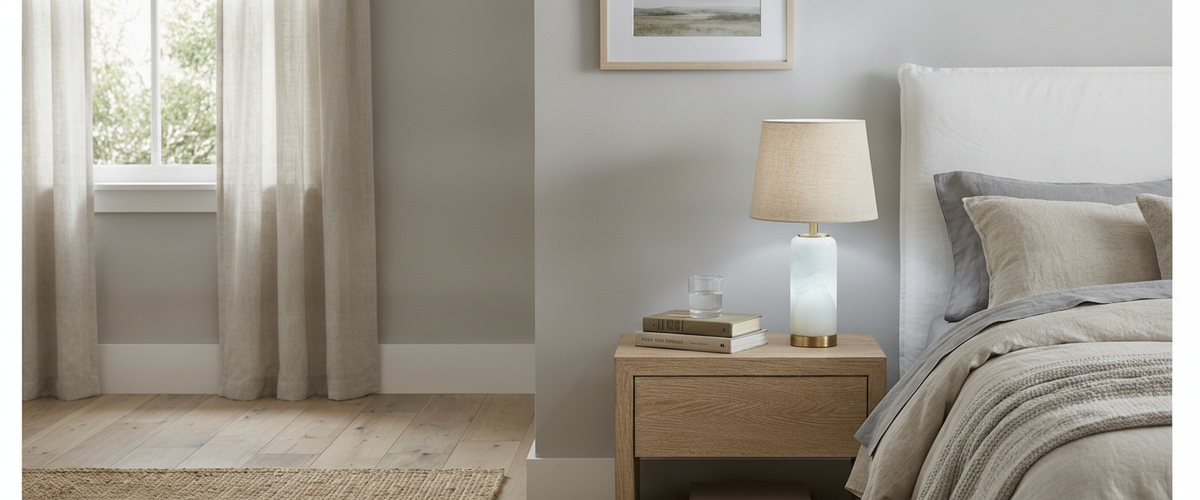

The best small table lamps bedroom shoppers can buy do one hard job well: they fit on a crowded nightstand and still throw light you can actually read by. Most fail at least half of that. They stay compact enough to leave room for a book, a glass of water and a phone, then cast light too dim or too harsh to use. This guide shows you how to match base, shade and bulb so a small bedroom table lamp works instead of just looking pretty on a shelf. Get the combination right and the lamp earns its place beside the bed.
At Niori we make alabaster and natural-stone lighting, and small table lamps for the bedroom are where the material really earns its keep. Alabaster is faintly translucent, so a lit base glows softly rather than staying dark and inert. That gives these lamps a second job: a low pool of ambient light for the room, plus a working beam from the shade for the page.

Key Takeaways Before You Shop
Size to the nightstand, not the room. The lamp base should take up roughly a third of the surface, leaving space to actually use the table.
Shade shape decides where light lands. An open-bottomed shade drops light onto a book; a narrow drum keeps it cosy but dim.
Aim for warm, dimmable light. Around 2700K, on a dimmer, suits winding down without wrecking sleep.
Get the shade below eye level when you are propped up reading. That is the single biggest fix for bedtime glare.
A glowing alabaster or stone base adds ambient light a plain ceramic base cannot.

Why a Small Base Still Needs to Throw Usable Light
The mistake we see most often is treating a bedside lamp as pure ornament. Someone falls for a pretty silhouette, brings it home, and then squints through their evening chapter because the light never reaches the page. The best small table lamps bedroom buyers rely on solve two problems at once: soft light for the room and directed light for reading. If a lamp only does the first, you end up switching on the harsh overhead you were trying to avoid.
This is where the material matters. A solid opaque base blocks all its light upward into the shade. An alabaster or onyx base, by contrast, lets a gentle glow escape through the stone itself, so the lamp reads as a quiet source of ambient light even before you factor in the shade. We had a client in a low-ceilinged period bedroom who wanted to drop the ceiling fixture entirely; a pair of glowing alabaster bases on the nightstands, plus wall reading lights, lit the whole room. You can see the range of translucent pieces across our alabaster lighting collection.
Read the Nightstand First
Before you look at a single lamp, measure the table it will share. A slim Parisian bedside cabinet and a deep American nightstand call for very different small table lamps for the bedroom, and a base that swamps the surface is the fastest way to make a bedroom feel cluttered.
A reliable starting point: the lamp footprint should occupy no more than about a third of the tabletop depth, leaving the front two-thirds clear for daily use. On a narrow table around 12 inches (30 cm) deep, that points you to a genuinely small base with a compact shade. Where the surface is tight, a low round-based piece such as the Essence Round Table Lamp keeps the footprint contained without giving up presence. On a generous 20-inch (50 cm) top, you have room for something with more weight. A stone base is heavier than ceramic or glass, which is a virtue on a wobbly antique table but worth noting if the nightstand is flimsy or wall-hung.
Think in pairs where you can. Matched small table lamps for the bedroom on either side of the bed give a room symmetry and calm, and they let both sleepers control their own light. If the bedside tables are different heights, choose lamps whose shade centres still land at a similar level; the eye reads the light, not the furniture.
Shade Shape Decides Whether Light Reaches the Page
Shade geometry does more work than most buyers expect. A shade that is open and slightly flared at the bottom lets light spill down and forward onto a book. A tall, narrow shade with a tight lower opening traps light inside and pushes most of it straight up at the ceiling, which looks moody and reads terribly.
For bedside reading, favour a shade with a wider bottom opening and a pale or translucent liner that bounces light rather than absorbing it. Dark, dense shades look handsome by day and disappoint at night. Alabaster shades on small table lamps for the bedroom sit in a useful middle ground: the stone diffuses the source so you never get a hard hotspot, while still passing enough light through the walls and base opening to work by. Where you want a crisper, more architectural line beside the bed, the squared profile of the Essence Square Table Lamp reads a little more structured while keeping the same diffused, glare-free finish. That soft light is exactly what you want in the last hour before sleep.
Bulbs and Wattage That Make a Compact Lamp Feel Generous
Small table lamps for the bedroom do not need a powerful bulb; they need the right one. For most bedrooms, an LED bulb around 2700K (warm white) with an output roughly equal to a traditional 40 to 60 watt bulb is the sweet spot. Warmer light, in the 2200 to 2700K range, supports the body's wind-down cues in the evening, which the Sleep Foundation links to better rest.
Put the lamp on a dimmer if you can, either through a dimmable bulb and compatible switch or an inline control. Being able to drop to a low glow for late-night wandering and lift it for reading turns one small bedside lamp into three moods. Small table lamps in the bedroom often take a smaller SES or E14 base, so check the bulb cap fits the fixture and that any smart bulb you choose is dimmable, since not all are. A warm, high-CRI LED will render skin tones and book pages far more pleasantly than a cheap cool-white one.
Height and Glare: Get the Shade Below Eye Level
Here is the rule that fixes most bedside disappointment. When you are sitting up in bed, propped against the headboard, the bottom of the shade should sit at or just below your eye line. That keeps the bare bulb hidden and stops the light firing straight into your eyes while you read.
To measure it at home: sit up in your normal reading position and have someone note the height of your eyes from the top of the mattress. Then measure from the floor to the top of your nightstand. The gap between the two is roughly the total lamp height you want, shade included. Most small table lamps for the bedroom land somewhere around 20 to 26 inches (50 to 66 cm) tall, but your headboard, mattress depth and table height decide the exact figure, so measure rather than guess. A taller person or a high bed pushes the lamp taller; a low platform bed pulls it shorter.
The Small Lamps We'd Steer Clear Of
Some compact lamps are built to photograph well and nothing more. A few tells among small table lamps for the bedroom:
A tiny shade on a tall base. The proportions look chic online but the shade is often too shallow to direct any light, so you get glare above and darkness below.
Dense, dark shades on a small lamp. Fine for a decorative accent lamp, poor for a bedside reader. If you plan to read, you need light to escape.
Flimsy plastic bases pretending to be stone. They stay dark when lit and topple easily. Genuine alabaster, marble or onyx has weight and depth, and it glows.
No dimming path at all. A fixed high output beside the bed is a nightly annoyance.
Are crystal table lamps okay for a bedroom? They can be, but treat them as accent pieces rather than serious readers. Faceted crystal scatters light in sharp glints that look lovely on a dressing table but can be distracting right beside your pillow. If you want the softer, held-in glow that suits small table lamps for the bedroom, a translucent stone reads gentler. It is worth browsing the wider lighting collection to compare how different materials handle the same bulb.
A Quick Buyer's Checklist
Measured the nightstand depth and left the front two-thirds clear.
Chosen a shade with an open lower edge and pale liner for reading.
Picked a warm (around 2700K), dimmable LED with 40 to 60 watt equivalent output.
Confirmed the shade bottom sits at or below eye level when sitting up.
Checked base material and weight suit the table.
Bought small table lamps for the bedroom as a pair where the layout allows.
Get those six right and small table lamps for the bedroom stop being a decorative afterthought and become the most-used light in the room. Well-chosen small bedroom table lamps are quiet enough to relax under, capable enough to read by, and made from a material that looks as good switched off as it does glowing. That is the whole point of a good small table lamp for the bedroom.