
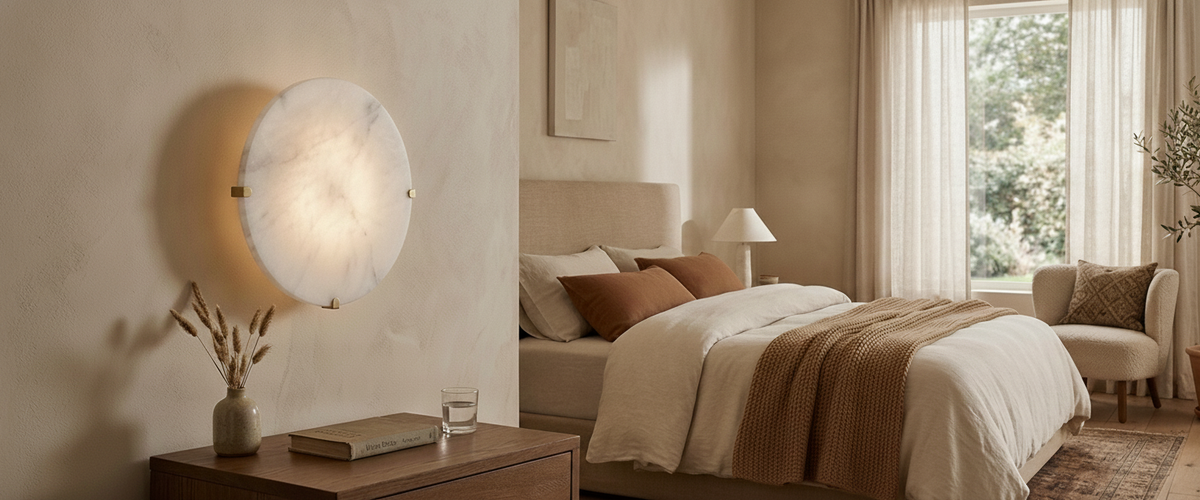

A badly placed bedroom sconce light shows up the moment you try to read in bed. Either the light lands behind your shoulder and leaves your book in shadow, or it sits so high and bright that your partner gets a lamp in the eye every time they turn over. Getting a sconce light fixture bedroom placement right is mostly geometry, and once you understand the geometry the design choices get easy. Alabaster helps too, because the stone diffuses output into a soft, even glow rather than a hard beam.
Here is the short version before we get into detail on any bedroom sconce light fixture.
Height: mount so the light source sits roughly level with your shoulders or lower head when you are sitting up against the headboard.
Position: centre the sconce over the bedside table, not the pillow, so the beam falls onto your book rather than your face.
Reach: a swing-arm suits readers; a fixed sconce suits a clean, symmetrical look.
Output: warm and dimmable, around 2700K, so it reads calm rather than task-bright.
Wiring: put the switch by the bed, and decide early whether you want a wall switch, a cord switch, or a smart control.

Where a Bedside Sconce Belongs Relative to the Headboard and Your Shoulder
Think about your body when you are actually using the light: sitting up against the headboard with a book. You want the light source of your bedroom sconce light fixture to sit slightly above and to the side of your shoulder, so the glow spills forward onto the page. If the sconce sits too far behind you, your own head blocks it and the page stays dim.
As a starting point, place the fixture so its centre lands roughly 30 to 36 inches (76 to 91 cm) above the mattress top, and set it out toward the edge of the bedside table rather than tight against the headboard. That gives the light a clear line to your lap. In the Niori studio we have shipped bedroom wall lights to clients with tall upholstered headboards where the headboard itself cast a shadow, and the fix for the bedroom sconce light fixture was always the same: bring it forward and slightly higher so it clears the top rail.
The width of your bed and table matters. A sconce light fixture in the bedroom that sits directly over a narrow nightstand keeps the beam where you need it. If your table is generous, nudge the fixture toward the pillow side so the light still reaches you rather than pooling over an empty tabletop. On a compact nightstand, a smaller disc such as the Essence Round Wall Light 75cm, Brass holds the beam close without crowding the wall, whereas a wider table can carry the presence of the Essence Round Wall Light 115cm, Brass.

Mounting Height for Reading in Bed Without Glare in a Partner's Eyes
Glare is the number one complaint with a bedroom sconce light fixture, and it almost always comes from a bare bright source at eye level. This is where alabaster earns its place. Because the stone is translucent, it turns a small bulb into a broad, gentle glow, so even when the fixture sits near eye height it never feels harsh. A clear glass or exposed-bulb sconce light fixture for the bedroom at the same height would be punishing for whoever is lying down.
If your partner reads later than you do, aim the light so the throw stays on their side of the bed. A downward-facing shade, or a stone diffuser that directs light forward and down, keeps the spill off the sleeping half. Mount your bedroom sconce light fixture a little lower than you think for reading; a fixture that sits closer to the book gives you usable light at a lower brightness, which is kinder to everyone in the room.
One practical check: sit on the bed before the electrician marks the wall. Hold a torch where the sconce will go and see where the light lands. Five minutes of this saves you from a bedroom sconce light fixture that looks right on paper and blinds you in practice.
Swing-Arm Versus Fixed: Which Suits Your Headboard and Bedtime Habits
A swing-arm sconce pivots out from the wall so you can pull the light over your book and push it back when you are done. This style of bedroom sconce light fixture suits committed readers, small bedrooms where a table lamp would crowd the nightstand, and anyone who wants to adjust the angle night to night. The trade-off is that the arm and joint become part of the look, so the fixture reads more mechanical than a single sculptural piece.
A fixed sconce stays put and gives you a cleaner, more architectural line. An alabaster fixed sconce light fixture for the bedroom tends to look calmer and more considered, which is why designers reach for them in principal bedrooms where the wall is meant to feel serene. The catch is that you commit to one angle, so the placement work above matters more.
Your headboard often decides this. A tall or deep upholstered headboard pushes the useful light zone forward, which favours a swing-arm you can pull past the padding. A low or open headboard leaves the wall clear, so a fixed alabaster sconce light fixture in the bedroom sits beautifully with nothing to fight. Where you want a crisper line against a plain wall, a squared profile like the Essence Square Wall Light 75cm, Brass reads more architectural than a soft disc. Browse the wider alabaster lighting range and you will see both approaches; the stone works either way, the mechanics are the choice.
Warm Dimmable Output That Reads Calm Rather Than Task-Bright
Bedrooms want warm light. Aim for bulbs around 2700K, which gives the relaxed, slightly amber tone that suits winding down. Cooler colour temperatures push toward daylight and keep you alert, which is the opposite of what you want last thing at night. For guidance on light, colour and evening routines, the Sleep Foundation covers how light exposure affects rest.
Dimming is non-negotiable for a bedside sconce. You want the same bedroom sconce light fixture to give you enough light to read and a low, ambient glow for the last few minutes before sleep. Pair a dimmable LED with a compatible dimmer; not every LED plays nicely with every dimmer, so check the bulb is listed as dimmable and match it to the control. Alabaster flatters low output especially well, because as you dim the stone keeps its warm inner glow rather than going flat and grey.
What Wattage and Bulb for a Bedroom Sconce
Forget watts as a brightness measure and think in lumens. For a bedside reading sconce, something in the region of 300 to 450 lumens per fixture is plenty; that is roughly a 5 to 7 watt LED. Anything brighter and you will spend your evenings dimming it down anyway. If the bedroom sconce light fixture is purely for ambient mood light rather than reading, you can go lower still. Choose a warm 2700K LED, confirm it is dimmable, and check the bulb cap fits the fixture holder before you buy.
Symmetry Across the Bed and the Case for Going Slightly Asymmetric
A matched pair of sconces either side of the bed is the classic look, and for good reason. Symmetry reads calm and hotel-considered, and it gives both sleepers their own light and their own switch. When you order a pair, make sure they are handed correctly if the design has a direction, and set each sconce light fixture in the bedroom at identical heights measured from the mattress, not the floor, so they line up with your eyeline rather than the skirting.
Perfect symmetry is not always the right answer, though. If one side of the bed sits against a window, a wardrobe, or a chimney breast, forcing a matching bedroom sconce light fixture into a cramped corner looks worse than a considered mismatch. In those rooms, a single well-placed sconce on the open wall and a compact table lamp on the awkward side can balance better than two fixtures crammed where they do not fit. Balance is about visual weight, not just mirror-image placement.
The Wiring and Switch Mistakes That Ruin an Otherwise Good Placement
The most common regret is a sconce you have to get out of bed to switch off. Decide early where the control lives. A wall switch beside the bed, a cord or rocker switch on the fixture itself, or a smart bulb you control from your phone all work; the mistake is not deciding until the wall is already chased and plastered.
If you are adding a hardwired bedroom sconce light fixture to an existing room, the cable run needs planning before decorating, because chasing a wall after the fact means fresh plaster and paint. For rental properties or rooms you would rather not disturb, a plug-in sconce light fixture for the bedroom is a genuine option, and many alabaster wall lights are offered in switched, plug-in, or hardwired versions. Whichever route you take, hardwiring and any work at the consumer unit should be done by a qualified electrician; the guidance from Electrical Safety First is a sensible reference before you start.
Two smaller mistakes worth avoiding. First, mounting the back box at the wrong height because it was set to the drawing rather than checked against the actual bed and mattress. Second, forgetting the cable exit position, so the flex on a swing-arm ends up on show. A little planning here is the difference between a bedroom sconce light fixture that looks built-in and one that looks bolted on. If you are still comparing fixture types across the room, the full lighting collection shows how sconces sit alongside pendants and table lamps.
A Quick Placement Checklist
Sit on the bed and test the light height before marking the wall.
Centre the sconce over the nightstand, edged toward the pillow if the table is wide.
Set the light source near shoulder height, roughly 30 to 36 inches (76 to 91 cm) above the mattress.
Choose alabaster or a stone diffuser to soften glare at eye level on your bedroom sconce light fixture.
Pick 2700K, dimmable, around 300 to 450 lumens for reading.
Match a dimmable LED to a compatible dimmer.
Decide the switch location and cable run before decorating.
Use a qualified electrician for hardwired work.
Get the geometry right and a bedside sconce quietly earns its keep every night. Niori works in alabaster and natural stone precisely because the material forgives so much: the right sconce light fixture bedroom pairing turns a modest bulb into a warm, even glow that reads calm at the end of the day. Whether you choose a matched pair or a single considered fixture on an open wall, a well-placed bedroom sconce light fixture is the small detail that makes the room feel finished.