
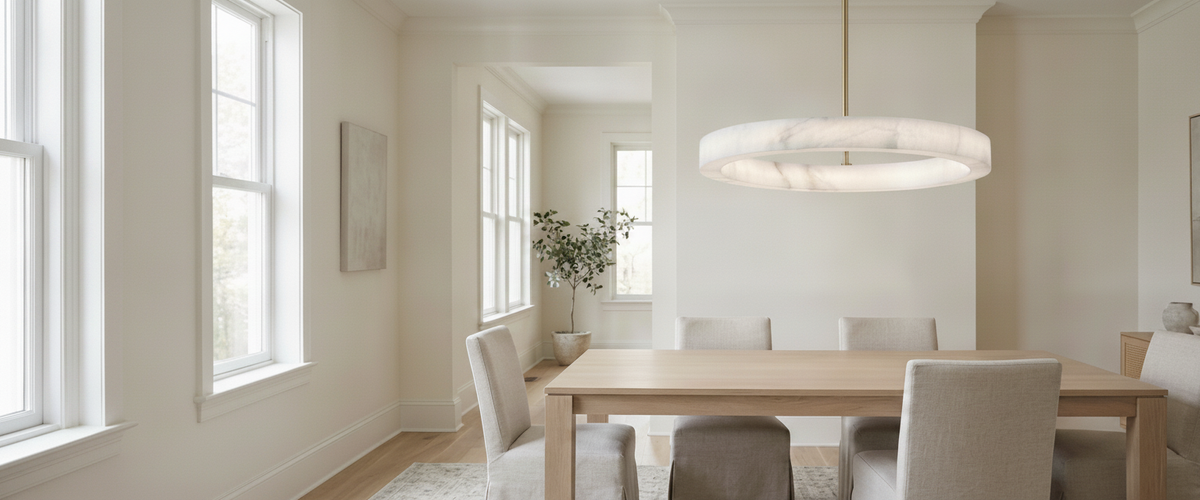

A single pendant hung 6 inches (15cm) too high can flatten an entire room, and no bulb upgrade will save it. That is the frustrating thing about pendants for lighting: the fixture can be beautiful and the light quality superb, yet the whole thing reads wrong because the height, scale or sightline was never worked out on paper. Alabaster makes this both easier and less forgiving. The stone throws a warm, diffused glow that flatters a space, but its weight and presence mean a badly placed light pendant sits there like an apology.
So before we talk fixtures, let us talk placement, because that is where most projects using pendants for lights go quietly wrong.

Key Takeaways
Height matters more than the fixture. Over a kitchen island, hang the underside roughly 30 to 36 inches (76 to 91cm) above the counter.
Scale to the surface below, not the room. A pendant should relate to the table or island it lights, not the four walls around it.
Alabaster rewards dimming. The stone glows from within, so a warm bulb on a dimmer reads far better than a bright, fixed output.
Sightlines are king. A pendant that blocks a face across the table has failed, however handsome it looks switched off.
Budget follows material, scale and engineering. Hand-carved natural stone and larger fixtures cost more; ask for a tailored quote rather than guessing.

What Pendants for Lights Actually Look Like in Different Rooms
The word pendant covers a huge spread, from a single small dome over a bedside table to a run of three matched fixtures over an island. When you choose pendants for lights in alabaster and natural stone, the character shifts again. A carved alabaster shade glows softly across its whole surface because light passes through the stone rather than bouncing off metal. Onyx pushes this further, with dramatic banded veining that becomes visible only when lit. Marble tends to read more solid, throwing light down rather than out.
That difference should drive where you use each one. A translucent alabaster dome earns its place where you want ambient warmth: a dining room, a hallway, over a bath. A more directional stone-and-brass light pendant suits task areas where you need light on a work surface. You can see the full spread of forms across our lighting collection, which helps when you are trying to picture how a shape behaves before it hangs.
Scale, Mounting Height and Sightlines
Three measurements decide whether one of these pendants for lights looks intentional or accidental.
Scale. Match the fixture to what sits beneath it. Over a dining table, a good rule is a pendant (or grouped ones) roughly one half to two thirds the width of the table. Over an island, aim for a total span that leaves 6 inches (15cm) or so of clearance at each end. Where a single wide dome is doing most of the work over a compact island, something at the larger end of the range such as the Gemini Pendant Light 105cm in Brushed Brass holds the space better than a modest shade floating over the middle. Undersized pendants for lights are the more common mistake; people buy for the ceiling and forget the surface.
Mounting height. For a dining table, hang the underside around 30 to 34 inches (76 to 86cm) above the tabletop. Over a kitchen island, 30 to 36 inches (76 to 91cm) works for most ceilings. In an entry or stairwell with a double-height void, you have more freedom, but keep the lowest point above head height for the tallest person likely to pass under it.
Sightlines. Sit down at the table before you commit. If the shade blocks the face of the person opposite, it is hung too low or sized too large. This is the single most common thing we correct on client projects with pendants for lights, and it never shows up until someone actually sits down.
Room-by-Room Placement: Where a Pendant Earns Its Keep
Pendant Lights for the Kitchen
Pendant lights for the kitchen almost always live over an island or a run of counter. Two or three matched fixtures along an island give even coverage and let you dim the whole line together. Where you want a repeated rhythm along a long island rather than one dominant shape, a smaller design like the Gemini Pendant Light 42.5cm in Black hung in a run reads more considered than a single oversized dome. Space them evenly, and resist the urge to centre one small light over a long island; it lights the middle and leaves the ends in shadow. Alabaster pendants for lights work beautifully here because the diffused glow softens what can otherwise be a hard, reflective room full of stone and steel. Pair it with focused task lighting under the cabinets so the overhead fixtures can stay warm and atmospheric rather than clinical.
Dining Room
The dining table is where a single statement piece does its best work. Because everyone is seated, sightlines and glare control matter most. A translucent alabaster fixture on a dimmer gives you a soft pool of light that flatters food and faces without a harsh hotspot. Centre it over the table, not the room, if the two do not align.
Hallways and Stairwells
A pendant in an entry sets the tone before anyone reaches a living space. In a double-height hall, a longer alabaster fixture or a small cluster of pendants for lights fills the vertical volume that a flush ceiling light cannot. Keep the base clear of the swing of any door.
Bedrooms
Paired lights either side of the bed free up the bedside tables and throw a warm, low glow that suits winding down. Hang them so the base sits roughly level with the top of the headboard when you are sitting up in bed. The alabaster lighting range suits bedrooms particularly well because the stone never produces the cold, flat light that keeps people awake; a warm colour temperature in the evening supports the body's wind-down, which CIBSE lighting guidance ties to comfort and circadian rhythm.
Bathrooms
Over a freestanding bath or beside a mirror, a hanging fixture adds softness that recessed spots cannot. Bathroom zones carry electrical rules, so this is a case where placement and a qualified electrician go hand in hand.
Bulb, Dimming, Backdrop and Contrast
Alabaster and natural stone reward the right bulb more than almost any other material, because you are lighting the stone itself, not just the room. A warm white LED, around 2700K to 3000K, brings out the honeyed tones and soft veining. Push the colour temperature too cool and the glow turns grey and lifeless.
Always fit a dimmer. The whole appeal of alabaster pendants for lights is the range between a low, resinous evening glow and a brighter working level, and you lose that with a fixed output. Check that your bulb, driver and dimmer are compatible; mismatched dimmers cause flicker and buzz that no one enjoys at dinner.
Backdrop and contrast decide how much the light reads. A pale plaster ceiling lets a white alabaster shade sit quietly and glow; a dark, moody ceiling makes the same fixture pop as a focal point. Onyx with strong veining wants a calmer background so the stone does the talking. Think about the wall or ceiling behind the fixture as part of the composition, not an afterthought.
Common Placement Mistakes We See in Client Projects
Hanging too high. A fixture floating near the ceiling loses all intimacy. Bring it down to the surface it serves.
Buying one when you need three. A long island or table needs a run of pendants for lights, not a lonely centrepiece.
Ignoring the seated view. Beautiful switched off, blinding switched on. Always test from a chair.
Cool bulbs in warm stone. A 4000K bulb in an alabaster shade wastes the material. Save cooler temperatures for task zones.
No dimmer. Fixed brightness flattens the very quality you paid for.
Forgetting weight. Natural stone is heavier than glass or metal shades. The ceiling fixing and mounting box must be rated for it, which is another reason to involve a qualified electrician.
Choosing the Right Pendant: A Buyer's Checklist
Measure the surface below and the ceiling height before you shop.
Decide whether you want ambient glow (alabaster, onyx) or downward task light (marble, stone-and-brass).
Confirm one fixture versus a run of pendants for lights, based on the length of the surface.
Set a mounting height and check sightlines from a seated position.
Choose a warm bulb and a compatible dimmer. If you cannot rewire, a plug in pendant light on a ceiling hook and nearby socket is a practical route for lighter designs.
Confirm the fixing can carry the weight of natural stone.
Ask for a tailored quote; price tracks material, scale, carving complexity and installation rather than any single number.
Get those seven right and pendants for lights stop being a gamble. If you want to compare forms and finishes as you plan, browse the alabaster lighting pieces alongside the wider range, and picture each one over the actual surface it will serve rather than the empty ceiling.