
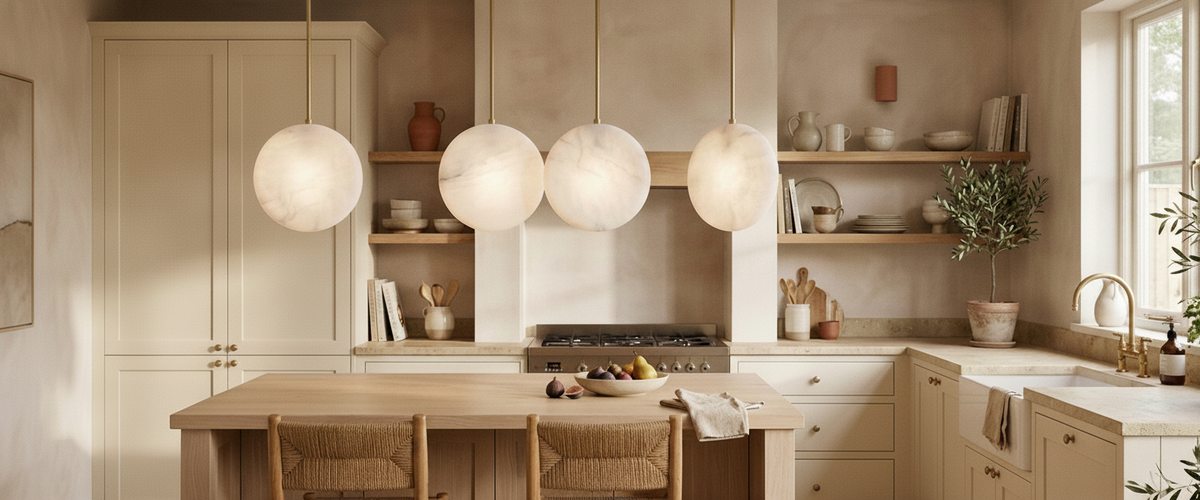

Hang a pendant an inch too low over a kitchen island and every tall guest ducks; hang it too high and it floats there doing nothing for the counter below. Pendant lighting height is the single measurement most people rush, and it is the one that decides whether a beautiful pendant light reads as deliberate or accidental. Get it right and an alabaster pendant becomes the anchor of a room. Get it wrong and even the finest carved stone looks like an afterthought.
This guide walks through the numbers that actually matter, then explains how a translucent material like alabaster shifts your pendant lighting height, because a glowing stone shade does not behave like a bare bulb.
Getting the pendant lighting height right over an island keeps light on the worktop without blocking sightlines.

Quick Answer: Standard Pendant Lighting Height
Over a kitchen island or counter: the bottom of the pendant sits roughly 30 to 36 inches (76 to 91 cm) above the worktop.
Over a dining table: 30 to 34 inches (76 to 86 cm) above the tabletop, lower for intimate lighting, higher for a lighter, more formal look.
In an entryway or open hallway: keep at least 7 feet (2.1 m) of clearance from the floor to the base of the fixture.
In a two-storey stairwell or void: the lowest point of the fixture should clear head height on the landing, usually no lower than 7 feet (2.1 m) above any tread.
Rule of thumb for ceiling height: add roughly 3 inches (7.6 cm) of drop for every foot of ceiling above 8 feet (2.4 m).
Those figures are starting points for your pendant lighting height, not commandments. Table height, worktop reflectivity, the number of pendants in a row and the size of the fixture all pull the ideal number up or down.

What Pendant Lighting Height Really Means and Who It Is For
Pendant lighting height is the distance from the floor (or a work surface) to the lowest point of the hanging fixture. It is the measurement that controls glare, task light spread and how the piece frames a table. Anyone hanging pendants for lighting over an island, a dining setting or a stairwell needs to settle this before the electrician arrives, because the drop rod, chain or flex is usually cut or set to a fixed length.
The right pendant lighting height matters most to three groups: homeowners renovating a kitchen, interior designers specifying over a client's dining table, and hospitality buyers hanging a run of pendants down a bar or reception desk. In each case the same trap appears. People choose the fixture, fall for the finish, then treat the drop as a formality on install day. By then the ceiling box is set and options narrow fast.
Alabaster changes the brief slightly. Because the stone glows from within rather than firing light straight down, you can often set the pendant lighting height a touch lower than you would for a clear glass or metal shade without punishing anyone with glare. The light leaves the surface softly and evenly, so the fixture reads as ambient sculpture as much as task light. That gives you room to lower it for presence, and it is exactly why the ideal pendant lighting height for stone differs from the textbook figures.
Materials, Finishes and Scale Decisions
Height and size are joined at the hip. A large fixture hung high looks marooned; a small one hung low looks lost. Before you commit to a drop, size the pendant to the surface below it and then dial in the pendant lighting height.
For a dining table, a single pendant or cluster should span roughly half to two-thirds of the table width. Over an island, a common approach is a run of two or three matched pendants, spaced evenly with a comfortable gap at each end rather than crammed to the edges. Pendant lights for kitchen islands tend to look best when the spacing between fixtures roughly matches the width of each pendant, which keeps the rhythm calm. Where you need a run of substantial fixtures to fill a wide island, a linear form such as the Gemini Pendant Light 105cm in Brushed Brass carries the length in one piece rather than asking three small shades to do the work.
Over a dining table, dropping the shade to around 31 inches delivers a candle-like glow through alabaster.
Material decides how the light lands. Alabaster and onyx are translucent, so the shade itself becomes a light source with warm, diffused output and the fine veining reading like a slow watercolour. Marble is denser and usually directs light down and out from the rim, which suits task-heavy zones. Brass detailing, whether polished, brushed or blackened, sets the temperature of the piece against your cabinetry and hardware. The alabaster lighting collection is where the translucency does the heavy lifting; browse it if you want the shade to glow rather than simply shine.
A note on weight and drop: natural stone is heavier than glass or metal of the same size, so the ceiling fixing and any adjustable drop must be rated for it. This is one reason we always recommend a qualified electrician set the final pendant lighting height rather than treating it as a DIY tweak on the day.
Where to Place a Pendant for the Strongest Impact
The kitchen island is the classic stage. Keep the base 30 to 36 inches (76 to 91 cm) above the worktop so the light pools onto the prep zone without blocking sightlines across the room. If the household includes anyone tall, lean toward the higher end of that pendant lighting height. In an open-plan kitchen where the island faces a sofa, an alabaster pendant at the higher end keeps the glowing shade visible as a soft focal point from the seating side. For a compact island or a spot where a single fixture reads better than a row, a smaller shade such as the Gemini Pendant Light 42.5cm in Black holds the scale without overwhelming the counter.
Over a dining table the maths loosens because nobody stands under it. Drop to around 30 to 32 inches (76 to 81 cm) above the tabletop for an intimate, held-together setting; this is where alabaster earns its place, since the warm diffused glow flatters faces and food. We shipped a pair of carved pendants to a Napa dining room last year where the client wanted candlelight without candles, and setting the pendant lighting height at 31 inches over a long walnut table did exactly that.
In stairwells and double-height voids, treat the pendant lighting height as a safety measurement first. Keep the lowest point clear of head height on every landing and tread, then let the fixture length fill the vertical drop so the void does not swallow it. A tall cascade or a single large stone pendant both work; the error is hanging something small near the top and leaving the shaft dark.
Entryways and hallways want generosity above, clearance below. Aim for at least 7 feet (2.1 m) of floor-to-base clearance so nobody meets the fixture on the way in. If you are working with a plug in pendant light for a rental or a spot with no ceiling box, you can swag the flex to a hook and route it to a socket; the same pendant lighting height logic applies, and a discreet cord is easier to hide than most people expect. The wider lighting collection covers wall lights and table lamps if a hard-wired pendant is not practical in your space.
Budget, Quality and Delivery Considerations
Price on natural-stone lighting depends on material, scale, the complexity of the carving, the engineering behind the fitting, and installation and finishing. A large hand-carved alabaster pendant with brass work is a different proposition from a small single shade, so rather than quote a band, we suggest requesting a tailored quote once you know the room, the drop and the number of fixtures.
Three quality checks worth making before you buy any pendants for lights:
Stone consistency: alabaster is natural, so veining varies piece to piece. Ask how a supplier handles matching across a run of island pendants.
Fitting and rating: confirm the drop system is adjustable and rated for stone weight, and that the fixture ships with a bulb spec suited to a translucent shade.
Lead time: carved stone is made to order, not stocked in infinite quantity, so build realistic delivery into a renovation timeline rather than assuming next-day dispatch.
Bulbs and Dimming for Stone Pendants
Translucent stone rewards a warm bulb. Aim for a colour temperature around 2700K to 3000K for living and dining spaces, where the warmth reads as candle-like through alabaster. Some kitchen pendants run cooler at 4000K for a crisper task light, which suits denser shades and busy prep zones better than it suits a soft glowing stone. Once the bulb is set, revisit the pendant lighting height to see whether the glow lands where you want it.
Always pair pendants with a dimmer. The whole appeal of alabaster is the range from a low evening glow to a brighter working level, and a compatible dimmer switch lets one fixture do both. Match the dimmer to the driver or bulb type; the ENERGY STAR guidance on light bulbs is a useful reference on LED and dimming behaviour if you want to check before buying. Avoid an over-bright bulb behind thin stone, which can create a hot spot and flatten the veining that makes the piece worth having.
Installation Checklist
Confirm the fixture size against the surface below (half to two-thirds of a table's width).
Set the base height using the standard ranges above, then adjust the pendant lighting height for ceiling height and household height.
Check clearance in walkways and on stair landings before finalising the drop.
Verify the ceiling fixing is rated for the weight of stone.
Fit a warm, dimmable bulb suited to a translucent shade.
Have a qualified electrician complete the wiring and set the final height.
Get the pendant lighting height right and the rest follows. A well-hung alabaster pendant stops being a fixture you notice and becomes the light you live under.