
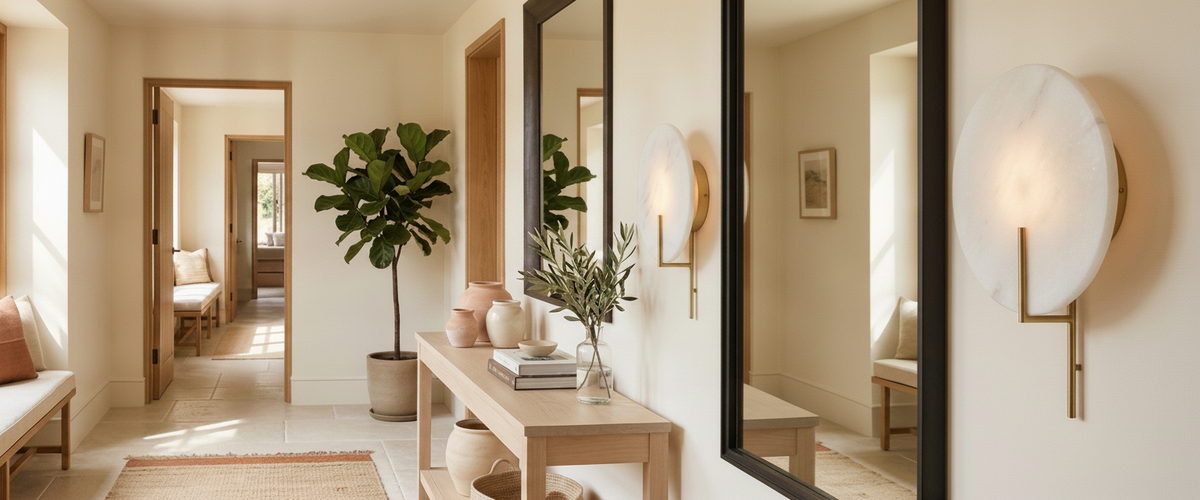

A sconce that works looks effortless, and a sconce that fails looks like an afterthought bolted to plaster. The difference is rarely the fixture itself. It comes down to height, projection, and where the light actually lands. Get modern wall sconce lighting right and a bare wall reads as considered and warm; get it wrong and you have a bright spot at eye level that everyone squints past. This guide is about the placement decisions we make every week for clients, and how alabaster and natural stone change the maths for modern wall sconce lighting.

Key Takeaways
Standard sconce centre height is around 60 to 66 inches (152 to 168 cm) from the floor, but reading and bedside sconces sit lower and mirror sconces sit higher.
Projection (how far the fixture sticks out) decides glare and how much of the wall you wash; check it before you buy.
Alabaster and stone diffuse the source, so the light feels soft even close to the eye, which forgives a wall that would look harsh with clear glass.
Symmetry reads as intentional, but it is fine to break it around asymmetric art or an off-centre fireplace.
Uplight, downlight, or all-round diffuse are three different jobs. Decide the job before the finish.
An alabaster sconce washes the wall evenly, glowing as an object even before you consider what it lights below.

What Separates a Sconce That Anchors a Wall From One That Just Fills It
An anchoring sconce has a relationship with something: a mirror, a headboard, a run of art, a fireplace, a doorway. It sits in proportion to that thing and to the wall around it. A filler sconce floats in dead space, usually because it was placed where the wiring already was rather than where the eye wants light. This is the first test any modern wall sconce lighting should pass.
Material does a lot of the heavy lifting here. Alabaster and onyx hold light inside the stone and release it slowly, so the fixture glows as an object even before you think about what it lights below. Clear glass or an exposed lamp gives you a point of brightness and a hard shadow line. When you are choosing modern wall sconce lighting for a room people linger in, a diffusing stone gives you a shape on the wall you are happy to look at, not just a source you tolerate. That is the core idea behind our alabaster lighting range: the stone is the shade, so the glow is even and the veining shows.
Mounting Height and Projection: The Numbers That Decide Glare and Comfort
Height is the first thing people get wrong with modern wall sconce lighting. For general wall sconces in a hallway, living room, or dining room, aim for the centre of the fixture at roughly 60 to 66 inches (152 to 168 cm) from the finished floor. That keeps the brightest part near or just above average eye level for a standing adult, so you are not staring into it as you walk past.
Projection matters just as much and gets ignored. A sconce that projects only 2 to 3 inches (5 to 8 cm) hugs the wall and washes it; one that projects 6 inches (15 cm) or more throws light forward and casts a wider pool. In a narrow corridor, a deep projection is a shin hazard and a glare source. In a wide room it can be exactly what you want. Always check the projection figure on the product page and picture it against the space you have.
Scale ties directly into this. On a broad wall or a generous stairwell, a larger diffusing face like the Essence Round Wall Light 115cm holds the space in a way a compact fitting cannot; over a narrower hallway or beside a doorway, the 75cm version keeps the same soft glow at a proportion that does not overwhelm. Because alabaster spreads the source across its whole surface, a shallow piece of modern wall sconce lighting can sit at eye level in a hallway without dazzling anyone. The Chartered Institution of Building Services Engineers publishes lighting guidance on glare and comfort for anyone specifying for a project rather than a single room. The short version for a home: soften the source, keep it out of the direct sightline, and you avoid most complaints.
A bedside sconce mounted at shoulder height throws light onto the page rather than the face.
Bedside Sconces: Light for Reading Without Waking the Whole Room
A bedside sconce should clear your clutter, throw enough light onto a book, and not blast your partner while they sleep. Mount the centre around 30 to 36 inches (76 to 91 cm) above the mattress, or roughly at shoulder height when you are sitting up against the headboard. Sit on the bed and test the sightline before you commit; the number is a starting point, not a rule. Bedside modern wall sconce lighting rewards this quick check.
For reading, you want a fixture with some downward throw or an adjustable arm so the light lands on the page rather than on your face. If you prefer a calmer, all-over glow, an alabaster sconce gives you soft ambient light that reads as restful. Pair it with a warm colour temperature, around 2700K, and put it on a dimmer. Cooler light late at night works against your body clock; the Sleep Foundation notes that warm, dim light in the evening supports winding down better than bright cool light. Two matched sconces flanking the bed also free up your nightstands, which any small bedroom appreciates.
Flanking a Mirror, a Fireplace, or Art: Symmetry and Where It Can Break
Around a bathroom or dressing mirror, sconces should light your face, not the mirror. Place a pair at roughly eye level, about 60 to 66 inches (152 to 168 cm) high, and set them 28 to 40 inches (71 to 102 cm) apart depending on mirror width. Light coming from the sides fills in shadows under the chin and eyes; a single sconce above a mirror does the opposite and ages everyone in the room. This is where modern wall sconce lighting earns its keep in a bathroom.
Flanking a fireplace or a piece of art, symmetry reads as deliberate and calm. Match the two fixtures, keep them equidistant from the centre, and align their centres with something in the composition (the mantel line, the top of the frame). Where the architecture is more geometric or the scheme leans minimal, a squared form such as the Essence Square Wall Light 75cm echoes hard lines better than a round face. Symmetry can and should break when the wall itself is asymmetric. An off-centre chimney breast, a single tall canvas, or a staircase wall all call for a considered single sconce or an offset pair. The eye forgives asymmetry when it looks chosen. It never forgives a pair that is almost, but not quite, level.
Uplight, Downlight, or Diffuse: Choosing the Beam the Room Needs
Three jobs, three different fixtures, and each one is a distinct approach to modern wall sconce lighting. An uplight throws light at the ceiling, bounces it back down, and makes a room feel taller and softer; it is flattering in living rooms and hospitality spaces. A downlight aims a pool downward, good for grazing a textured wall, marking a stair, or lighting a task. An all-round diffuse sconce, which is where stone shines, glows evenly in every direction and doubles as a soft object on the wall.
Up-and-down fixtures give you both washes at once and suit exterior walls, entrances, and modern facades. For outdoor use, look for a proper IP rating and a finish that handles weather; our outdoor wall lights in grey and coffee tones are built for that. If you want to compare shapes and formats of modern wall sconce lighting across the whole range before deciding, the full lighting collection is the place to browse pendants, chandeliers, and sconces side by side.
The Placement Mistakes We Keep Correcting in Client Homes
We shipped a pair of round alabaster sconces to a client redoing a bedroom in a Victorian terrace, and the electrician had already chased the cables in at 72 inches, far too high for reading in bed. They ended up as gentle ambient lights instead, which worked, but it taught the client to mark heights on the wall with tape and live with them for a day before any wiring goes in. That single habit prevents most modern wall sconce lighting regrets.
Mounted too high. Sconces creep upward when someone eyeballs them against a picture rail instead of measuring from the floor.
Pairs that are not level. On a wonky old wall, measure from a consistent datum, not from the skirting, which is rarely straight.
Wrong colour temperature. A cool 4000K sconce in a warm living room jars against everything else. Keep bulbs consistent across the room.
Ignoring switch position. A beautiful bedside sconce with no local switch means getting up to turn it off. Plan the control early.
Too small for the wall. A dainty sconce on a broad chimney breast disappears. Scale the fixture to the wall, not to the fitting.
Skipping the dimmer. Diffuse stone light is at its best dimmed low in the evening. Confirm the driver or bulb is dimmable before you buy.
One caveat that is not optional: any hardwired sconce should be installed by a qualified electrician. Marking heights and choosing fixtures is yours to enjoy; the wiring is not a weekend project.
A Quick Buyer's Checklist
Decide the job: ambient glow, reading light, mirror light, or wall wash.
Confirm mounting height for that job and tape it up on the wall.
Check the projection figure against how much space you can give it.
Choose the material for the effect: alabaster or onyx for soft diffusion, brass detailing for warmth.
Match colour temperature and bulb type across the room, and confirm dimming.
Sort switching and wiring with your electrician before anything is chased in.
Handled this way, modern wall sconce lighting stops being decoration you notice only when it is off and becomes part of how the room feels. Niori works almost entirely in alabaster and natural stone precisely because those materials give modern wall sconce lighting that soft, held glow at eye level, where cheaper sources tend to glare.