
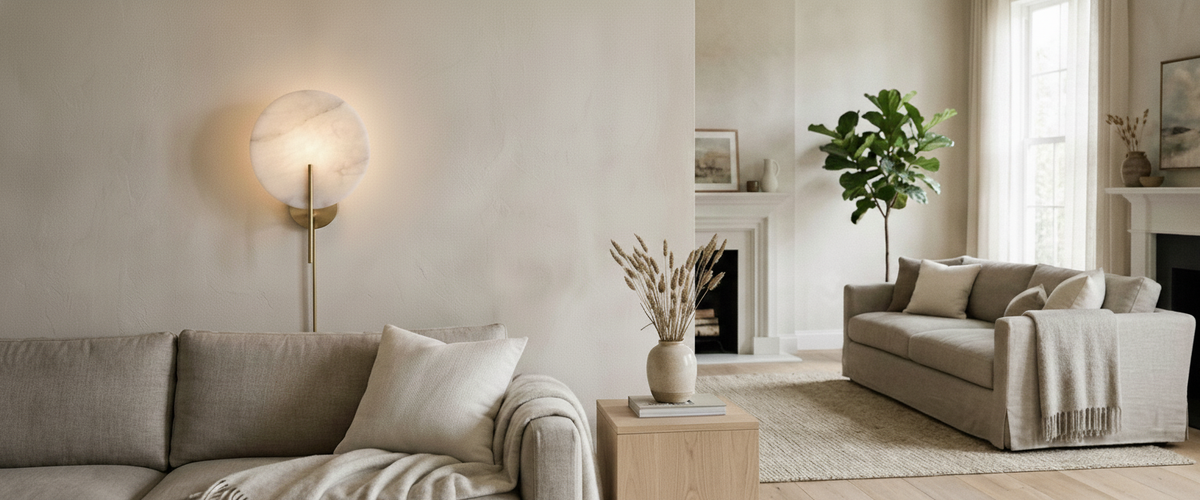

There is a thin line between a room that looks deliberately modern and one that just looks stripped back, and modern wall lights sit right on it. Get the wash, the height, and the material wrong and a clean scheme reads as unfinished. Get them right and the same white wall feels intentional, warm, and quietly expensive. The difference rarely comes down to the fixture alone; it comes down to how the light lands.
At Niori we make alabaster and natural-stone lighting, and modern wall lights are where the material earns its keep. Stone diffuses a lamp from the inside out, so instead of a bright point you get a soft, glowing plane. That is worth knowing before you buy, because it changes which fixtures suit which walls.
Alabaster wall lights glow as a surface rather than a point, softening a hard scheme.

Key Takeaways
Decide the wash first. Uplight, downlight, or both changes the mood more than the shape of the fixture.
Height and spacing signal intent. A pair of modern wall lights mounted at the same measured height reads as design; a rough guess reads as an afterthought.
Alabaster softens hard schemes. Its warm diffusion takes the edge off concrete, glass, and matte black.
Wall colour matters. The finish behind the sconce either supports the glow or fights it.
Watch for glare and float. Two common install mistakes quietly undo an otherwise clean scheme.

Deliberately Modern Versus Merely Stripped Down
Modern wall lights are easy to get wrong because "modern" is often read as "take everything out." A bare cylinder throwing a hard cone of light onto a flat wall is minimal, but it is not considered. The eye can tell the difference. Considered contemporary lighting has a reason for every choice: the direction of the light, the way it meets the wall, the material that shapes it.
This is where modern wall sconce lighting in stone behaves differently from a metal or acrylic equivalent. An alabaster face does not just hold a bulb; it becomes the light source. The glow reads as a surface rather than a spot, which is far more forgiving in a room built from hard planes. If your scheme is already spare, the warmth of the material is what keeps it from feeling cold. You can see the range of forms this works with across our alabaster lighting collection.
Uplight, Downlight, or Both: Choose the Wash Before the Fixture
Before you look at a single product, decide what you want the light to do. This is the step most buyers skip, and it is the one that matters most when you are specifying modern wall lights.
Uplight throws light toward the ceiling. It lifts a room, softens the mood, and works beautifully in living spaces and bedrooms where you want ambient glow rather than task light. In a room with a tall or vaulted ceiling, uplight makes the volume feel generous.
Downlight pushes light toward the floor. It is useful along a hallway, beside a bed for reading, or to graze a textured wall. Downlight has more drama and more control, but it can also create harsh pools if the fixture sits too proud of the wall.
Up-and-down modern wall lights do both, splitting the beam into two washes. These are excellent outdoors and on stairways, where you want the wall lit above and the treads lit below. On an exterior facade where you want that dual duty in a weatherproof form, a piece such as the Rex Up Down Outdoor Wall Light is built for exactly that split-beam job.
A translucent alabaster sconce softens both directions at once because the stone leaks a gentle ambient glow regardless of where the main beam points. That is the quiet advantage of the material: even a downlight-focused piece never goes fully dark against the wall.
Even spacing and matched height along a hallway make a run read as deliberate design.
Mounting Height and Spacing That Look Intentional
A pair of modern wall lights that are level and evenly spaced reads as design. A pair that are slightly off reads as a builder's guess. This is the cheapest, highest-impact thing you can control.
As a working rule, general wall sconces sit around 60 to 66 inches (roughly 152 to 168 cm) from the floor to the centre of the fixture, which puts the light near eye level for most people standing. Adjust for use:
Beside a bed: mount so the light falls onto the page when you are propped up, usually a little above the mattress and clear of the headboard.
Flanking a mirror or artwork: keep the pair symmetrical and let the fixture height relate to the object, not the ceiling.
Down a hallway: space fixtures evenly, commonly 8 to 10 feet (about 2.4 to 3 m) apart, and keep every one at the same height so the run feels rhythmic.
Scale is part of this decision too. On a broad feature wall a larger disc such as the Essence Round Wall Light 115cm holds its own where a smaller fixture would float, while in a tighter hallway or beside a bed the 75cm version keeps the same glow at a proportion that suits the space. Measure from the finished floor, not the subfloor, and mark both fixtures before you drill either. On a symmetrical pair, one being an inch high is more obvious than you think. We always tell clients to hold the fixture, or a paper template of it, against the wall at night with a lamp behind it before committing to the fixing points.
Where an Alabaster Sconce Softens a Hard Contemporary Scheme
The rooms that most need warmth are usually the hardest ones. Polished concrete, large-format porcelain, structural glass, matte black joinery: these surfaces look sharp in daylight and can feel clinical after dark. An alabaster wall light is a corrective. The stone glows amber-warm and slightly uneven, and that natural variation reintroduces the softness the hard materials removed. This is where modern wall lights do work that recessed downlights cannot.
We shipped a pair of round alabaster fittings to a client finishing a concrete-and-steel extension outside London. Their brief was blunt: the space photographed beautifully but felt like a showroom to sit in. Two low-level sconces on the longest wall changed the temperature of the whole room in the evening, because the light now came from a warm surface at seated height rather than only from the ceiling. Nothing structural changed. The feeling did.
Natural stone has been valued as a diffuser of light for a very long time; thinly worked alabaster was used in medieval church windows precisely because it passes a soft, honeyed light, as the Victoria and Albert Museum notes in its material collections. That same property is what makes it flatter a modern room today.
Wall Colours and Finishes That Let a Modern Sconce Sit Right
The wall behind the light is part of the fixture, whether you plan it or not. Its colour and finish decide how the glow reads, and it can make or break a set of modern wall lights.
Warm off-whites and soft greys bounce an alabaster glow cleanly and keep the light looking natural rather than tinted.
Deep, moody colours such as charcoal, ink blue, or forest green make a stone sconce read as a jewel; the contrast lets the glow float.
Matte finishes absorb stray light and keep the beam controlled, which suits downlight and grazing effects.
High-gloss or very reflective surfaces can throw hotspots and double the light source in a distracting way, so test before you commit.
Texture matters too. A downlight over a plaster or stone wall reveals every ripple, which can be lovely or unforgiving depending on the finish. If your wall is imperfect, choose uplight or a diffuse alabaster face rather than a tight downward beam. You can compare fixture shapes and outputs across the wider lighting range to match the wash to your wall.
The Glare and Float Mistakes That Undo a Clean Install
Two errors ruin more modern wall lights than anything else.
Glare. A visible bulb or an over-bright lamp at eye level is tiring and cheap-looking. The fix is partly the fixture (choose one that shields the source or diffuses it through stone) and partly the bulb. Use a warm colour temperature, around 2700K, and put the circuit on a dimmer so you can bring the level down in the evening. Glare control is a core part of good lighting design, not an afterthought, and it is worth taking as seriously at home as any specifier would on a project.
Float. This is when a fixture looks stranded on a large empty wall, disconnected from anything. Modern wall lights need a relationship: to a piece of furniture, a doorway, a mirror, a headboard, or a matching partner opposite. A single light marooned in the middle of a blank wall reads as a mistake even when it is perfectly level. Anchor it to something.
Quick Buyer's Checklist
Decide uplight, downlight, or both before choosing a shape.
Pick the material to suit the room: alabaster to warm a hard scheme, metal for crisper task light.
Confirm mounting height for the specific use, measured from the finished floor.
Mark and level both fixtures of a pair before drilling either.
Choose a warm bulb around 2700K and wire the circuit to a dimmer.
Use a qualified electrician for any hardwired install.
Anchor each fixture to furniture, art, or a matching partner so nothing floats.
Caring for Stone Wall Lights
Alabaster and marble are softer than glass, so treat them gently. Dust with a dry, soft cloth. Avoid household sprays and anything acidic, which can etch the surface over time. If a mark needs lifting, a barely damp cloth and immediate drying is safer than any cleaner. Kept out of constant wet contact, stone modern wall lights hold their glow and veining for decades.
Buying With Confidence
Budget for modern wall lights depends on material, scale, engineering, and finishing, so it is worth asking for a tailored quote rather than assuming a figure. A carved alabaster face is a different proposition to a pressed metal shade, and the price reflects the work in the stone. Decide the wash and the room first; let those choices lead you to the fixture, and your modern wall lights will read as deliberate rather than merely bare.