
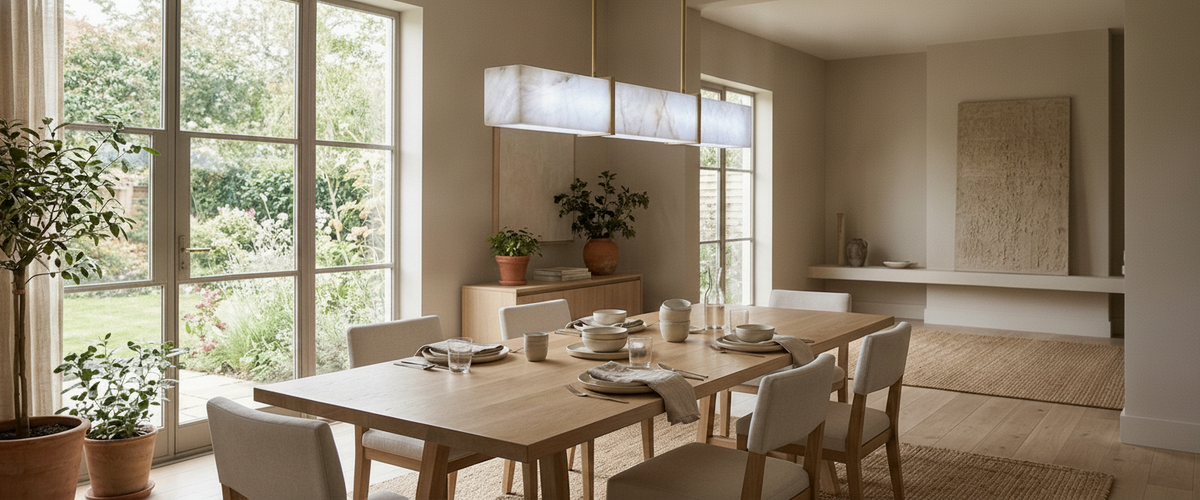

Modern chandeliers in the dining room do the heavy lifting on atmosphere: they mark the table as the center of the space and set the light level for everything that happens around it. Swap a builder-grade ceiling fitting for a well-chosen modern chandelier and the room stops feeling like a passage and starts feeling like somewhere people want to linger. Get the scale and drop right and the fixture reads as deliberate. Get them wrong and even a beautiful piece looks stranded, floating too high or crowding the table like an afterthought. This guide walks through scale, drop, shape, and placement so your modern chandeliers dining room choice lands as the anchor of the room.
At Niori we make alabaster and natural-stone lighting, and the dining room is where our pieces earn their place. Stone diffuses light in a way clear glass and bare bulbs never do, which matters over a table where you want a warm, flattering glow rather than glare bouncing off wine glasses. This is why modern chandeliers for the dining room reward a material with some substance behind it.
An alabaster fixture centered over the table sets the evening mood.

Key Takeaways
Center the chandelier over the table, not the room, and hang the bottom of the fixture roughly 30 to 36 inches (76 to 91 cm) above the tabletop.
Match shape to the table: a linear chandelier for a long rectangle, a round or square fixture for a square or round table.
Aim the fixture width at around half to two-thirds the width of the table.
Alabaster and natural stone soften output, so pair it with dimmable warm-white bulbs for control.
Ceiling height, backdrop, and the surrounding light all decide whether a minimal fixture breathes or disappears.

How a Modern Chandelier Changes the Room's Whole Mood
Traditional dining rooms leaned on crystal and formality. A modern dining room chandelier does the opposite job. It can hold presence over the table while keeping the space relaxed, especially when the material carries the interest rather than a busy silhouette. An alabaster piece reads as sculptural when it is off and glows gently when it is on, so the room shifts from daytime calm to evening warmth with the turn of a dimmer. That flexibility is exactly why modern chandeliers in the dining room have edged out the fussier options.
The trick is letting the fixture set a tone that suits how you actually eat. A slim linear form over a long table suits everyday family suppers and dinner parties equally. A single strong pendant or a compact cluster suits smaller tables where you want one clear focal point. Browse the shapes across our lighting collection before you commit; seeing the forms next to each other makes the decision easier than judging one piece in isolation. Good modern chandeliers for the dining room start with that shortlist.
Scale and Drop: Presence Without Blocking Faces
Scale is where most people go wrong with modern chandeliers in the dining room. A fixture that looks generous in a showroom can shrink over a real table, so err larger than instinct tells you. A useful starting rule: the chandelier's diameter (or length, for a linear piece) should sit at around half to two-thirds the width of the table. Over a 40-inch-wide (102 cm) table, that points you toward a fixture roughly 20 to 27 inches (51 to 69 cm) across. For a table in that range where you want presence without bulk, a six-light fixture such as the Dynamite 6 Light Chandelier in black spreads its mass across the width rather than concentrating it in a single heavy globe.
Aim for half to two-thirds the table width and a 30 to 36 inch drop.
Drop height is the other half of the equation. Hang the bottom of the chandelier about 30 to 36 inches (76 to 91 cm) above the tabletop. That range keeps light on the food and clears sightlines so people across the table can see each other without a fixture bisecting their faces. Taller ceilings can take the higher end of that range; add a little clearance for every foot of ceiling above the standard eight (2.4 m). The Royal Institution of Chartered Surveyors notes that standard ceiling heights hover around 2.4 metres, which is the height most of these rules assume, so adjust upward for period rooms with lofty ceilings. Drop is the setting people fudge most with modern chandeliers in the dining room.
One lesson from the studio: when clients send us a table width and a ceiling height, we can almost always talk them out of a fixture that is too small. The most common regret we hear about modern chandeliers in the dining room is not that a piece is too big. It's "I wish I'd gone larger."
Linear Over a Long Table, Round Over a Square
Shape should follow the table beneath it. A linear chandelier in the dining room mirrors a long rectangular table and spreads light evenly along its length, which is why long banquettes and farmhouse tables almost always want a linear form rather than a single central globe. Where a long surface needs even coverage rather than a single pool of light in the middle, a horizontal run such as the Essence Linear Pendant Light in brass keeps the whole table lit without dark ends. This is where modern chandeliers for the dining room prove their worth.
Round and square tables ask for a different answer. A round fixture over a round table echoes the geometry and pulls the eye to the center. A square linear or a compact cluster suits a square table for the same reason. The point is that a dining room table chandelier should feel like it belongs to the table, not the ceiling grid. Mismatched shapes are the quiet reason a room feels slightly off even when every individual piece is lovely.
If your table extends with leaves for guests, plan for the longer configuration. A linear fixture that flatters the everyday four-seat setup can look mean once the table stretches to seat eight. Our alabaster lighting range includes both linear and clustered forms so you can size to the table you host at, not just the one you eat at on a Tuesday. Either way, modern chandeliers for the dining room work best when the outline answers the shape below.
Bulbs and Dimming That Keep Clean Lines from Feeling Harsh
Modern fixtures live and die by their light quality. Clean minimal lines can turn cold and clinical if the bulbs fight the material, so this is worth getting right. Choose warm-white LEDs in the 2700K to 3000K range for dining; that warmth flatters skin, food, and wood. Alabaster and marble already soften and scatter output, so you rarely need high wattage. You need control.
Fit a dimmer. Non-negotiable in a dining room. You want bright enough to lay the table and dim enough for a long dinner, and a single fixed level can never do both. This is where modern chandeliers in the dining room pay you back, because a smooth low-end dim gives you that candle-adjacent glow. Check that your chosen bulbs are genuinely dimmable and that they pair cleanly with your dimmer switch, because mismatched LED-and-dimmer combinations flicker or buzz. When stone diffuses the light, that low dim reads warm without any visible bulb hotspots through the shade. Leave any wiring or switch changes to a qualified electrician rather than a weekend project.
Backdrop and Ceiling Height: Let a Minimal Fixture Breathe
A restrained chandelier needs room to register. Against a busy gallery wall or a heavily patterned ceiling, a minimal fixture gets lost. Give it a calmer backdrop: a plain or softly colored ceiling, uncluttered walls nearby, and enough negative space that the eye reads the silhouette. Alabaster in particular rewards a quiet setting because the veining and glow become the detail. It's the setting that makes modern chandeliers in the dining room look considered.
Ceiling height changes the whole calculation for modern chandeliers in the dining room. Low ceilings suit flush or shallow-drop fixtures and linear forms that hug the horizontal. Double-height dining rooms and open-plan spaces can carry longer drops and more sculptural pieces that would overwhelm a standard room. If you have a mezzanine or a stairwell edge overlooking the table, remember the fixture will be seen from above too, so pick something that looks resolved from every angle.
Placement Mistakes That Strand a Striking Chandelier
The most frequent error is centering the chandelier on the room instead of the table. If your table is not dead-center in the room (and few are), the fixture must move with it. A chandelier hovering over empty floor while the table sits off to one side is the classic tell of a fixture installed before the furniture was planned. It undoes even the best modern chandeliers in the dining room.
A short checklist to avoid the usual traps with modern chandeliers in the dining room:
Center on the table, not the walls. Mark the table's center point and hang from there.
Don't undersize. Measure the table width and aim for half to two-thirds of it.
Respect the 30 to 36 inch drop. Too high and it detaches; too low and it blocks faces.
Coordinate, don't clone. Nearby wall lights or a sideboard lamp should share a warmth and finish, not repeat the exact same fixture.
Layer the light. A single chandelier rarely lights a whole dining room; add wall lights or downlights on separate dimmers so the chandelier can stay low and atmospheric.
Handled well, modern chandeliers in the dining room do more than light the meal. They tell everyone at the table that this is the room where the day slows down. With alabaster or natural stone doing the diffusing, modern chandeliers in the dining room keep the light warm and forgiving from the first course to the last glass.