
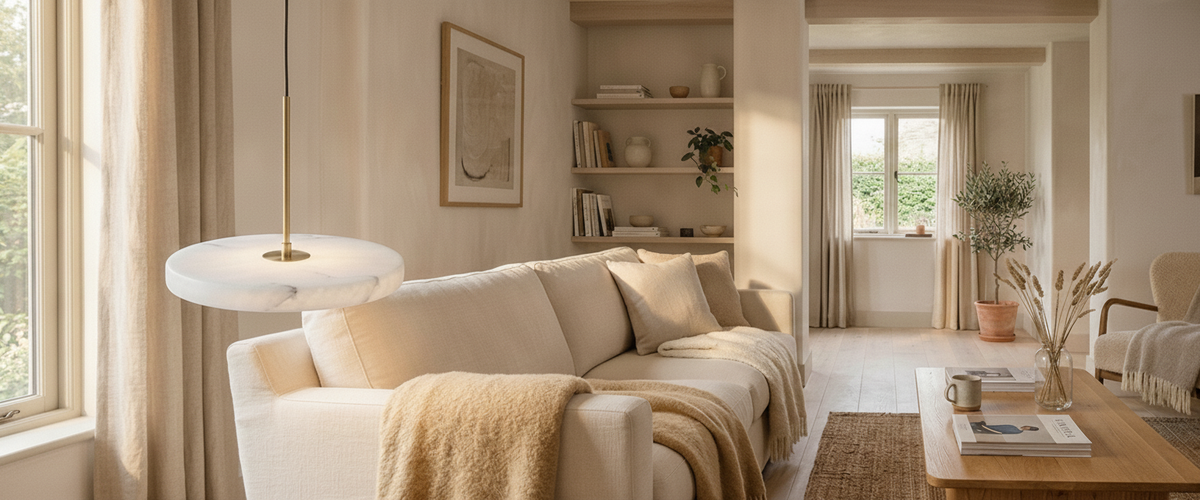

Walk into a lot of newly finished modern living rooms after sunset and you get the same feeling: a bit like a dental surgery with better sofas. Flat white downlights, one glaring pendant, everything lit at the same brightness. The design intent was calm and minimal. The result is clinical. A living room modern in feel can hold its clean lines and still feel like somewhere you'd want to sink into a chair with a glass of wine, and the fix is almost always about light quality rather than more fittings.
The trap is that minimalism and cold light get bundled together. They don't have to be. Some of the warmest rooms we've shipped into are the most stripped-back ones, because there's less clutter competing with the glow of a well-placed lamp.

Key Takeaways
Cold, evenly bright light is what makes a living room modern in style feel clinical, not the minimalism itself.
Aim for warm colour temperature (roughly 2700K) and full dimming on the main circuits.
Natural materials like alabaster diffuse light and soften a pared-back scheme without adding visual noise.
Layer three or four light sources at different heights instead of relying on one bright ceiling fitting.
Two floor lamps in a living room are completely fine, and often better than one.

Why Modern Living Rooms End Up Over-Lit
Two habits do most of the damage. The first is treating downlights as the whole scheme, so a grid of ceiling spots ends up carrying every job at once: reading, watching television, having people over. The second is buying cool-white bulbs because they look crisp in the shop and forgetting that a living room modern in look is somewhere you unwind, not somewhere you file paperwork.
A modern living room needs contrast to feel restful. Pools of warm light and quieter shadow read as calm; a room lit to one flat level reads as an office. Once you stop asking the ceiling to do everything, the whole thing relaxes.
Warmth From the Bulb Up
Colour temperature is the single biggest lever you have, and it's measured in kelvin. Lower numbers are warmer and more amber; higher numbers push cold and blue. For a living room modern in style we point people at around 2700K, which sits close to the tone of traditional incandescent light and flatters skin, timber, and stone alike. Anything from 4000K upward starts to feel like a task-lit space rather than a room to relax in.
Colour rendering matters just as much. Look for a CRI of 90 or higher so that fabrics and finishes show their true colour instead of a washed-out version. The Chartered Institution of Building Services Engineers publishes guidance on lighting quality that's worth a read if you're specifying a whole scheme rather than swapping a bulb or two.
Then dim everything you reasonably can. A modern room lives or dies on the ability to drop the level as the evening goes on. Fit trailing-edge LED dimmers matched to your bulbs, and check compatibility before you buy, because a mismatched dimmer is the usual cause of that faint flicker or buzz people blame on the lamp itself.
Letting Natural Materials Do the Softening
Here's where a pared-back scheme has an advantage most people miss. When you take away pattern and clutter, the materials that remain carry more weight, and light-diffusing stone does a lot of quiet work in a minimal room.
Alabaster is the material we build around at Niori for exactly this reason. It's a translucent stone that lets light pass through its body rather than bouncing it off a hard shade, so instead of a bright point you get a soft, even glow with the stone's own veining faintly visible. That glow reads as warmth even before you touch the dimmer. The same is true of onyx and some thinner marbles, each with its own character: onyx tends toward richer, banded colour, alabaster toward a creamy, cloud-like diffusion.
Because the material is doing the softening, you don't need to layer on decorative shades or fussy detailing to warm the room up. A single alabaster table lamp on a console can change the whole feel of a living room modern in taste. You can see the range of stone we work with across our alabaster lighting collection, from table lamps to larger ceiling pieces.
Statement Fittings That Suit Clean Lines
Modern doesn't mean invisible. A well-chosen statement fitting anchors a living room modern in mood; the trick is choosing one that has presence through form and material rather than through fuss.
An alabaster pendant hung low over a coffee table or a reading corner gives you a focal point that glows softly instead of glaring. A linear stone pendant works over a long sofa or a dining zone in an open-plan space. If the ceiling height allows it, a restrained chandelier built from stone rather than crystal keeps the sense of occasion without the sparkle that fights a minimal scheme. Brass detailing on a fitting reads as warm and considered next to stone, where chrome can tip a room back toward cold.
Scale is where people slip up. In a double-height or open-plan room, a fitting that looked generous in a photo can vanish. As a rough starting point, add the room's length and width in feet and use that number in inches as a guide for a central fixture's diameter; a 14 by 16 foot room (about 4.3 by 4.9 metres) points toward something around 30 inches (76 cm) wide. Treat it as a starting point, then trust your eye.
Layering Light So the Room Reads Calm After Dark
The rooms that work have three or four sources at different heights, each doing one job.
Ambient: a pendant, chandelier, or dimmed downlights set low. This is your base wash, not your main event.
Task: a floor lamp or table lamp beside the chair you actually read in.
Accent: a wall light or a small stone table lamp that puts a warm pool in a corner and kills the dead zones a single ceiling fitting leaves behind.
Feature: light grazing a textured wall, a picture, or a shelf, so the eye has somewhere soft to land.
Put these on separate switches or dimmers where you can. The point is being able to switch off the ambient layer entirely on a quiet evening and run the room on two lamps. That's the moment a living room modern in style stops feeling clinical.
Where to Place Floor Lamps in a Living Room
Floor lamps are the most forgiving layer because you can move them, so use that freedom in any living room modern in feel. A few placements that consistently work:
Beside a reading chair or sofa end, with the light source roughly at shoulder height when you're seated, so it lights the page without shining in anyone's eyes.
In a dead corner, where a floor lamp turns wasted space into a warm anchor and stops the corner reading as a black hole after dark.
Framing a focal point such as a fireplace or a large piece of art, where the lamp adds height and balance.
Behind or beside a sofa in an open-plan room, where it quietly marks the edge of the seating zone.
Can you have two floor lamps in one living room? Yes, and in a larger or open-plan space you often should. Two lamps let you balance the room diagonally, so the light doesn't all pile up on one side. Keep them broadly related in style or material rather than identical; a matched pair reads formal, while two complementary lamps feel more relaxed and suit a living room modern in taste. If you're browsing options, the full lighting collection covers floor, table, and wall pieces you can mix within one scheme.
Common Modern-Scheme Missteps
Cool-white bulbs everywhere. Even one 4000K lamp in a warm room sticks out. Match colour temperature across every fitting.
Relying on downlights alone. They flatten a room and cast unflattering shadows straight down. Add lamps at eye level.
No dimming. Full brightness is a daytime setting. Without a dimmer you've lost the whole evening mood.
Under-scaling the statement fitting. A timid pendant in a big open-plan room looks like an afterthought.
Ignoring the off state. Alabaster and stone still look considered when unlit, whereas a cheap plastic shade announces itself. In a minimal room the fittings are on display all day, so the daytime look counts.
Caring for Stone Fittings
Alabaster is softer than marble and porous, so keep it dry. Dust with a soft dry cloth and avoid household sprays, which can mark or dull the surface over time. The Smithsonian's preservation guidance on porous stone is a useful primer on why moisture and harsh cleaners are the enemy. Let LED bulbs do their bit too, since they run cool and put far less thermal stress on a stone shade than old halogens ever did.
A living room modern in style that feels warm rather than clinical isn't the product of one clever fitting. It's warm bulbs, honest materials, and light placed at more than one height so the room has depth after dark. Get those right and the minimalism finally does what it promised: calm, not cold.