
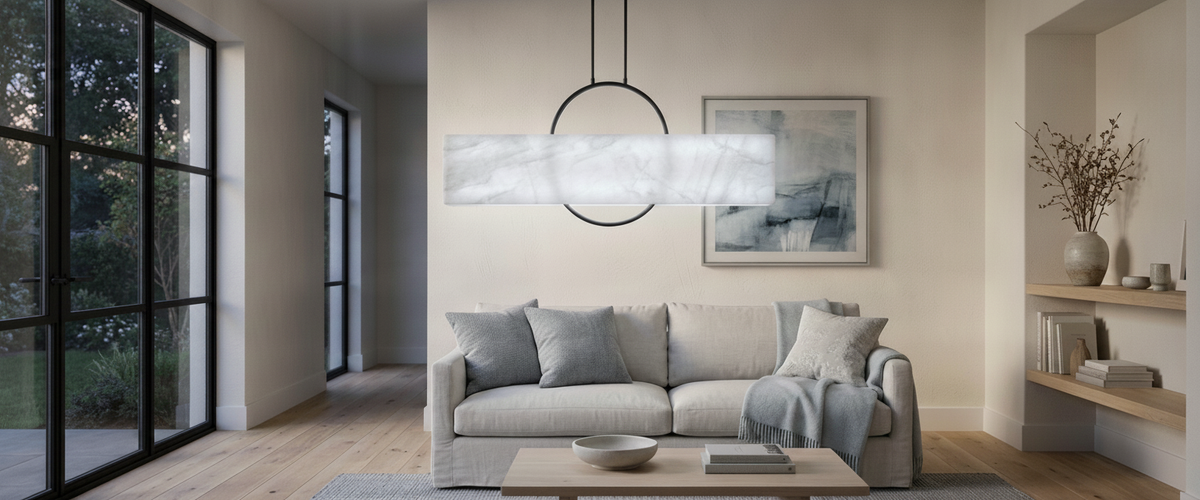

The difference between living room lights that feel warm and lived-in and ones that feel flat usually comes down to decisions made before anyone switches them on. With alabaster, the stone itself is the shade, so what a maker chooses at the quarry and on the workbench matters more than any bulb you drop in later. Get the block wrong and no amount of clever wiring saves it.
Here at Niori we work only with alabaster and natural stone, so we spend a lot of time thinking about how a single fixture will read once it is lit in a real room. This piece pulls back the curtain on how we plan living room lights and gives you the questions worth asking before you commit.
Alabaster reads as an object by day and a soft glow by night.

Key Takeaways
Stone quality drives everything. Translucency and veining decide how a fixture glows; the electrics are secondary.
Layer your living room lights. One central fixture rarely does the job; mix ambient, task and accent.
Warm bulbs matter. Aim for a 2700K color temperature and dimmable LEDs to flatter alabaster's natural cream tones.
Ask about the block. A reputable maker can tell you where the stone came from and why they cut it that way.
Budget follows craft. Price reflects material, scale, carving and finishing, so request a tailored quote rather than assuming a flat rate.

What Makers Actually Think About Before Crafting Living Room Lights
The first question in the workshop is never "what shape". It is "what will this stone do with light". Alabaster is a gypsum-based stone, soft enough to carve and translucent enough to let a warm glow pass through the material rather than bounce off it. That translucency is the whole point of alabaster living room lights. A well-chosen block turns a single LED into a soft, even wash; a poor one leaves you with dark patches and hot spots.
For a living room specifically, we think about how the piece reads both lit and unlit. You look at these fixtures all day, not just in the evening. A pendant over a coffee table needs to hold its own as an object in daylight and then come alive after dark. That double life shapes everything from the wall thickness to how much veining we leave visible.
Scale is the next call. A large room with tall ceilings, common in an open-plan build or a converted warehouse loft, can carry a substantial chandelier or a wide pendant. A snug in a period terrace wants something lower and more contained. If you are browsing the full lighting range, start by measuring the ceiling height and the distance from seating to the fixture before you fall for a shape.
Craft Decisions That Change the Final Result and the Price
A few choices in the workshop quietly set both the look and the cost of your living room lights.
Wall thickness. Thin walls glow brighter and warmer but are more fragile and harder to carve without cracking. Thicker walls diffuse light more gently and survive shipping better. Getting this balance right is skilled work, and it is one reason two alabaster pendants of the same size can differ so much in price.
Carving detail. A smooth, minimal drum shade takes less hand-work than a fluted or sculpted form. Every extra hour at the bench shows up in the final figure. Neither is better; it depends on whether you want the stone to whisper or speak.
Metalwork. Brass and bronze fittings are chosen for tone as much as strength. A warm brass collar picks up the cream in the alabaster; a cooler nickel can make the same stone look gray. We tend to favor brass detailing because it flatters the material under warm bulbs.
Because these variables stack up, there is no honest flat price for a living room pendant. The budget depends on material, scale, complexity, engineering and finishing, so the sensible move is to request a tailored quote once you know the size and style you want for your living room lights.
Backlit veining is what gives each fixture its character.
Why Stone Selection and Veining Make or Break How Living Room Lights Glow
No two alabaster blocks are the same, which is the joy and the risk of the material. Veining runs through the stone in ribbons of amber, honey and gray, and when it is backlit those ribbons become the character of the piece. The Natural Stone Institute has good background on how these gypsum stones form and vary (naturalstoneinstitute.org), which is worth a read if you want to understand why consistency is never guaranteed with stone living room lights.
A maker selects blocks with an eye to how the vein will sit once the piece is carved and lit. Heavy mineral streaks can block light and read as dark bruises when illuminated. Too little veining and the piece looks bland, closer to frosted glass than natural stone. The craft is choosing stone with enough movement to feel alive but not so much that it fights the light.
This is also why ordering alabaster is different from ordering a mass-produced fixture. You are buying a specific block with its own map of veins. If you are furnishing a room where the living room lights are the focal point, that individuality is the reason to choose stone over glass in the first place. Our alabaster lighting collection shows how varied that veining can be from piece to piece.
From Quarry Block to Wired Fixture: The Workshop Process
The path a fixture takes through the workshop runs in a fairly fixed order, and each stage depends on the one before.
Stone selection. A block is chosen for translucency and vein pattern, then inspected for hidden fractures that could open up under carving.
Cutting and rough shaping. The block is cut down and the basic form roughed out, leaving margin for the fine work.
Carving and hollowing. The interior is hollowed to the target wall thickness. This is where the glow is really decided.
Finishing. Surfaces are sanded and sealed. A matte finish softens the light; a polished one gives more sheen.
Wiring and assembly. The electrical components go in, matched to the fixture and to the bulb it is built for.
Installation. Ceiling and wall fittings should be fitted by a qualified electrician, both for safety and to carry the weight of the stone properly.
That last point is worth stressing. Alabaster is heavier than it looks; a mid-size pendant can weigh several kilograms, so the fixing needs to be sound. Guidance from Electrical Safety First is a sensible reference for anyone commissioning installation work on their living room lights (electricalsafetyfirst.org.uk).
Can Lights, Layout and Layering in the Living Room
Plenty of buyers ask about can lights for the living room, and whether recessed downlights can carry the whole room. They can handle general brightness, but they rarely give a room warmth on their own. Recessed can lights throw light downward in pools, which is useful over a reading chair or to graze a wall of shelving. On their own they can feel clinical.
For can light placement in the living room, a rough rule is to space fixtures roughly four to six feet (1.2 to 1.8 meters) apart and keep them two to three feet (0.6 to 0.9 meters) off the walls so you wash the vertical surfaces rather than lighting bare floor. A sensible can light layout puts them on their own dimmer circuit, separate from your decorative living room lights.
The real trick is layering. Use can lights as your quiet background, then let an alabaster pendant or chandelier do the emotional work overhead, with a table lamp or a pair of wall fittings filling the corners. The stone fixtures give you that soft, diffused pool of warm light; the recessed spots fill in around them. Together these living room lights let you shift a room from bright and functional in the afternoon to low and intimate at night.
What Wattage and Bulb for a Living Room
People often ask what wattage bulb suits a room like this, and with LEDs the honest answer is that lumens matter more than watts. For a main alabaster pendant you generally want a warm, dimmable LED around the equivalent of a 40 to 60 watt incandescent, landing at a 2700K color temperature. That warmth is what makes alabaster's cream and honey tones sing; a cool white bulb drains the life out of the stone.
Always fit dimmable bulbs on a compatible dimmer. Alabaster living room lights reward being dialed down; the glow gets richer and the veining more pronounced at lower levels. Check the maximum wattage the fixture is rated for and stay within it, both for safety and to protect the stone from unnecessary heat.
Honest Red Flags to Ask About Before You Commit
A few questions quickly separate a considered maker from a middleman shipping generic living room lights.
Can they tell you about the stone? A real maker knows the block, its translucency and why they cut it as they did. Vagueness here is a warning sign.
Is the wiring rated for your market? The fixture should meet your local electrical standards, not just look the part.
How is it packed and shipped? Stone chips. Ask about crating and insurance for international delivery before you pay.
What does care involve? Alabaster is porous and does not like water. A dry, soft cloth is usually all it needs; the maker should say so without prompting.
Is the price itemized? A quote that reflects material, scale and finishing tells you far more than a round number pulled from thin air.
Ask those five things and you will avoid most of the disappointments we hear about from buyers who came to us after a bad first purchase. If you want a sense of the living room lights on offer before you enquire, the Niori homepage is the easiest place to see how alabaster and natural stone behave across pendants, chandeliers, wall lights and lamps.