
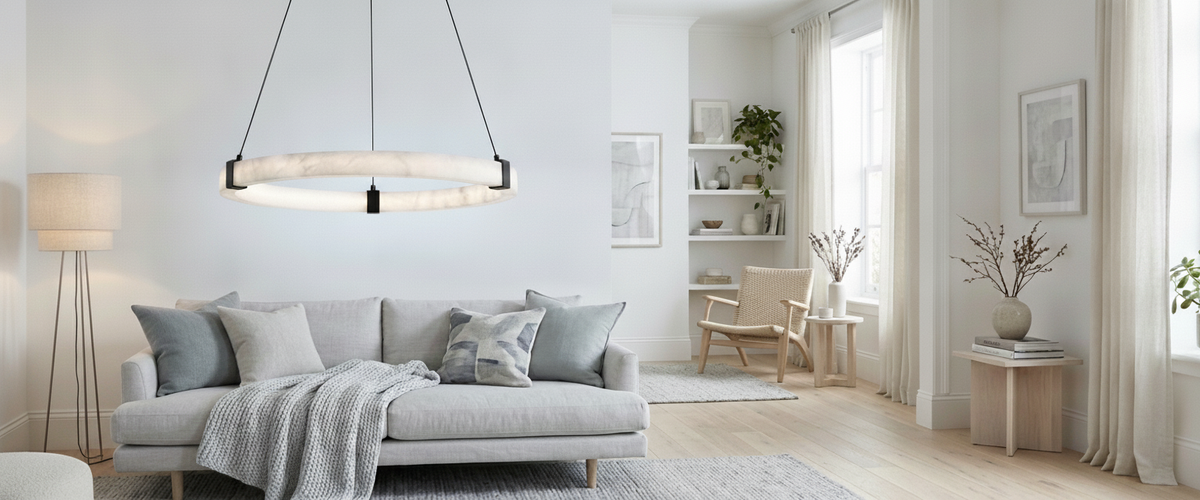

Most living rooms are lit by a single fitting in the middle of the ceiling, and most living rooms feel flat because of it. That one bright disc pushes light straight down, drops the corners into shadow, and gives you nowhere comfortable to sit come nine o'clock. The best living room lighting ideas start by throwing out the notion that one source can do the whole job. A room that reads well after dark is built from several layers, each doing something the others cannot.
We ship alabaster and natural-stone fittings to homes and design projects, and the same note comes up again and again: the room looked fine on the plan and dull in real life. Fixing it is rarely about buying a brighter bulb. The living room lighting ideas that hold up are about placing light where the eye and the body actually want it.
A layered scheme: ambient pendant, task floor lamp and accent wall lights working together.

Key Takeaways Before You Buy a Thing
Plan at least three layers: ambient for the overall wash, task for reading and work, accent for depth.
Never rely on one central ceiling light; it flattens the room and kills the corners.
Put everything on dimmers so the same room can go from bright afternoon to low evening.
Warm materials like alabaster, marble and onyx glow rather than glare, which softens the whole scheme.
Read the shape of your room first; long rooms, square rooms and open-plan spaces each want different placement.

Why One Ceiling Light Never Lights a Living Room Properly
A single overhead fitting creates one pool of brightness and a lot of nothing around it. Sit under it and you get shadows on the page you are reading; sit away from it and you are in the gloom. It also lights the floor far more than the walls, and walls are what your eye reads as the edge of a room. Under-lit walls make a space feel smaller and lower than it is. This is where most living room lighting ideas fall down before they start.
There is a physics point worth understanding here. Light falls off sharply with distance, so a source in the ceiling centre is already weak by the time it reaches your sofa in the corner. That is why professional schemes spread several modest sources around the room instead of relying on one strong one. Guidance from lighting bodies like the Illuminating Engineering Society makes the same case: comfortable rooms use distributed, layered light rather than a single high-output source.
Building the Layers: Ambient, Task and Accent That Cooperate
Ambient is your base wash, the light that fills the room so you can move around and hold a conversation without squinting. This can come from a chandelier, a set of pendants, wall lights, or a mix. In an alabaster pendant, ambient light stops being harsh; the stone diffuses it into a soft, even glow that reaches the corners without a hard edge. It is the first of the living room lighting ideas that pays off the moment you switch it on.
Task light is aimed and practical: a floor lamp beside a reading chair, a table lamp on a side table, directional light near a games table or piano. Task light should be brighter than ambient and close to whatever you are doing.
Accent is the layer people skip and then wonder why the room feels flat. Accent picks out a fireplace, a bookcase, a piece of art, or a run of alabaster wall lights that graze a textured wall. It adds the shadows and highlights that make a room feel three-dimensional. Get all three working together and the room stops looking lit and starts looking designed. You can browse the range of pendants, wall lights, table and floor lamps across our lighting collection to see how the layers add up in stone.
What Are the Best Ambient Lighting Ideas for Living Rooms?
For genuinely soft ambient light, translucent materials do the heavy lifting. Alabaster and onyx let light pass through the stone itself, so the fitting glows from within rather than firing a beam at the room. An alabaster chandelier or a cluster of stone pendants over a coffee table gives you that warm, low-glare wash. Pair it with a couple of wall lights at head height to lift the perimeter, and you have ambient light with no dead corners. Of all the living room lighting ideas people ask us about, this quality of diffusion is what our alabaster lighting range is built around.
Rescuing a dark corner with a floor lamp and stone wall lights instead of a brighter ceiling bulb.
Reading Your Room's Shape Before You Place a Single Fitting
Placement is decided by geometry, not guesswork. A long, narrow room wants light distributed along its length; one central fitting will leave both ends dark. Two pendants or a linear arrangement over the seating, plus wall lights at each end, keeps the whole length even. The best living room lighting ideas start with the plan, not the fitting.
A square room can carry a single statement piece in the centre for ambient duty, but it still needs task and accent around the edges. High ceilings, say over 2.7 metres (about 9 feet), give you room to hang a chandelier with real drop and presence; low ceilings favour flush or semi-flush fittings and lean harder on lamps and wall lights to build height visually.
Open-plan spaces need zoning. Use one lighting group over the sofa area and a separate group over dining or reading, each on its own switch, so the living zone can stay low while another zone stays bright. Zoning is one of the living room lighting ideas that quietly does the most work in a big space.
Corners, Alcoves and the Dead Zones a Good Scheme Rescues
Every living room has corners that a ceiling fitting cannot reach. These are the spots that quietly make a room feel unfinished. A floor lamp in a reading corner, a table lamp on a console against the far wall, or a pair of alabaster wall lights flanking a chimney breast will fill them. Corner-first living room lighting ideas are the ones guests notice without knowing why.
Alcoves either side of a fireplace are worth treating deliberately. A wall light or a small lamp inside an alcove throws light onto the books or objects you keep there and turns a shadowed recess into a feature. We once helped a client with a wide Victorian double reception where the far half went dark every evening; two stone wall lights and one floor lamp in the neglected corner did more than any brighter ceiling bulb ever could.
Dimming and Switching: Controlling the Room From Bright to Evening
A living room has to do too many jobs to run at one brightness. You want it bright for cleaning or afternoon reading and low for an evening in front of the fire. Dimmers make one scheme cover both, and they turn static living room lighting ideas into a room that shifts through the day. Put your ambient layer on a dimmer at minimum, and ideally split your layers across separate circuits so you can drop the overheads and keep the lamps.
Match the dimmer to the bulb. LED needs a trailing-edge dimmer rated as compatible with the lamps you are using, or you get flicker and buzz. Warm-dim LEDs, which shift to a warmer color as you lower them, suit alabaster beautifully because they lean into the honeyed tone the stone already carries. Any new switching or circuits should be signed off by a qualified electrician; the Electrical Safety First guidance is a sensible starting point before you commit to a wiring change.
What Are the Best Track Lighting Ideas for Living Rooms?
Track lighting earns its place when you have art, a gallery wall, or an architectural feature to pick out, and it works best as an accent layer rather than the main event. Run a discreet track along one wall and aim the heads at pictures or a textured surface. Keep the fittings unobtrusive and let the objects do the talking. Among track-based living room lighting ideas, this restraint is what keeps it from taking over. In a room that already has alabaster pendants doing the ambient work, a low-key track adds precision without competing with the softer fittings.
Warm Materials Under Light: Making Stone, Timber and Fabric Glow
Light is only half the equation; what it lands on matters just as much. Warm materials come alive under warm light. Timber grain deepens, wool and linen soften, and natural stone shows its veining. Alabaster is the standout here because it is translucent: light travels into the stone and comes back out carrying the color of the mineral, so the fitting itself becomes a warm object in the room. Material choice is where good living room lighting ideas separate from lazy ones.
The material has a long pedigree for exactly this reason. Alabaster has been carved for lamps and windows since antiquity precisely because it passes soft light, a property visible in the ancient pieces held at the Metropolitan Museum of Art. In a modern living room that translates to a fitting that glows rather than glares, which is what makes an evening scheme feel calm.
Keep color temperature warm across the whole room, around 2700K, so nothing jars. A cool white lamp next to a warm alabaster pendant reads as a mistake even if you cannot say why. Consistency in tone is what pulls a set of separate living room lighting ideas into one considered scheme.
A Quick Buyer's Checklist
Count your layers: do you have ambient, task and accent, or are you missing one?
Map the dead corners and assign a lamp or wall light to each.
Choose warm-toned bulbs (around 2700K) and keep them consistent.
Confirm your dimmers are rated for the LEDs you plan to use.
Match fitting scale to ceiling height and room size, not to the picture in a catalog.
Ask for a tailored quote rather than guessing at budget; cost depends on material, scale, engineering and installation.
Budget for these living room lighting ideas varies widely and there is no honest one-size figure. What drives it is the material, the size and complexity of the fitting, the engineering behind it, and the installation and finishing. If you are planning a full scheme built on the living room lighting ideas above, it is worth requesting a quote against your actual room rather than working from a rough band.