

Push the app slider from cold blue to hot pink and, for about ten seconds, an led ceiling downlight rgb feels like magic. Then the novelty fades and you are left with the question that actually matters: does colour change help this room do its job, or does it just add clutter to a ceiling you will look at every day for the next fifteen years? At Niori we sell alabaster and natural-stone lighting for a living, so we spend most of our time thinking about the quality of warm light rather than the drama of colour. That gives us a slightly contrarian view on the led ceiling downlight rgb category, and it is worth hearing before you spec a whole ceiling of colour heads.
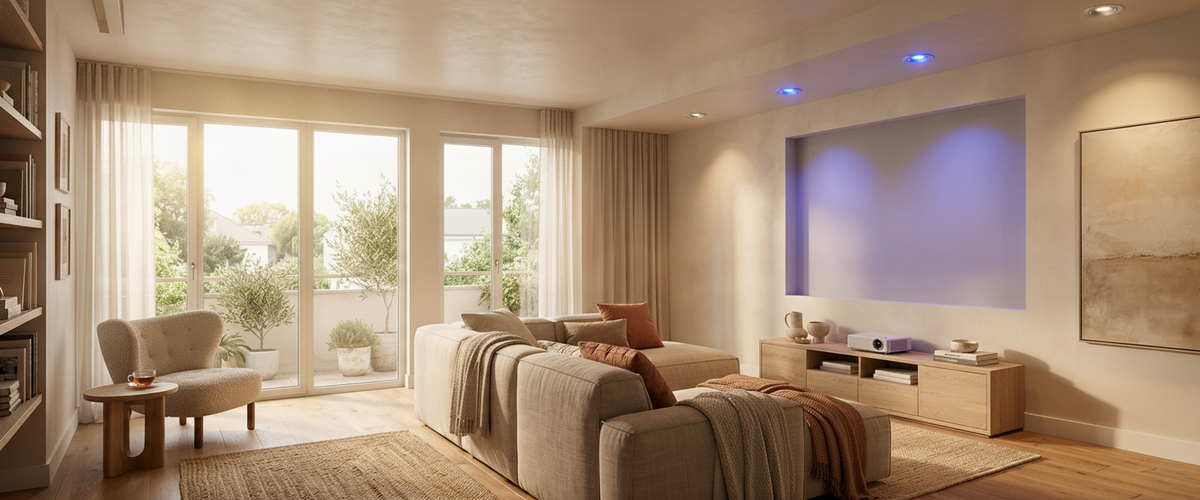
Colour change earns its place in leisure rooms like this cinema wash.
The short version is that an rgb led ceiling downlight has a real place, but a narrow one. Used well it adds atmosphere to spaces designed for leisure. Used badly it turns a considered interior into a games room.

Key Takeaways
RGB earns its place in media rooms, bars, gyms, pools and children's spaces, not in kitchens, bathrooms or bedrooms you rely on daily.
Tunable white (warm to cool, no colour) is the quieter, more useful upgrade for most homes.
Drivers and controls decide whether a colour fade looks smooth or flickers; cheap gear ruins good fittings.
A led recessed ceiling downlight needs even spacing so the ceiling reads consistent, whatever colour it is set to.
Keep alabaster and stone fittings on their own warm circuit, away from the colour-change wiring.

What an RGB Downlight Actually Delivers Next to a Fixed Warm White
A fixed warm white downlight does one thing and does it well: it throws a clean pool of 2700K to 3000K light onto a floor, worktop or table. There is nothing to fiddle with. A led ceiling downlight rgb adds red, green and blue diodes so the same unit can shift across the spectrum, usually with a separate white channel for practical light.
The catch sits in that word "usually". Many budget colour heads mix their white from the coloured diodes, which gives you a flat, slightly grey daylight rather than a genuine warm glow. So the everyday light, the light you use almost all the time, is worse than a good fixed fitting. Better RGBW and RGBWW units keep dedicated white diodes for exactly this reason. If you are buying an rgb led ceiling downlight, that extra W is the difference between a fitting you can live with and one you switch off in disgust after a week. Where a room simply needs a clean, dedicated warm source rather than a colour effect, a fixed 3000K fitting such as the Look LED Round Ceiling Light 20cm 3000K in White is closer to the right design language.
The Rooms That Reward Colour Change, and the Ones It Cheapens
Colour belongs in rooms built for play. A home cinema gains from a low blue wash during a film. A basement gym feels sharper under a cool tone and more relaxed under amber for stretching. Bars, snugs, pool surrounds and teenage bedrooms all take a led ceiling downlight rgb happily because nobody expects them to be neutral.
The rooms it cheapens are the ones that need honesty. A kitchen with green downlights makes food look inedible. bathroom ceiling led downlights that drift purple flatter no complexion; you want skin to read true when you are shaving or applying makeup. Bedrooms suffer too, since coloured light near bedtime works against the wind-down you actually want. If a space is about food, faces or focus, keep it white.
We once shipped a run of alabaster wall lights to a pool house where the client had already fitted colour-change recessed heads across the whole ceiling. In daylight the room looked confused; the stone wanted warmth and the ceiling kept flashing cyan. The fix was not more colour. It was pulling the colour circuit back to the covered lounge area only and letting the alabaster carry the rest.
Why Tunable White Quietly Beats Full RGB for Daily Living
Tunable white is the upgrade most people actually want when they think they want a led ceiling downlight rgb. Instead of the full colour wheel, it slides from a candle-warm 2200K up to a crisp 5000K or so, all in white light. That range covers the useful cases: warm and low in the evening, bright and cool for cleaning or working, without a single moment where the room looks like a nightclub.
There is a health-adjacent reason to prefer it. Warmer, dimmer light in the evening sits better with the body's natural rhythm, something the Sleep Foundation discusses in its guidance on light and sleep. Tunable white lets you follow that curve through the day; an led ceiling downlight rgb tempts you to override it for a party trick. For a ceiling of a led recessed ceiling downlight across a whole home, tunable white is the specification we point most buyers toward.
Driver and Control Quirks That Turn a Smooth Fade Into Flicker
The single biggest reason colour installs disappoint is the control gear, not the diodes. A led ceiling downlight rgb needs more data channels than plain dimming, and cheap drivers cannot keep up. You get visible stepping between colours, a stutter as the light fades, or a low-level flicker that gives some people headaches under a long film.
Matched drivers and a proper control protocol keep colour fades smooth.
A few things protect you here:
Match the driver to the fitting. Mismatched constant-voltage and constant-current gear is a common cause of flicker and early failure.
Prefer a proper control protocol. DMX or a well-implemented Zigbee or Casambi system handles smooth fades far better than a generic radio remote.
Check the dimming floor. Many RGBW units cannot go truly low without colour shift; ask what happens at ten per cent.
Group your circuits. Do not put a led ceiling downlight rgb and plain white heads on one channel and expect either to behave.
Continuous colour runs, such as cove or strip lighting, bring their own connection details, where components like an RGB LED Strip Connector 120mm 12V DC keep the coloured channels aligned along a length rather than jumping at each join. Any mains work here should go to a qualified electrician. Low-voltage control wiring is one thing; the supply side is not a weekend project, and installs should follow current wiring regulations as advised by Electrical Safety First.
Recessed Placement: Spacing Colour Heads So the Ceiling Reads Even
A ceiling mounted led downlight scheme lives or dies on spacing. Get it wrong and you see scallops of light on the walls and dark gaps between fittings, which a led ceiling downlight rgb only makes more obvious. As a rough starting point, space recessed heads at a distance roughly equal to the ceiling height, so a 2.7 m (9 foot) ceiling wants heads around 2.7 m apart, then adjust for the room's use and any feature you want to graze.
With a ceiling recessed led downlight in colour, evenness matters even more, because a single head that sits slightly off-tone stands out the instant you set a saturated hue. Keep the heads on a consistent grid, use the same batch where you can, and avoid mixing colour-change units from different suppliers on the same visible run. Beam angle counts too: narrow beams punch dramatic pools, wider beams give a softer wash that hides small colour differences between fittings.
Scale is part of that grid decision. Over a larger open span a broader fitting such as the Look LED Round Ceiling Light 40cm 3000K in White covers more area per point and keeps the spacing legible, whereas a compact 20cm head suits tighter zones and corridors. If you want a full picture of fixture types before you commit a whole ceiling, our lighting collection shows how pendants, wall lights and ceiling fittings work together in a scheme rather than as isolated points.
Keeping Alabaster and Stone Fittings Clear of the Colour Circus
Here is the part we feel strongly about. Alabaster and onyx earn their keep because they diffuse a warm light through natural veining, giving a glow that reads as candlelight rather than technology. Push saturated colour through stone and you lose the whole point: the tint muddies against the mineral tones and the veining turns murky. Backlit stone wants a clean, warm source, held steady, never a led ceiling downlight rgb throwing hue at it.
So we keep the two jobs separate. Let the colour downlights do atmosphere in the rooms that suit it, and let alabaster pendants, wall lights and table lamps carry the warm, human layer everywhere else. On more than one project the smartest move has been fewer colour heads and one well-placed alabaster piece as the anchor. If you are weighing that balance, the alabaster lighting range is a useful reference for what warm diffused stone actually looks like against a cooler recessed grid.
Think in layers. Recessed heads for general and task light, dimmable and ideally tunable white. A colour circuit only where play justifies it. Then stone and glass for the warm, low, evening glow that no colour slider can fake. That hierarchy keeps a room calm by default and playful on demand.
A Quick Buyer's Checklist
Ask what makes the white. Dedicated white diodes (RGBW/RGBWW), not colour-mixed white.
Confirm the control system before you buy the fittings, not after.
Limit the colour zones to leisure rooms; specify plain warm or tunable white elsewhere.
Choose one supplier per visible run to keep colour consistent.
Budget honestly. Cost of a led ceiling downlight rgb depends on fitting quality, driver, control protocol, number of zones and installation, so request a tailored quote rather than trusting a headline price.
Keep stone fittings on a separate warm circuit so alabaster and onyx never get dragged into the colour show.
Colour is a tool, not a lifestyle. Spec a led ceiling downlight rgb where a room is meant to change mood, keep it away from food, faces and sleep, and let warm stone do the quiet work everywhere else. Do that and you get the best of both: a ceiling that can throw a colour when you want a party, and a home that feels considered every other night of the year.