

Most kitchens are lit by one bright ceiling fitting doing the work of three, and it shows. You get glare over the sink, shadows across the chopping board, and a room that reads like an operating theatre at nine in the evening. Good kitchen lights solve a harder problem than "make it bright": the same room has to cook, dine, and wind down, often within the same hour. The trick is layering, and the payoff when you get the kitchen light fixtures right is a kitchen that flatters food, faces, and stone worktops alike.
Niori works in alabaster and natural stone, so we think about kitchens in terms of how light behaves when it passes through a material rather than bouncing off a shiny reflector. Alabaster diffuses a warm, low-glare glow that suits the long social hours a modern kitchen keeps, which is why we choose it for so many of our kitchen light fixtures. More on where that matters below.
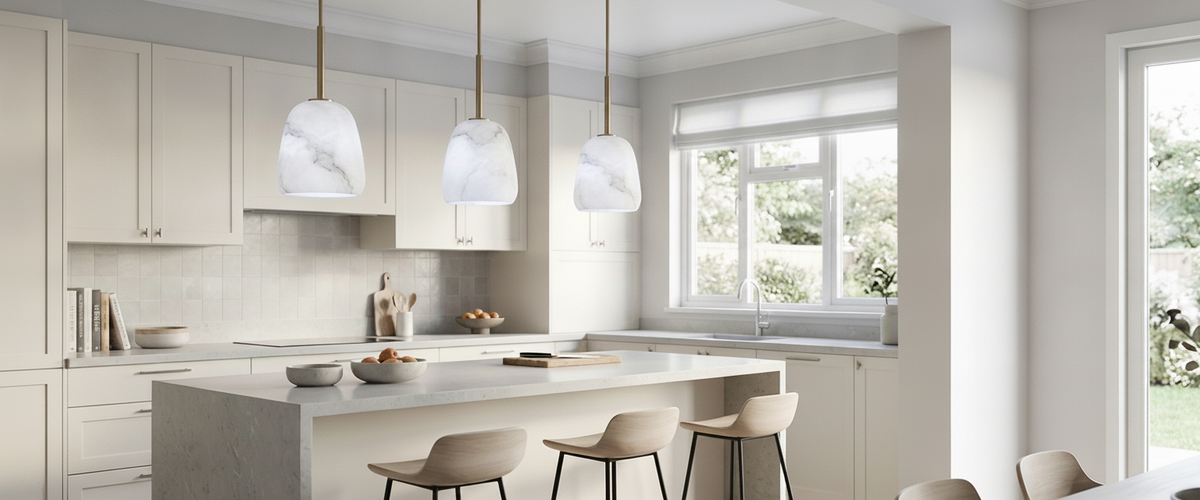
Layered lighting over a stone-topped island keeps the whole room warm rather than flatly bright.

Key Takeaways Before You Buy
Layer, don't stack. Plan task, ambient, and accent light as separate circuits, not one big fitting turned up loud.
Aim task light in front of you so your body never casts a shadow onto the worktop.
Island pendants want roughly 30 to 36 inches (76 to 91 cm) of clearance above the surface, spaced evenly.
Go warm-white LED around 2700K and put your kitchen light fixtures on dimmers so the room can shift from prep to supper.
Draw the plan before you spend. A rough scale sketch saves you from buying the wrong number of fittings.

Why One Kitchen Fixture Can't Do Everything
A kitchen asks three different things of its lighting across a single evening. Chopping and reading a recipe need crisp, directed light on the surface. Eating at the island or table wants something warmer and lower, pooled over the food. Late-night pottering, a glass of wine, a child fetching water, wants a soft wash that keeps the room feeling calm rather than clinical.
No single fitting hits all three. Turn a bright ceiling light up for chopping and it flattens the whole room at dinner. Dim it for atmosphere and you can't see what you're slicing. That's why the best kitchen light fixtures are built in layers, each on its own switch or dimmer, so you dial in the scene the moment calls for. Good kitchen lights respect that split.
The layers are simple to name: task light onto the work surfaces, ambient light filling the volume of the room, and accent or feature light, usually your island pendants, doing the decorative and social work. Get all three and the kitchen light fixtures stop fighting you.
Task Light: Aim It So You Don't Shadow Your Own Hands
The most common mistake we see is task light placed behind where you stand. Recessed downlights sitting over the middle of the room throw your own shadow forward onto the counter the instant you lean in to chop. The fix is to bring the light source forward, over the front edge of the worktop, so it lands on your hands rather than your back.
Under-cabinet strips handle this beautifully along a run of base units, lighting the surface directly with no shadow at all. For islands and peninsulas with no cabinet above, that job falls to pendants or downlights positioned toward the working edge. The Illuminating Engineering Society recommends noticeably higher light levels for detailed kitchen tasks than for general circulation, which is exactly why task light has to be its own layer rather than an afterthought (see the IES for lighting-level guidance).
Aim for even coverage across the whole worktop, not a few hot pools with dark gaps between. Cool it too far toward blue and food looks grey; keep it warm and it still reads as a place you want to eat.
Kitchen Island Lighting: Height, Spacing, and When Stone Suits the Room
The island is where kitchen pendant lighting earns its keep, and it's where kitchen light fixtures get noticed. It's the one place people actually look at the fixture, so it carries the decorative weight of the room. Get the geometry right first, then worry about looks.
Height. Hang pendants so the bottom of the shade sits roughly 30 to 36 inches (76 to 91 cm) above the island surface. Higher and the light spreads thin and stops feeling intimate; lower and tall guests knock their heads and sightlines across the island are blocked.
Spacing and number. For a run of matching pendants, space them evenly and keep the outer ones clear of the island ends rather than hung right at the edge. As a rough rule, two pendants suit an island up to around 6 feet (1.8 m); three suits longer runs. Larger single pendants or a linear fixture can cover a big island on their own if you prefer one statement piece.
At around 32 inches, alabaster pendants pool a warm glow that makes honed marble look lit from within.
The island itself sets the tone here. A pale marble-topped piece like the Vanvorne Kitchen Island with Marble Top reflects light gently and wants pendants that warm the stone rather than bleach it, while a warmer oak-framed island such as the Etvorne Kitchen Island in Natural Oak reads best under a low, honeyed pool of light. This is where alabaster and natural stone come into their own as kitchen light fixtures. A polished-metal pendant over a stone-topped island can throw hard reflections and hotspots straight back at you. An alabaster or onyx shade does the opposite: it glows rather than glares, and the warm diffused light picks up the veining in a marble worktop instead of bleaching it out. If you want to see how those materials read at pendant scale, our alabaster lighting collection is the place to start. For the wider mix of pendants, ceiling lights, and lamps, browse the full lighting range.
One lesson from the studio: we shipped a pair of alabaster pendants to a client with a dark honed-marble island in a barn conversion, and their first instinct was to hang them high to "show them off." We talked them down to about 32 inches. At the lower height the stone shades cast a soft pool of light that made the marble look lit from within at supper. Height is not a detail; it changes the whole effect, and it can make or break otherwise good kitchen light fixtures.
The Ambient Layer That Fills the Dead Space
Task and feature light leave gaps: the far corner, the walk-in pantry doorway, the strip of floor between island and hob. Ambient light fills that volume so the room feels evenly held rather than spotlit in patches.
This is the job of kitchen ceiling lights and, in more decorative rooms, wall lights. A flush or semi-flush ceiling fitting spreads a gentle wash across the whole space; alabaster and natural-stone ceiling lights do it without the flat, shadowless look of a bare downlight grid. Wall lights on a dimmer add a lower band of glow that keeps the room warm after the task layer switches off. These are the quiet kitchen light fixtures that most people forget to plan.
Can Lights in the Kitchen: Placement and Spacing
Recessed downlights (can lights) are the workhorse of the ambient layer, and their placement matters more than their number. A common starting point for can light spacing is to divide your ceiling height by two to get the rough gap between fittings; a 9-foot (2.7 m) ceiling suggests cans about 4.5 feet (1.4 m) apart. Keep them off the very centre of the ceiling and pull the row toward the front of the worktops so they double as task support, not just fill.
Avoid the temptation to carpet the ceiling in cans. A dozen downlights blazing at full output is the glare problem you were trying to escape. Fewer cans on a dimmer, paired with under-cabinet task light and warm pendants, does far more with less.
Warm-White LED and Dimming: From Prep to Supper
Colour temperature is what separates a kitchen that feels like a workshop from one that feels like a home. For most kitchens, warm-white LED around 2700K is the anchor. It flatters skin, wood, and food, and it sits well with the honey and cream tones of alabaster. Push toward 3000K if your scheme is cooler and more contemporary; going beyond that starts to feel commercial.
Dimming is non-negotiable if you want one room to serve prep and supper. Put the task layer, the ambient layer, and the pendants on separate dimmers so you can drop the ceiling to a whisper while the island pendants hold a warm pool over the food. Buy LED lamps and drivers rated as dimmable, and match them to a compatible dimmer; mismatched kit is the usual cause of flicker and buzz. Because kitchens are heat and moisture-heavy rooms, treat the wiring for your kitchen light fixtures as a job for a qualified electrician rather than a weekend project.
Plan the Whole Scheme on Paper First
The cheapest fix for a bad kitchen lighting plan is a pencil. Before you buy a single fitting, sketch the kitchen to rough scale and mark three things: where you stand to work, where you sit to eat, and where the room goes dark. Those three notes tell you where task, feature, and ambient light have to land.
A Quick Buyer's Checklist
Map your circuits. Task, ambient, and island pendants should each switch and dim independently.
Count the pendants to the island length, not to a magazine photo. Two under 6 feet, three beyond.
Check clearance. 30 to 36 inches above the island; nothing hanging into a walkway or head height.
Confirm dimmable everything, lamps and dimmers matched, ideally around 2700K.
Weigh the fixture. Stone and alabaster kitchen light fixtures are heavier than they look; make sure the ceiling fixing and back box suit the load, and ask us for the fitting weight before you commit.
Think about cleaning. A gentle dust and the occasional wipe keeps alabaster reading warm; skip harsh kitchen sprays on natural stone.
Budget for kitchen light fixtures depends on material, scale, engineering, and installation rather than any single headline figure, so it's worth pricing the whole layered scheme together and requesting a tailored quote once you know your fitting count. Well-chosen kitchen light fixtures, arranged in considered layers with alabaster or stone carrying the island, are the difference between a kitchen you tolerate and one you linger in.