

The industrial ceiling lights kitchen designers specify most often fail for a dull, fixable reason: they hang at the wrong height for the room they are in. The fitting is fine. The finish is fine. But the pendant sits 15cm (6in) too low under a 2.4m (8ft) ceiling and every tall guest ducks, or it sits too high over an island and the light spills sideways into people's eyes instead of onto the worktop. Almost every industrial ceiling lights kitchen problem is a geometry problem rather than a taste problem. Before you choose between a cage pendant and a ribbed shade for your industrial kitchen ceiling lights, settle the drop. Everything else follows from it.

Key Takeaways
Height first. Most industrial ceiling lights kitchen installs hang too low. Aim for roughly 75-90cm (30-36in) between the worktop and the bottom of the shade, then adjust for ceiling height and sightlines.
Surfaces sell the look. Industrial fittings read intentional against concrete, quarry tile, brick or raw timber. Against high-gloss handleless units they can read like a leftover.
Shade shape is a signal. Cage says workshop, bare bulb says restraint (and glare), ribbed glass says softened industry.
Finish decides the line between industrial and unfinished. Matte black, aged iron and brushed steel each behave differently under warm light.
Not every kitchen wants it. Where glare, softness or evening atmosphere matter more than attitude, alabaster and natural stone beat industrial kitchen ceiling lights outright.
Drop height decides whether a pendant reads as considered or as an obstacle.

Industrial Ceiling Lights Kitchen Planning Starts With Ceiling Height
A great many people choose the fitting, then find out what their ceiling will allow. Reverse that. In a typical British new-build kitchen with a 2.4m (roughly 8ft) ceiling, a long-drop industrial pendant with a wide metal shade will crowd the room the moment anyone stands up from a stool. In a converted warehouse or a barn conversion with 3.5m (about 11ft) of headroom, that same pendant looks undersized and lost, and you need either a bigger diameter, a cluster, or a fitting with real visual weight. Scale is the reason two rooms can take the same catalog page and get completely different results.
Work through it in order. Measure floor to ceiling. Measure worktop to ceiling. Decide who sits under the light and where their eyeline lands when seated. Then choose a drop that keeps the bulb, or the bright inner surface of the shade, above that eyeline. This is the single most common correction we make to industrial ceiling lights kitchen schemes when a client sends photos of a room that is not working: the fitting is right and the drop is wrong by about a hand's width.
Low ceilings are not a reason to give up on industrial kitchen ceiling lights. They are a reason to switch category. Semi-flush fittings with a shallow metal or glass shade give you the same material language without the head-height problem, and they spread light more evenly across a galley run than two pendants ever will. Where a room needs three points of light held close to the ceiling rather than one long drop, something like Aetheron 3 Light Semi-Flush Ceiling Light keeps the arrangement above the eyeline while still giving the ceiling plane some structure.
The Surfaces That Make Industrial Fittings Read Intentional
An industrial fitting is a quotation. Industrial ceiling lights kitchen schemes only read as deliberate when something else in the room shares the vocabulary. Polished concrete worktops, board-marked concrete ceilings, glazed brick, quarry or encaustic floor tile, reclaimed timber shelving, a steel-framed Crittall door: any one of these gives the pendant a reason to exist.
Without that, you get a fitting that looks like it wandered in from a different project. A high-gloss lacquered kitchen with integrated handles and a waterfall island is asking for something quieter. That is not a rule about taste, it is about material tension. Rough surfaces absorb light and forgive shadow; smooth reflective surfaces bounce it and expose every hotspot. A bare-bulb pendant over a matte concrete island looks composed. The same pendant over a mirror-polished quartz island produces a reflected filament you will see from every seat at the table, which is how good industrial kitchen ceiling lights end up blamed for a problem the worktop caused.
Timber is the most forgiving partner for industrial ceiling lights kitchen projects. Raw oak, scaffold board, or a chunky butcher's block warms up the coolness of aged iron and keeps the scheme from tipping into a set for a coffee roastery.
Cage Pendants, Bare Bulbs and Ribbed Shades: What Each One Actually Signals
These three are treated as interchangeable in most listings. They are not.
Cage Pendants
A metal cage is a workshop reference, originally a guard to stop a swinging lamp smashing against machinery. In a domestic kitchen it throws a striped shadow across walls and ceiling, which is charming above a scullery sink and busy above a dining island. Cages also collect grease near a hob faster than any other shade type, and cleaning a cage properly means removing it, so they are the highest-maintenance option in any industrial ceiling lights kitchen scheme.
Bare-Bulb Fittings
The most restrained option and the hardest to get right. Everything depends on the bulb. A clear glass envelope with a visible filament at a low lumen output is jewelry; the same fitting with a bright frosted lamp is an interrogation light. Bare-bulb industrial kitchen ceiling lights belong where nobody looks straight at them for long: over a peninsula seen from the side, or in a run along a corridor of galley units.
Ribbed and Prismatic Shades
The compromise that usually wins. Ribbed glass, holophane-style prismatic shades and opal-lined metal cones scatter the light before it reaches your eye. You keep the factory silhouette and lose most of the glare. If you want industrial kitchen ceiling lights that you can actually eat under for two hours, this is the direction to take.
Island Placement Versus Peninsula Placement
An island is seen in the round. A peninsula is seen from one or two sides. That difference changes the spec more than the style does.
Over an island, everyone at the worktop sees the underside of the fitting, and this is where industrial ceiling lights kitchen layouts most often come unstuck. Open-bottomed metal shades expose the lamp to anyone seated opposite, so choose a shade deep enough to conceal the bulb from a seated eyeline, or specify a diffuser. Space multiple pendants evenly along the island's long axis and keep the outermost fittings inboard of the worktop ends by a comfortable margin, so the arrangement reads as a considered group rather than a row that ran out of island.
Over a peninsula, one side is against a wall or run of units, which means the light is usually viewed from the room rather than from under it. You can be bolder with an open shade. You also need to check that the fitting does not obstruct the sightline between whoever is cooking and whoever is sitting in the adjoining space. In open-plan rooms, that sightline is the whole point of the layout, and industrial kitchen ceiling lights hung dead center as a single fat pendant can quietly ruin it.
One more thing on islands: extraction. If you have a downdraft or a ceiling-recessed extractor, the positions available to your industrial ceiling lights kitchen layout are constrained before you start. Sort that with the kitchen designer, not afterwards.
Finishes That Stop the Look Tipping From Industrial to Unfinished
Matte black is the default and the riskiest finish for industrial ceiling lights kitchen schemes. It is graphic, it disappears against dark ceilings, and in a room with little contrast it can look like a hole punched in the air. Use it where there is enough pale surface around it to give the silhouette something to sit against. A spoked, arm-based form such as Sorvessa 5 Light Sputnik Ceiling Lamp in black works on that principle: the finish only reads as deliberate because the shape is drawn against a light ceiling rather than lost in it.
Aged iron and blackened steel carry a little brown and a little sheen, which reads as age rather than paint. This is the finish that stops industrial ceiling lights kitchen schemes from looking like they were bought last Tuesday. It also flatters warm light, whereas flat black absorbs it.
Brushed steel and pewter are cooler and more architectural. They pair well with stainless appliances and with gray stone, and they age gracefully. Whichever way you go, avoid mixing more than two metal finishes across the ceiling plane, and treat brass as a deliberate accent rather than a third competing tone.
Bulbs and Dimming: The Part People Skip
Industrial fittings expose the lamp more than almost any other style, so in industrial ceiling lights kitchen planning the bulb specification is half the design. The fittings people regret are almost always the ones bought without a lamp in mind. Stay between 2400K and 2700K for evening warmth in a kitchen that doubles as a dining space. Push to 3000K if the room is genuinely a work kitchen with a lot of white surfaces, where an integrated flush fitting like Zon White LED Flush Ceiling Light 90W 3000K, 60cm covers a wide prep area at a fixed, predictable color temperature rather than leaving it to lamp choice. Anything cooler starts to feel clinical after dark.
Choose lamps with a color rendering index of 90 or above so food, timber and stone hold their color. Check the dimming protocol before you buy the switch: leading-edge dimmers and low-wattage LED lamps are a common cause of flicker and buzzing, and both problems get magnified by industrial kitchen ceiling lights with a visible filament. Any new circuit, downlight relocation or dimmer swap in a kitchen is notifiable work in England and Wales under Approved Document P, so use a qualified electrician and keep the certificate.
When Industrial Ceiling Lights Kitchen Schemes Are the Wrong Call
Here is the honest version. Industrial fittings are directional, hard-edged and unforgiving. They are excellent over a prep zone and mediocre over a table where people linger. If your kitchen is the room where the family ends up every evening, glare will beat character within a month, however well chosen the industrial ceiling lights kitchen fittings happen to be.
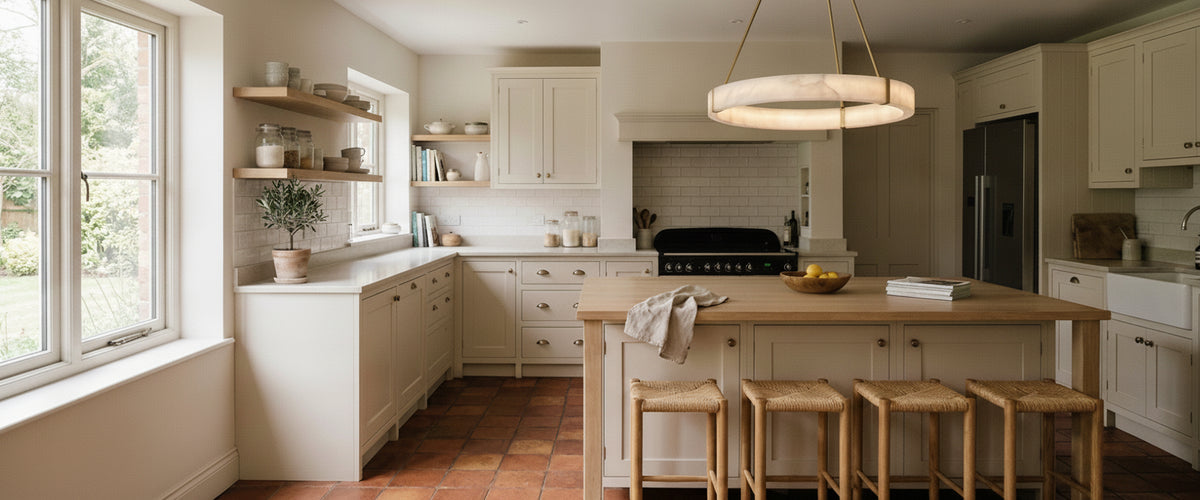
Stone shades on blackened steel keep the factory framework and lose the glare.
That is where alabaster changes the maths. Alabaster is a fine-grained gypsum stone, soft enough to be carved thin and naturally translucent, so light passes through the body of the shade rather than escaping only from the bottom. You get a lit object rather than a bright point. The British Geological Survey classifies it among the gypsum minerals, which explains both the glow and the one care rule that matters: it dislikes water.
A client converting a mill building in West Yorkshire had lived with cage pendants over a concrete island for two years and finally admitted the reflected filaments in the glass splashback were driving them mad. We replaced them with alabaster pendants on blackened steel suspensions. The industrial framework stayed; the glare went. That combination, stone shade with an aged metal fixing, is the most reliable way to keep the attitude of industrial kitchen ceiling lights in a warehouse conversion while making the room bearable to sit in. Niori builds most of its pendants and chandeliers around exactly this pairing, and you can see the range of shapes across the alabaster lighting collection.
Marble and onyx behave differently again. Marble usually reads as solid and reflects light off its surface, so it suits a fitting where the drama is in the form. Onyx is more strongly veined and more theatrical when backlit, which makes it a better single-statement piece than a repeated row of three.
Buyer's Checklist Before You Order
Measure ceiling height and worktop height, then confirm the fitting's adjustable drop range covers what you need.
Sit on a stool at the island and mark the eyeline. Nothing bright should sit below it.
Check whether the shade conceals the lamp from a seated position opposite, which is the failure point for most industrial ceiling lights kitchen installs.
Confirm the ceiling rose positions against the extractor, joists and any recessed downlights.
Count your metal finishes across the whole room. Two is a scheme; four is an accident.
Specify lamp color temperature, CRI and dimming protocol at the same time as the fitting.
For stone shades, ask about weight and fixing requirements, especially on plasterboard ceilings.
Budget realistically. Cost depends on material, scale, carving complexity, metalwork and installation, so request a tailored quote rather than working from a guess.
Living With the Fitting
Kitchens are the harshest room in the house for any light. Airborne grease settles on horizontal surfaces first, which is why open-topped cage pendants near a hob need attention every few weeks. Metal shades take warm soapy water and a soft cloth. Alabaster does not: dust it dry with a soft brush or microfiber, and if a mark needs lifting, use the barest touch of a barely damp cloth and dry it at once. Never let water sit on the surface and never use a household spray cleaner on stone.
Position matters for longevity too. Keep any stone fitting out of the direct plume of a hob and make sure your extraction actually works at the rate the appliance claims. A well-specified extractor protects your lighting as much as your walls, and it keeps industrial kitchen ceiling lights with open shades looking clean for far longer.
Get the geometry right and industrial ceiling lights kitchen schemes can be one of the most satisfying decisions in the whole project. Get it wrong and you will be squinting at reflections every evening. If you are weighing hard metal against something softer, it is worth browsing the wider lighting collection before you commit; seeing a stone pendant next to a steel one usually settles the argument quickly.