
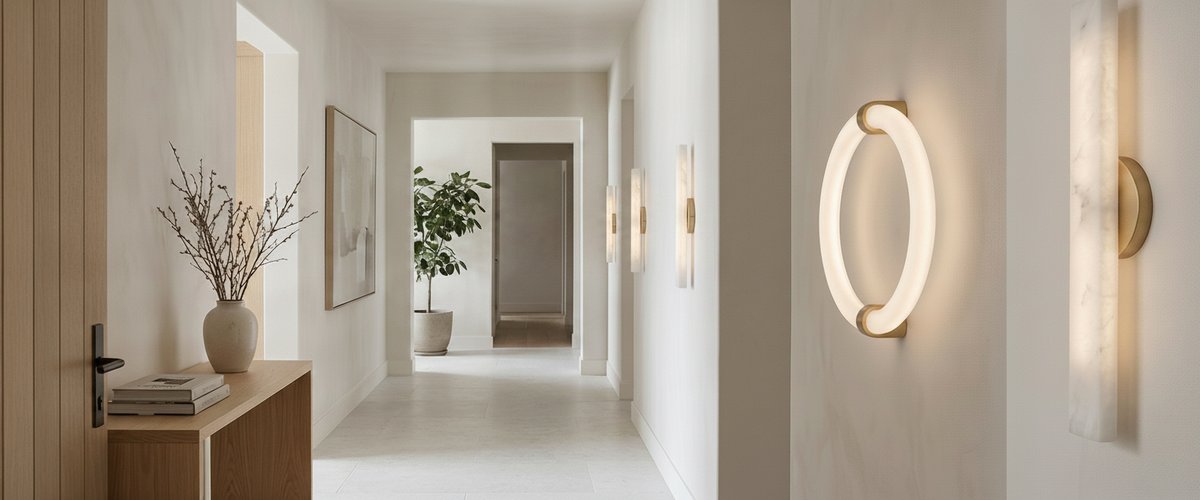

A hallway is the one room nobody sits in and everybody walks through, which is exactly why the lighting so often gets ignored. One builder's fitting drops in the middle of the ceiling, and the far end stays in gloom for the life of the house. The best hallway light fixture ideas start before you open any catalogue: you read the corridor itself, then choose fittings that carry light the full length rather than leaving a bright patch by the front door and shadow everywhere else.
This is the kind of space where alabaster and natural stone earn their place. Most good hallway light fixture ideas share one habit; they treat a hard corridor with bare walls and a stone floor as a surface that bounces sound and light in equal measure. A warm, diffused source at eye level softens all of that, and it does the work without glare in your face as you pass.

At a Glance: Hallway Lighting in Five Decisions
Measure the drop first. Low ceiling means flush or semi-flush; a stairwell void invites a pendant.
Never rely on one central light in a hall longer than roughly 12 feet (3.6m).
Layer wall lights along the run to break a tunnel into pools of light.
Warm colour temperature wins: aim for 2700K, and put it on a dimmer.
Alabaster diffuses instead of dazzling, which matters in a narrow space you view at close range.

Read the Corridor Before the Catalogue
The most practical of all hallway light fixture ideas costs nothing: walk the length of your hall at the times you actually use it, the morning rush and the evening return in the dark. Note three things. Where does daylight reach, and where does it die? Where are the pinch points, the doorway you turn through or the console table you brush past? And how high is the ceiling at each point, because halls with a return or a stair rarely have one consistent height.
Length is the single most useful number. A short entrance hall of 6 to 8 feet (roughly 1.8 to 2.4m) can be handled by one well-chosen fitting. Anything past 12 feet (3.6m) needs a plan, because a single source in the centre will always leave both ends darker than the middle. That is not a fault in the fitting; it is simple falloff. Light weakens fast with distance, so a lamp that looks generous overhead barely touches the wall six feet away.
Flush Over a Low Ceiling, Pendant Over a Stairwell
Good hallway light fixture ideas match the fitting to the drop you actually have, not the drop you wish you had. If your ceiling sits under about 8 feet (2.4m), a flush or semi-flush ceiling light keeps the headroom and avoids the constant sense that something is hanging into the space. An alabaster flush fitting is a quiet upgrade here: the stone glows rather than glares, so you get presence without a bright disc drawing the eye upward every time you walk under it.
A stairwell or a double-height entrance changes the maths entirely. Now you have a void to fill, and a pendant or a small chandelier reads as a proper feature rather than an obstacle. A carved alabaster pendant in a period stairwell earns its place: less about raw brightness, more about the hall finally having a centre of gravity. Hang the drop so the base of the fitting sits above head height at the tallest point of traffic, and let it be seen from the floor below.
Browse the shapes that suit each drop across the alabaster lighting range before you commit, since the same room can take a flush disc or a slim pendant depending on how you read the ceiling.
Why One Central Light Leaves the Far End in Shadow
Here is the trap in most hallway ceiling lights ideas: they solve for the middle. You stand under a generous fitting, the light looks ample, and you tick the box. Then you notice the coats at the far end sit in a pool of grey, and the picture frames on the last stretch of wall disappear after dusk.
The fix is not a bigger bulb. Pushing more lumens through one point just makes the bright zone brighter and the contrast with the dark end harsher. What you want is distribution: several modest sources spaced along the run so the light hands off from one to the next. This is where the layered hallway light fixture ideas pull ahead of the single fitting. Think of it as stepping stones rather than a single floodlight. Each fitting only has to cover its own patch, which means you can run warmer, softer light throughout without any single point feeling harsh.
Wall Lights: The Trick That Turns a Tunnel Into a Sequence
Wall lights are the most underused tool in hallway lighting fixtures ideas, and the most transformative in a long corridor. Set at roughly eye level to just above, spaced evenly down the run, they break a flat tunnel into a rhythm of pools. Your eye reads the sequence and the space feels longer and more considered, not shorter.
Alabaster wall lights do something a metal-and-glass sconce cannot. Because the stone diffuses the source through its own thickness, you get a warm block of glow at close range without the filament or LED biting into your vision as you pass. In a narrow hall you view these fittings from inches away, so glare control is not a nicety; it is the whole point. Pair uplight and downlight in the same sconce and you wash both the ceiling and the wall below, which lifts a low corridor visually.
Space them by the geometry of the hall. As a working rule, a wall light every 6 to 8 feet (1.8 to 2.4m) keeps the pools overlapping rather than islanded. Align them with doorways or artwork so the placement looks deliberate. Of all the hallway light fixture ideas here, this is the one that changes a corridor fastest.
Warm Stone at Eye Level: Where Alabaster Earns Its Keep
A hallway is often the hardest surface set in the house: tiled or stone floor, plaster walls, a run of built-in cupboards. Those surfaces are reflective and unforgiving, and a cold, bright fitting only exaggerates the echo-chamber feeling. Warm stone at eye level counters it, which is why so many hallway light fixture ideas lean on alabaster.
Alabaster is naturally translucent, which is why it has been carved for lamps and window screens for centuries; the Metropolitan Museum of Art holds carved alabaster vessels that show how long people have prized the way light passes through the material. That same translucency is what gives a modern alabaster fitting its low, buttery glow. The veining catches the light differently across the surface, so even a plain corridor gains some depth. Keep the colour temperature warm, around 2700K, so the stone reads honey rather than clinical.
The Oversized Statement That Swallows a Narrow Entrance
Scale is where entrance halls go wrong most often, and it is where plenty of hallway light fixture ideas fall down. A grand pendant photographs beautifully, so it gets chosen for a hall it physically overwhelms. In a narrow entrance, an oversized fitting eats the width, forces you to duck or sidestep, and turns arrival into an obstacle course.
The honest rule is that a statement piece needs statement space. Reserve the large chandelier or the sculptural pendant for the double-height stairwell or the wide period hall with room to breathe. In a slim corridor, restraint reads as confidence: a slim linear pendant, a run of discreet wall lights, or a semi-flush fitting that sits close to the ceiling. Among the best hallway light fixture ideas for tight spaces, you can see the range of scales side by side across the wider lighting collection, which helps calibrate what a space that size can actually carry.
Spacing So the Light Carries Instead of Stopping Halfway
Once you have decided on layered fittings, spacing is what makes or breaks the result. Map the hall on paper, mark the pinch points and the dark zones you found on your walk, then place fittings so their pools of light overlap slightly rather than leaving gaps. Ceiling fittings roughly every 6 to 8 feet (1.8 to 2.4m); wall lights on the same rhythm, offset if you want a gentler wash. This step is what turns a set of hallway light fixture ideas into a scheme that actually works end to end.
Put the whole scheme on a dimmer. A hall needs to do bright and practical for the school run and low and welcoming for the late arrival home, and one circuit on a dimmer covers both without rewiring. All fixed and hard-wired work should be done by a qualified electrician; the guidance from Electrical Safety First is worth a read before you brief anyone.
Buyer's Checklist for Hallway Fixtures
Ceiling height under 8 feet (2.4m): choose flush or semi-flush, not a hanging pendant.
Hall longer than 12 feet (3.6m): plan for two or more sources, never one central light.
Stairwell or double-height void: a pendant or small chandelier fills it properly.
Colour temperature: 2700K warm white, on a dimmer.
Glare check: at eye level, pick diffusing materials like alabaster over exposed bulbs.
Spacing: fittings every 6 to 8 feet (1.8 to 2.4m) so pools overlap.
Scale: match the fitting to the width; save the big statement for a hall that can hold it.
Installation: hard-wired fittings fitted by a qualified electrician.
Caring for Alabaster in a High-Traffic Hall
Hallways collect dust and knocks more than most rooms. Alabaster is a softer stone than marble, so treat it gently: dust with a dry, soft cloth and avoid water and household cleaners, which can mark or dull the surface over time. Keep it away from splash zones near a front door in wet weather. Handled sensibly, an alabaster fitting holds its glow for years, and the material only looks richer as the light warms it day after day. The best hallway light fixture ideas end here: warm, layered and read from the corridor out.