

Most fittings that look composed in a showroom fall apart in a hallway. The ceiling sits lower than you expected, the corridor is narrower than the shop floor, and the fixture that drew your eye now hangs at head height or throws a single bright pool with gloom either side. Hallway ceiling lights have to solve a room that has no daylight, no seating, and no forgiveness. Get it right and the hall reads calm and intentional. Get it wrong and it feels like a service passage.
At Niori we make alabaster and natural-stone lighting, and hallways are where the material earns its keep. Stone diffuses the source so you get a soft, even wash instead of the glare you notice most in a tight space. Below is how we think about the whole problem, from ceiling drop to the finish that survives coats brushing past your hallway ceiling lights every day.
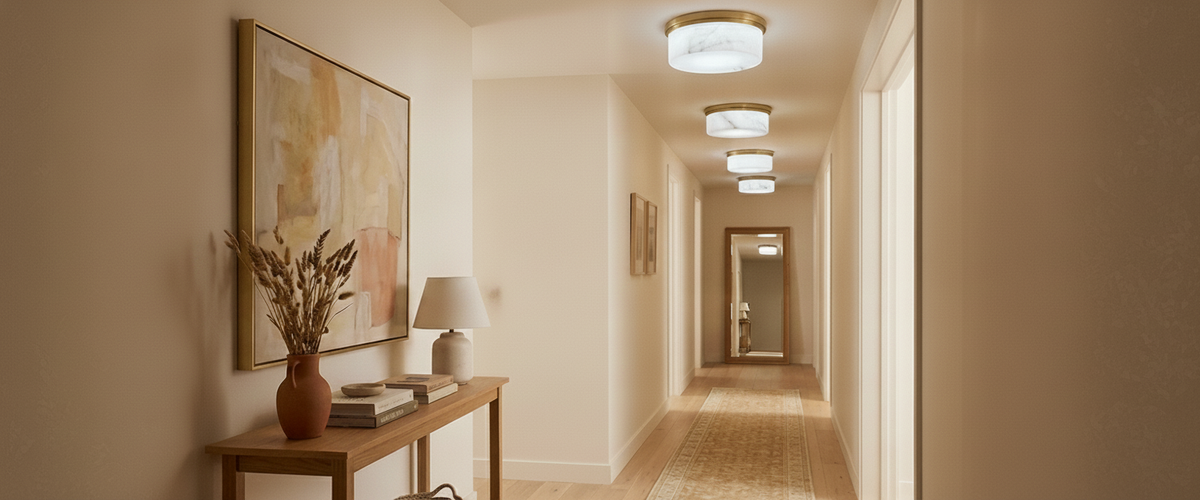
Alabaster diffuses the source for an even wash along a windowless hall.

Key Takeaways for Hallway Ceiling Lights
Measure the ceiling drop first. Under 2.4m usually means flush or semi-flush; a generous void allows a pendant.
Light the run, not one spot. Long halls need spaced fixtures or a mix of ceiling and wall lights to avoid dark patches.
Warm, diffused light suits a windowless corridor. Alabaster softens the source and lifts a dark hall without glare.
Choose a durable finish. Brass, plaster and stone handle scuffs and repainting better than delicate lacquers.
Buy your hallway ceiling lights for the corridor as a whole, matching finish and beam across every fitting rather than shopping one lamp at a time.

Why Hallways Defeat Fittings That Look Fine in the Showroom
A showroom hangs a light at eye level against a pale wall with plenty of ambient light around it. Your hallway does none of that. It is often the darkest space in the house, with no natural light and walls close enough to bounce or block the beam. A fixture that looked delicate in the shop can read as a hard, bright dot once it is the only source in a windowless corridor.
Scale is the other trap. Halls are read while you are moving through them, not standing still, so the eye needs a steady rhythm of light rather than one dramatic centrepiece. This is why lightening a dark hallway with no natural light is rarely a matter of a bigger bulb. Good hallway ceiling lights use a softer source, placed more than once, at the right height. Alabaster helps here because the stone itself glows rather than the lamp, which is far kinder in a space you pass through at close range.
Flush, Semi-Flush or Pendant: Matching the Fixture to Your Ceiling Drop
Ceiling height decides most of this for you. Measure from floor to ceiling before you fall for anything.
Flush hallway ceiling lights sit tight to the ceiling and are the safe answer for anything under about 2.4m (roughly 8 feet), or wherever people carry things through. Where the corridor needs a soft, even wash rather than a hard downlight, a round stone fitting such as the Look Round Ceiling Light 40cm in Plaster is closer to the right design language, giving clean coverage without anything to catch a shoulder. Our ceiling lights collection leans heavily on this form for exactly that reason.
Semi-flush drops a few inches and buys you a little more presence and a softer spread, useful in a hall with 2.4m to 2.7m of height. It is the middle path when a flush disc feels too plain but a pendant would crowd the space.
Pendants want a proper void. A double-height entrance hall or a landing with a stairwell can carry an alabaster pendant beautifully, since the stone reads as a warm lantern from below. In a standard corridor, though, a pendant usually hangs too low and gets knocked. Save it for where the ceiling genuinely gives it room, and keep flush hallway ceiling lights for the tighter runs.
Spaced flush fittings keep a long run evenly lit rather than lighting one spot.
Spacing Multiple Lights So a Long Hall Doesn't Turn Into Dark Patches
The most common mistake in a long corridor is one central fitting doing all the work. You end up with a bright middle and two shadowy ends. Ceiling lights for a hallway should be planned as a set.
As a working rule, space flush or recessed fittings roughly the same distance apart as the ceiling height, and keep the end fittings a similar distance from the walls at each end. A 6m hall with a 2.4m ceiling might take three fittings rather than one. In a wide run where you want each fitting to lift the overall level rather than mark a single point, a larger disc like the Gemini Flush Ceiling Light 61cm in White spreads its output far enough to close the gaps between positions. The Chartered Institution of Building Services Engineers publishes lighting guidance on uniformity worth a look if you want the technical basis for even coverage (cibse.org).
People also ask about can lights in a hallway, meaning recessed downlights. They work, but on their own they can feel clinical and cast hard shadows on faces as you pass. We prefer to pair a few discreet downlights with alabaster hallway ceiling lights or a sconce, so the recessed lights do the task work and the stone does the mood. That combination is what stops a corridor feeling like an airport gate.
Finishes That Shrug Off Scuffs, Coats and Constant Traffic
A hallway takes more punishment than any other room. Bags, coats, the hoover, decorators' ladders and repainting all happen here. The finish on your hallway ceiling lights matters as much as the shape.
Brass ages gracefully. Small marks blend into a living patina rather than standing out as damage. A compact brass piece such as the Look Square Ceiling Light 20cm in Brass suits a narrow entrance where a smaller footprint reads as considered rather than crowded.
Alabaster and natural stone are dense and hold up well overhead, where they rarely get touched. Each piece carries its own veining, so minor variation reads as character.
Plaster-finish fittings can be over-painted to match a repaint, a quiet advantage in a hall you redecorate every few years.
Avoid high-gloss lacquers and delicate painted surfaces at low level, where a coat sleeve or a suitcase will find them. If you want to see how stone and brass detailing behave together across different forms, our alabaster lighting range shows the material in flush, pendant and wall formats.
When a Wall Sconce Carries the Hall Better Than Anything Overhead
Sometimes the ceiling is the wrong place to start. If your hall has beams, sloped eaves, or no existing ceiling point, hallway wall sconce lighting can do the heavy lifting instead of hallway ceiling lights. Sconces sit at around 1.5m to 1.7m, cast light up and down the wall, and light faces at a flattering angle rather than from directly above.
This also answers how to light a hallway with no outlets overhead. A qualified electrician can often run a spur to a wall position more easily than into a ceiling void, and battery or plug-in wall lights exist for genuinely awkward runs. Always use a qualified electrician for any mains work; the electrical-safety guidance from Electrical Safety First is a sensible reference before you start (electricalsafetyfirst.org.uk).
A pair of alabaster sconces along a longer wall gives you the rhythm a single overhead fitting can never manage, and the stone glow reads as warm and residential rather than functional. In practice we often specify sconces and a flush fitting together, so the wall lights carry the atmosphere and the hallway ceiling lights lift the overall level.
Buying for the Run, Not the Single Fitting
The step most buyers skip is treating the corridor as one composition. Before you order your hallway ceiling lights, sketch the run and decide the whole scheme.
Measure length and ceiling height, then count how many fittings the run needs for even coverage.
Pick one finish family, so brass sconces and a brass-detailed ceiling light read as a set.
Match the light temperature. Keep everything to a warm, consistent output; mismatched cool and warm sources look accidental.
Add dimming where you can, so the hall can be gentle at night and brighter on arrival.
Confirm mounting with your electrician before ordering, especially ceiling points and switch positions.
One project sticks in mind: a Victorian hallway with a long, narrow run and a single dim pendant near the door. We replaced it with two alabaster flush fittings spaced down the corridor and a pair of sconces near the stairs. The owners said the hall stopped feeling like a tunnel overnight, and nobody has knocked a fitting since, because the hallway ceiling lights sat tight to the ceiling and the sconces to the wall.
You can browse the full Niori range to see how flush hallway ceiling lights, pendants and sconces work as a coordinated set rather than one-off pieces. A hallway repays that planning more than almost any other space in the house.