
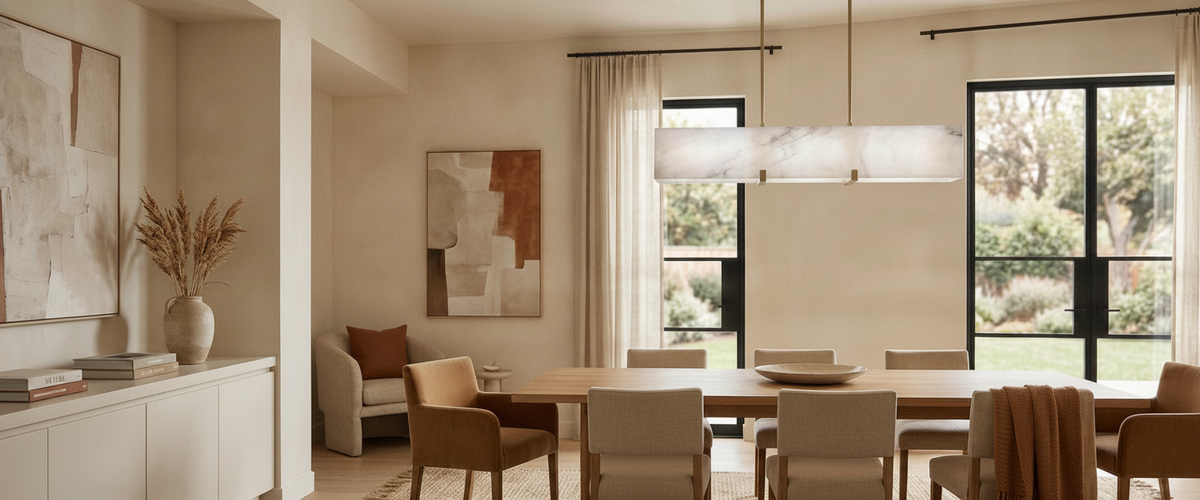

Crystal earns its keep after dark, when a low warm bulb catches every facet and scatters little points of light across the table. That is the case for dining room chandeliers with crystals, and it is also where most people go wrong. They shop for daylight, hang the fixture too high, run it at full brightness, and end up with a piece that glares over the toast instead of glittering over the wine. Getting dining room chandeliers crystals right is less about spending more and more about matching cut, shape, height and dimming to how you actually eat in the room.
The reason to care is simple. A dining chandelier is the one light people sit directly beneath for an hour or more at a stretch. Every decision you make is felt at eye level, and with crystal chandeliers over a table that is doubly true. Well-chosen dining room chandeliers with crystals reward that attention every evening.

Key Takeaways
Size the chandelier to the table, not the room. Aim for roughly one third to one half of the table width.
Hang the fixture around 30 to 36 inches (76 to 91 cm) above the tabletop for an 8 foot (2.4 m) ceiling.
Match a linear chandelier to a long rectangular table and a round or oval fixture to a square or circular one.
Cut crystal throws sharp sparkle; smooth glass and alabaster give a softer wash. Many rooms want a mix.
Put the fixture on a dimmer. Warm and low reads as jewellery; bright and cool reads as an office.

What Crystal Does to Warm Light
Crystal is a light-splitter. When a warm, low-output bulb sits behind faceted cut crystal, the facets refract and bounce that light into dozens of small bright points. This is why dining room chandeliers with crystals look alive at a candlelit dinner and slightly dead at midday, when flat daylight from the windows overwhelms the contrast the facets rely on.
That daytime versus evening gap matters more than the crystal grade printed on the spec sheet. A bright lunch wants gentle, even light so faces look natural and the food shows its real color. A late dinner wants pooled warmth and sparkle. The fixture cannot change its physics between meals, so the control layer does the work, which is why dimming is not optional with dining room chandeliers with crystals.
If you want that glitter without the glare that comes from a cluster of bare facets, this is where alabaster and natural stone come in. A stone element in the fixture, whether a central bowl, backplate or diffuser, gives you a soft base glow that the crystal then punctuates. You keep the sparkle and lose the hard hotspots. Niori builds dining room chandeliers with crystals around exactly this idea, pairing alabaster and natural stone with glass and brass detailing, and you can see the range across the lighting collection.
Linear Versus Round Crystal: Match the Fixture to Your Table
Table shape decides fixture shape before anything else. Get this wrong and no amount of crystal quality will save the look, even on the finest dining room chandeliers crystals can offer.
A long rectangular or oval table wants a linear chandelier. A single round fixture over a 9 foot (2.7 m) table leaves the ends dim and the middle overlit. A linear chandelier dining room setup, or two matched chandeliers spaced along the run, keeps light even from head to foot. Where the table is long and the scheme leans contemporary, a slim horizontal bar such as the Essence Linear Pendant Light in Brass runs light evenly end to end without the density of a period cascade. It is one of the calmer ways to read dining room chandeliers with crystals in a modern space.
A square or round table wants a round or oval chandelier centered on it. Here a classic multi-arm crystal fixture, or a compact stone-and-crystal piece, sits naturally and throws light in all directions equally. For a round table that can carry a fuller crystal statement, a piece like the Murano 6 Light Crystal Chandelier in Gold reads as the still center of the setting rather than a puck floating off to one side. This is dining room chandeliers with crystals at their most classic.
For a modern dining room chandelier, the honest test is proportion and restraint. Fewer, larger elements and a cleaner metal frame usually age better than a dense cascade of tiny droplets, which can tip period rather than contemporary. Among dining room chandeliers with crystals, a sculptural fixture such as the Dynamite 6 Light Chandelier in Brass shows how a pared-back frame holds presence over a table without tipping ornate.
How High to Hang a Dining Room Chandelier
This is the question I get asked most, so let me be exact. The comfortable range over a dining table is 30 to 36 inches (76 to 91 cm) from the tabletop to the lowest point of the fixture, assuming a standard 8 foot (2.4 m) ceiling.
That height clears sightlines across the table, keeps the bulb out of your eyeline when seated, and puts the crystal close enough to the tabletop that its reflections read on the glassware and plates below. Go higher and the sparkle drifts away from the setting; go lower and people crane to see each other. This is where dining room chandeliers with crystals reward careful placement.
For every additional foot (30 cm) of ceiling height above 8 feet, raise the fixture by roughly 3 inches (7.5 cm). A double-height dining room in a barn conversion or a Georgian townhouse needs the piece hung on a longer drop so it still relates to the table rather than hovering near the ceiling. One client we shipped a linear piece to had a 3.4 meter ceiling and initially hung it far too high; dropping it by half a meter completely changed how the crystal caught the candles below.
Two practical notes. Center the chandelier over the table, not the room, because the two rarely align. And a fixture on a dimmer needs a compatible driver, so have a qualified electrician confirm the dimming setup and mounting before install; guidance from Electrical Safety First is a sensible reference for wiring work.
Cut Crystal, Glass and Modern Droplets: How Each Throws Light
Not all sparkle is the same, and the material changes the mood at the table. It is the single biggest factor in how dining room chandeliers with crystals feel once you sit down.
Cut lead crystal has the sharpest, most defined refraction. Its facets throw bright, distinct points of light and small rainbows when the sun catches them. This is the classic glittering effect people picture, and it suits formal rooms and period homes. The trade-off is that at full brightness it can feel busy.
Smooth glass drops refract less and glow more. They soften the light and give a calmer, more even shimmer, which works well in modern schemes where you want presence without theatre.
Alabaster and natural stone do not sparkle at all; they diffuse. Backlit, stone glows from within with warm color and visible veining, giving a steady pool of light that flatters faces and food. In dining room chandeliers with crystals that also carry stone, the alabaster holds the ambient glow and the crystal adds the accents. The alabaster lighting collection shows how that soft diffusion reads across pendants and chandeliers. Alabaster is a fine-grained gypsum stone that has been carved for lamps and vessels since antiquity, valued precisely because it lets light through, a property the Metropolitan Museum of Art notes across its ancient stone collections.
Dimming So It Glitters at Dinner, Not Glares at Breakfast
A dining chandelier with only an on switch is a fixture working at half its potential. Dimming is what lets dining room chandeliers with crystals serve a bright family lunch and a low candlelit dinner from the same piece.
Fit a dimmer rated for the fixture's LED load and confirm the bulbs are marked dimmable. For crystal, warm color temperature does most of the heavy lifting. Aim for bulbs around 2400K to 2700K; the warmer the light, the more the facets glow amber and the more the whole setting feels like candlelight. Cool white kills the effect and makes cut crystal look clinical.
Run it low in the evening so the crystal reads as jewellery and the room falls into pools of light. Bring it up for daytime meals, and let daylight carry the ambient load while the fixture sits back. If you can, wire the dining chandelier on its own circuit rather than sharing a dimmer with downlights, so you can balance the two independently. That control is what separates good dining room chandeliers with crystals from tired ones.
Size to the Table, Not the Room
The most common sizing mistake is scaling the chandelier to the floor area. That gives you a fixture that looks fine from the doorway and wrong from every chair, and it undoes even the best dining room chandeliers with crystals.
Instead, size to the table. A useful starting rule: the chandelier's diameter (or a linear fixture's length) should be around one third to one half of the table's width for a round or square table, and for a rectangular table, a linear fixture should run to roughly half to two thirds of the table length. So a 42 inch (107 cm) round table pairs with a chandelier around 17 to 21 inches (43 to 53 cm) across.
A dining room table chandelier sized this way anchors the setting. It reads as belonging to the table, draws the eye down to where people gather, and leaves clear air around it so the room does not feel crowded. When in doubt, hold a template up over the table at the intended height before you commit; live in the space, and choose the piece that sits right at the table, not the one that impresses from across the room. This is where dining room chandeliers with crystals earn their place.
Because scale, material, crystal count, engineering and installation all vary so widely, there is no single price for dining room chandeliers with crystals. Budget depends on the fixture and the finish, so it is worth requesting a tailored quote once you have settled on shape and size. Pick the shape first, dim it warm, hang it right, and dining room chandeliers crystals will do the glittering they were made for. You can browse forms and finishes from the Niori homepage to narrow the shortlist first.