
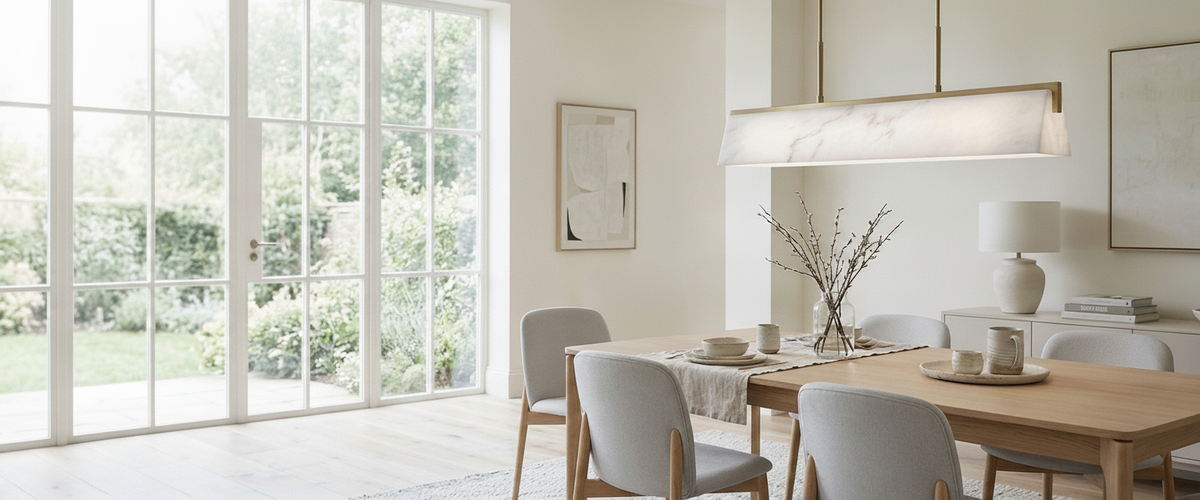

A single alabaster fixture can carry a hallway one week and look lost in a living room the next, and the stone itself has not changed at all. What changes is everything around it: the height it sits at, the angle you see it from, the color of the bulb behind the veining, and how honestly the surface has been kept. Clean alabaster lighting depends as much on where and how you hang the pieces as on the piece you chose. Get the placement right and the stone glows like it is lit from inside a cloud. Get it wrong and you notice fingerprints, glare, and a slab that feels stuck on rather than designed in. Clean alabaster lights start with these decisions, not with the price tag.
We have shipped enough alabaster into British homes and hospitality projects to see the same handful of decisions decide whether a piece sings or sulks. Below is what actually moves the needle for clean alabaster lights.
Placement, not the piece itself, decides whether alabaster reads deliberate.

Key Takeaways
The same fixture reads differently in a hallway than a living room; adjust scale and height, not just the piece.
Mounting height and sightline decide whether veining looks intentional or accidental.
Warm, dimmable bulbs around 2700K flatter stone; cool white flattens it.
Contrast in the backdrop lifts pale alabaster; a white wall can swallow it.
Keeping clean alabaster lights is a dry, gentle job, never a wet one.

How the Same Alabaster Fixture Reads in a Hallway Versus a Living Room
A hallway asks a fixture to do quiet, continuous work. You pass through it, glance up, keep moving, so the light needs to feel present without shouting. A compact alabaster semi-flush or a pair of wall lights suits that pace: low glare, warm wash, nothing that demands you stop and admire it. Where a corridor needs presence without bulk, something like the Orbis Small LED Alabaster Semi-Flush sits close to the ceiling and reads as texture you register in passing, which is exactly right for that pace.
Move the identical form into a living room and the brief flips. Now people sit for hours under it, eyes rest on it, and the piece is asked to hold a room together. Here the veining and the depth of glow become the point. A fixture that looked substantial in a tight corridor can suddenly read as modest across an open-plan space. Where a hallway wants restraint, a living room can carry the scale of a multi-arm piece such as the Luxoria 10 Light Alabaster Chandelier, which anchors an open plan in a way the smaller version never could. If you are weighing options across rooms, viewing the full range of clean alabaster lighting side by side makes the scale jump obvious in a way a single product page never does.
Scale and Mounting Height: The Choices That Make Stone Feel Deliberate
Alabaster has visual weight. It is opaque enough to read as solid stone even when lit, so an undersized piece hung too high looks apologetic, and an oversized one hung too low crowds the space. The fix is rarely a different fixture; it is usually a different height. This is where clean alabaster lights either earn their keep or quietly fail.
For a dining pendant, aim for roughly 30 to 36 inches (76 to 91 cm) between the underside of the shade and the table surface. Over a kitchen island, similar. In a hallway or entry, keep at least 7 feet (2.1 m) of clearance underneath so nobody clips it. Those are starting points, not laws; taller ceilings and wider tables push everything up and out.
Scale is the other half. A common rule of thumb: add the room's length and width in feet, and a chandelier diameter in inches near that sum tends to feel right. A 14 by 16 foot room lands around a 30 inch fixture. Alabaster reads heavier than glass or fabric of the same size, so if you are between two diameters, we usually suggest the smaller one for stone. The material already gives you presence; you rarely need the extra inches. Well-scaled alabaster lights look designed in rather than dropped in.
Sightlines That Flatter Alabaster and the Angles That Expose Its Flaws
Alabaster is translucent, not transparent, and that single fact governs how it should be viewed. Light passes partway through the stone and scatters, which is what gives the warm, diffused glow that made the material a favorite for centuries; the British Museum holds carved alabaster pieces that show craftsmen exploiting exactly this quality long before electricity (britishmuseum.org). To get that glow from clean alabaster lights, the viewer needs to see the lit face of the stone, not a hard edge or an exposed bulb.
A shallow upward gaze onto a broad, curved surface flatters the stone most.
The angle that flatters most is a shallow upward or level gaze onto a broad, curved surface. That is why bowl pendants and rounded wall lights forgive so much. The angle that exposes flaws is looking up into an open bottom where the lamp sits bare, or across a flat panel edge-on so you catch every seam and mounting bracket. Before you commit to a height, sit where people will actually sit and look. If you can see hardware or a naked bulb from the sofa, raise the piece or choose a form with a deeper skirt.
Wall lights deserve their own note. Mounted at eye level, roughly 60 to 66 inches (152 to 168 cm) to center, they wash the wall and let the stone's veining catch the light at a grazing angle. Where a room needs a soft diffused glow at eye level rather than a hard downlight, a rounded fitting such as the Aurelia LED Alabaster Wall Light is closer to the right design language, grazing the veining without exposing the source. Too high and the glow drifts to the ceiling; too low and you stare into it. Alabaster wall lights placed this way keep their glow clean and even.
Bulb Temperature, Dimming and the Backdrop Contrast That Lifts the Stone
Color temperature is where good alabaster gets ruined by the wrong bulb. Stick to warm white, around 2700K, which pushes the honey and cream tones in the stone forward. Cool white above 4000K drains the warmth and makes even fine alabaster lights look gray and clinical. Choose bulbs with a high color rendering index, ideally CRI 90 or above, so the natural mineral color reads true.
Dimming matters just as much. Alabaster at full brightness can look flat; brought down to 40 or 50 percent it deepens, and the veining gains contrast. Pair LED bulbs with a compatible dimmer, and if you are hard-wiring anything, use a qualified electrician. For guidance on lighting levels and glare in living spaces, the Chartered Institution of Building Services Engineers publishes sensible reference material (cibse.org).
Then there is the backdrop. Pale alabaster against a bright white wall can disappear, because there is nothing for the glow to register against. Give it contrast: a deeper wall color, timber panelling, a darker plaster, or a shadowed alcove. One client in a bright new-build kept feeling their entry pendant looked weak. The fixture was fine; the problem was a gallery-white ceiling swallowing the light. A warmer ceiling paint two shades down brought the whole thing to life. If you are still choosing between fixture types for a given wall or ceiling, the wider lighting collection shows how form and backdrop interact across pendants, wall lights and ceiling pieces.
Placement Mistakes We Keep Fixing in Client Homes
A short list of the errors that come up again and again with clean alabaster lights:
Hanging over an island but not centered on it. People center on the ceiling joist instead of the worktop. Center on the surface people use.
One lonely wall light on a large wall. Alabaster wall lights almost always work better in pairs or a run; a single unit looks stranded.
Cool bulbs left in from the builder. Nine times out of ten the stone was never the problem, the 5000K lamp was.
No dimmer. A dimmer is the cheapest upgrade you can make to any alabaster piece.
Mounting too high to save headroom. A pendant pushed up near the ceiling loses its glow and its purpose. Give it room to hang.
How to Clean Alabaster Lights Without Damaging the Stone
Alabaster is a soft, porous form of gypsum, and it does not behave like glass or marble. Water is the enemy: it can dull the surface, leave marks, and over time cloud the stone. So cleaning alabaster lights is a dry job first, damp only as a last resort.
For everyday care, dust with a soft, dry microfiber cloth or a clean natural-bristle brush. Do this with the light switched off and cool. Work with the grain of the veining rather than scrubbing in circles. For a shade with light fingerprints or a slight film, a barely damp cloth wrung out until almost dry, wiped over quickly and then followed by a dry cloth, is as wet as you should ever go. Never soak, never use household sprays, and never reach for anything acidic like vinegar or lemon, or anything abrasive. Keeping clean alabaster lights dust-free with a dry cloth does more for the glow than any product ever will. The Natural Stone Institute's care guidance on soft, calcareous stone is a useful cross-check if you want to read further (naturalstoneinstitute.org).
A practical cleaning checklist for clean alabaster lights:
Switch off and let the fixture cool completely.
Dust dry with microfiber or a soft brush, following the veining.
For marks, use a cloth wrung out until nearly dry, then buff dry immediately.
Skip all sprays, solvents, waxes and polishes unless the maker specifies one.
Check mounting hardware and bulbs once or twice a year while you are up there.
Faux-alabaster and resin shades tolerate a slightly damper wipe, but the same principle holds: gentle, dry-leaning, no chemicals. Treat every shade as if it were the real stone and your clean alabaster lights will never let you down.
Placed well and kept clean, alabaster does something no printed shade can fake. Clean alabaster lights turn an ordinary bulb into a soft, mineral glow that changes through the day. The stone rewards care and punishes shortcuts, which is exactly why it is worth getting the details right.