
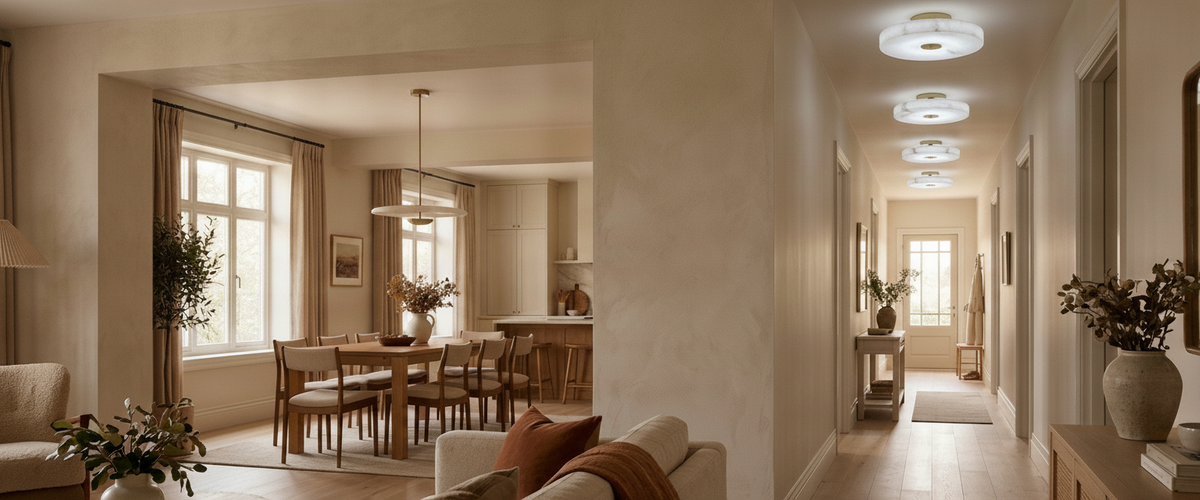

A hallway is the one room you never sit down in, and that changes how it reads its light. You walk through it, glance in a mirror, drop keys, climb stairs. The eye is always moving, so ceiling lights for hallway use have to do two jobs a living-room fitting never worries about: hold a steady wash from one end to the other, and set a tone the instant the front door opens. Get that wrong and even a handsome fitting looks stranded in a pool of its own shadow.
Most hallways are long, narrow and short on daylight. That combination punishes a single central light and rewards a planned run of fittings. Alabaster and natural stone earn their place in ceiling lights for hallway schemes because they scatter light softly instead of throwing a hard cone at the floor, which is exactly what a corridor of moving eyes wants.
A planned run of soft flush fittings keeps a long corridor evenly lit.

Key Takeaways Before You Choose
A hallway needs even light across its length, not one bright spot in the middle.
The entrance fitting sets the mood for the whole house, so treat it as the hero.
Long corridors usually need two or more ceiling points, or a mix of ceiling and wall lights.
Landings and turns hide shadows a single fitting cannot reach.
Alabaster diffuses light gently, which flatters faces at the mirror and softens a tight space.
Budget depends on material, scale and installation; ask for a tailored quote rather than guessing.

How a Hallway Reads Its Ceiling Light Differently
In a sitting room, light pools around where people settle. A hallway has no anchor point, so the brain judges it by contrast: bright patch, dark patch, bright patch. Uneven spacing reads as gloom even when the total output is generous. This is why ceiling lights for hallway use chosen purely on lumen count often disappoint. The number can be right and the spacing still wrong.
Ceiling height decides the fitting type. Under about 2.4 metres (roughly 8 feet), a flush or semi-flush fitting keeps clearance and avoids the pendant-in-the-face problem on the stairs. Taller Victorian and Edwardian halls, common across older homes, can carry a small pendant or a compact chandelier without crowding. A flush alabaster disc suits the low ceiling; a stone pendant suits the tall one. Browse the shapes across our lighting collection to see how each form sits at different heights.
The Entrance Zone: The First Fitting Sets the Tone
The fitting nearest the door is the one guests notice before anything else, so it deserves the most thought. Warm, diffuse light here is flattering and welcoming; a cold downlight is not. Where the entrance wants a soft glow rather than a hard beam, a carved plaster disc such as the Look Round Ceiling Light 40cm in Plaster reads as hospitable the moment the door swings open, its 40cm span filling a standard entrance without dominating it. This is where ceiling lights for hallway entrances earn their keep.
Keep the entrance fitting bright enough to read faces and find coats, but resist the urge to over-light. A hallway that blazes at the door then dims down the corridor feels like walking out of a spotlight. Aim for the entrance to be the warmest point, not dramatically the brightest.
Mid-Corridor Placement: Even Brightness Door to Door
A long hallway is where single-fitting plans fall apart. One light in the centre leaves both ends murky, and the eye reads those dark ends as the true condition of the space. The fix is spacing. Two or three matched flush fittings run down the corridor keep the wash consistent, and a repeated form reads as calm rhythm rather than clutter. Well-planned ceiling lights for hallway runs make this look easy. For a longer corridor that needs real output at each point without a pendant drop, a wide flush unit such as the Gemini Flush Ceiling Light 61cm in White spaces well down the run and keeps the ceiling line clean.
Where ceiling points are limited, wall sconces lift the passage without new ceiling wiring.
If your corridor cannot take extra ceiling points, hallway wall sconce lighting fills the gap. A pair of alabaster wall lights at eye level bounces soft light onto the ceiling and walls, lifting the whole passage without touching the ceiling wiring. This ceiling-and-wall mix is often the most flexible answer for older homes where adding a new ceiling rose means lifting a floor above.
For a genuinely dark corridor, alabaster wall sconces do quiet, heavy lifting alongside your ceiling lights for hallway spacing. Because the stone glows rather than glares, you can place them closer together than you would a glass fitting without creating hotspots. See how the sconce forms compare in our alabaster lighting range.
Landings and Turns: Where a Single Light Leaves Shadows
Stairs and landings are the trap. A ceiling light on the landing throws its brightest circle straight down, which means the treads below sit in its shadow, exactly where you least want darkness. This is the placement error we correct most often when clients plan ceiling lights for hallway and stair zones: one landing fitting, no light on the stairs themselves.
Treat the turn as its own zone. A landing ceiling light handles the flat space, and a low wall light or two takes care of the steps. On a half-landing where the stair changes direction, a single fitting almost never covers both flights; plan for the corner, not the centre. UK building guidance treats stairs and circulation routes as areas that need careful, even lighting for safe movement, as set out in Approved Document L, and a hallway is precisely that route through your home.
Backdrop and Contrast: Pale Ceilings, Dark Walls
The surfaces around a fitting change how much you get out of it. A pale ceiling acts as a reflector, spreading the upward light of a semi-flush or sconce and making the space feel taller. Dark walls, popular in dramatic hallway schemes, absorb light and swallow output, so a deep charcoal or forest corridor needs more fittings, or brighter ones, than a white one to reach the same brightness. Plan your ceiling lights for hallway output around the paint, not just the plan.
Alabaster works with both. Against a pale ceiling its glow reads soft and airy; against a dark wall it becomes a warm point of light that draws the eye down the corridor. Where a dark scheme calls for a metal finish that catches the light rather than disappearing into it, a small brass fitting like the Look Square Ceiling Light 20cm in Brass holds its own against a deep wall without adding bulk. If you are lighting a dark hallway with no natural light, lean on this: warm, glowing fittings placed at regular intervals do far more than one powerful cold source ever will. Pale skirting, a mirror opposite a light, and a light-toned runner all stretch what the fittings give you.
The Placement Errors We Keep Fixing
A few mistakes come up again and again when clients send us photos of ceiling lights for hallway schemes that feel dim despite new fittings.
One light doing the work of three. A single central fitting in a long corridor always leaves dark ends. Add points or add sconces.
The fitting hung too low over the stairs. Pendants near a staircase get walked into and cast awkward shadows. Use flush fittings above steps.
Cold colour temperature at the door. A crisp 4000K fitting can suit a utilitarian back hall, but the main entrance usually wants a warmer tone for a welcoming first impression.
Ignoring the walls. Dark paint that eats light, then blaming the fitting. Match output to the backdrop.
No dimming. A hallway used at 7am and at midnight needs range. Fit a dimmable driver and a compatible switch, and have a qualified electrician confirm the pairing.
If you are starting a whole scheme rather than replacing one fitting, our homepage gives a sense of how alabaster and natural stone behave across a room set before you commit to a hallway plan.
A Quick Buyer's Checklist
Measure ceiling height. Under 2.4 metres (8 feet), choose flush or semi-flush hallway ceiling lights.
Count the dark zones: entrance, mid-corridor, landing, turn.
Decide whether extra ceiling points are practical, or whether wall sconces fill the gaps.
Pick a warm colour temperature for the entrance; match dimming to how you use the hall day and night.
Match output to your wall colour, not just the corridor's length.
Confirm fixings and installation with a qualified electrician before you buy.
Choosing ceiling lights for hallway runs rewards planning more than spending. A well-spaced line of soft alabaster fittings, warm at the door and steady to the last step, turns the least-loved space in the house into the one that quietly makes the first impression.