
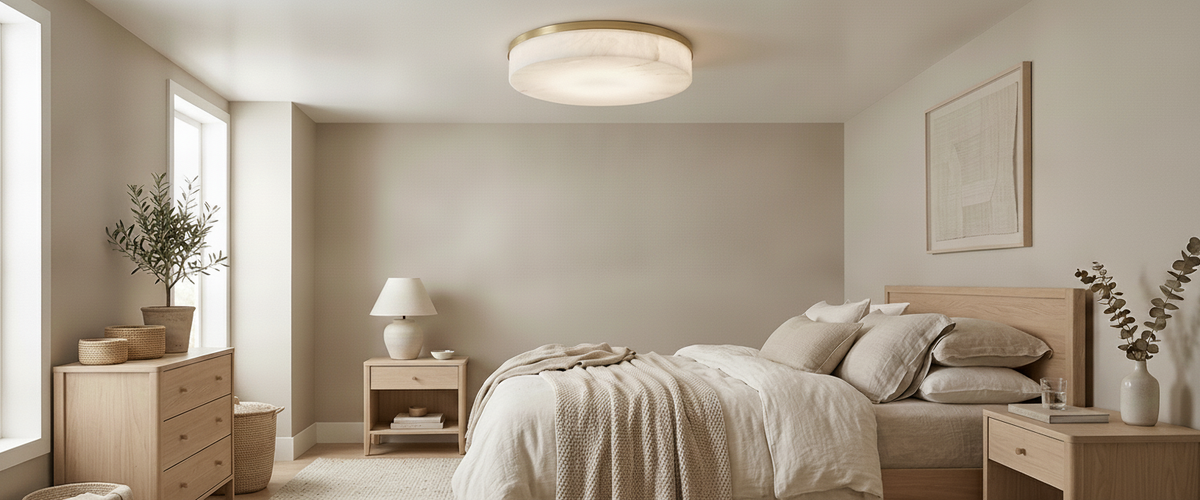

The best ceiling lights for bedroom schemes never work alone. One bright fitting bang in the centre of the ceiling is the quickest way to make a room feel like a corridor: it lights the floor, casts hard shadows under everyone's eyes, and gives the light nowhere soft to land. A good overhead does the opposite job. It washes the ceiling gently, sits above a scheme of bedside and wall light, and lets you read, dress, and wind down without ever hitting a harsh single source. That is the difference between a room you switch on and a room that settles.
At Niori we make alabaster and natural-stone lighting, and the bedroom is where the material earns its keep. Stone diffuses light from the inside, so an alabaster fitting glows rather than glares. Here is how to plan the layers, place the sconces, and hand the wiring to the right person when you are choosing ceiling lights for bedroom use.
An alabaster flush fitting turns the ceiling into a soft reflector.

Key Takeaways
A single central fitting flattens a bedroom; pair the overhead with bedside light so the glow has somewhere to go.
An alabaster or natural-stone overhead softens the whole ceiling into a calm wash instead of a clinical spot.
Mount bedside sconces so the bottom of the shade sits roughly 30 to 36 inches (76 to 91 cm) above the mattress for glare-free reading.
Warm bulbs around 2700K and a good dimmer matter more than raw wattage.
Switching and wiring layouts are worth handing to a qualified electrician before any fixture goes up.

Why One Central Fitting Flattens the Room
A lone overhead pushes light straight down. That flattens faces, kills the shadows that give a room depth, and leaves the corners dark while the middle of the floor is over-lit. In a bedroom, where you want the mood to drop as the evening does, a single bright source fights you. This is where badly chosen ceiling lights for bedroom schemes fall down. You end up switching it off and reaching for a phone torch, which tells you the scheme failed.
The fix is layering. Treat the ceiling fitting as the quiet ambient base, then add task light at the bed and accent light where you want the eye to rest. When the overhead is only doing one job, you can specify it to do that job beautifully rather than asking it to light the whole room by force. Our full range of alabaster and natural stone lighting is built around that idea of layers rather than a single hero fitting, and it shapes how we think about ceiling lights for bedroom projects.
Pairing the Overhead With Bedside Sconces
The bedside is where a bedroom scheme lives or dies. A sconce light fixture bedroom setup on either side of the bed frees up the nightstand, throws readable light onto the page, and gives the overhead a partner so it never has to work alone. Two matched wall lights also frame the bed and pull the eye up, which makes low ceilings feel taller. Bedside fittings and ceiling lights for bedroom layers should be planned together, not bought piecemeal.
Alabaster sconces do something table lamps cannot. Because the stone is lit from within, the whole shade becomes a soft panel of warm light rather than a bright bulb behind fabric. That reads as calm at the edge of your vision when you are half asleep. If you want fixtures made for exactly this, our alabaster lighting collection covers wall lights and pendants cut from the same stone family, so the bedside and overhead can share a look.
Put the sconces on their own switch or, better, on a dimmer separate from the ceiling fitting. The point of a layered bedroom is that you rarely run every layer at full. Reading in bed usually means sconces on low, overhead off.
Bedside sconces give the overhead a partner and keep the nightstand clear.
Sconce Mounting Heights That Give Reading Light Without Glare
Height is the detail people get wrong most often. Too high and the light spills across the pillows into your partner's eyes. Too low and you cannot see the book. As a working guide, aim for the bottom of the shade to land roughly 30 to 36 inches (76 to 91 cm) above the mattress top, with the fixture centred a little outside the pillow line so the light falls onto the page, not the headboard.
A few things shift that number:
Tall headboards. Mount higher and choose a sconce with a downward bias so the beam clears the upholstery.
Sitting up to read. If you read propped against pillows, err toward the lower end so the light reaches the book.
Adjustable arms. A swing-arm alabaster sconce forgives a lot; you can angle it after install instead of guessing on paper.
Mark the positions in painter's tape on the wall and lie on the bed before anyone drills. We tell every client to do this. It takes five minutes and saves a patched wall.
How an Alabaster Overhead Softens the Ceiling Into Calm
The reason we keep coming back to stone for bedrooms is the quality of the light. This is what separates good ceiling lights for bedroom use from the merely bright. Alabaster is naturally translucent, so light passes through the body of the material and picks up its veining on the way out. Instead of a hard disc of brightness, you get a warm, slightly uneven glow that feels closer to candlelight than a downlight. The Metropolitan Museum of Art holds carved alabaster objects prized for exactly this luminous quality, which is why the stone has been used for lamps and vessels for centuries.
A flush or semi-flush alabaster fitting works well in rooms with limited head height, which covers most bedrooms. It sits close to the ceiling, lights the plaster around it, and turns the whole upper plane of the room into a soft reflector. In a standard double bedroom where you want the overhead to disappear into the plaster rather than announce itself, a compact flush fitting such as the Gemini Flush Ceiling Light 42.5cm in White keeps the ceiling calm without crowding the head height. Over a larger room or a bed set beneath a higher ceiling, stepping up to the Gemini Flush Ceiling Light 61cm in Brushed Brass gives the plane enough scale to read as intentional, with the brass warming the tone and tying into bedside metals. If the ceiling is tall enough, a low-hung alabaster pendant or a small chandelier over the foot of the bed can anchor the space, but keep it clear of head height on either side of the mattress.
Match the stone tone to your walls. Warm white alabaster suits soft neutrals and plaster pinks; a greyer marble reads cooler and pairs with deeper, moodier schemes. Brass detailing warms the fitting further and ties it to bedside metals, which is worth planning when you compare ceiling lights for bedroom finishes.
What Wattage and Colour Temperature Belong in a Bedroom
Buyers ask what watt light bulb belongs in a bedroom more than almost anything else. With LED it is the wrong question to lead with, because a modern LED gives the light of an old 60-watt incandescent while drawing under 10 watts. Look at lumens and colour temperature instead of wattage when you spec ceiling lights for bedroom use.
Colour temperature: Choose 2700K for the ambient overhead and bedside light. It is warm without going orange and it supports winding down at night.
Brightness: For an ambient ceiling fitting, something in the region of 400 to 800 lumens is plenty in a normal bedroom. You are not lighting a kitchen.
Dimming: Non-negotiable. A dimmable warm source lets one fitting move from getting-dressed bright to nearly-asleep low.
Warmer, lower evening light also fits what sleep researchers advise about limiting bright and blue-heavy light before bed; guidance from the Sleep Foundation points the same way. If you buy a fixed-output alabaster fitting, confirm it is 2700K and on a compatible dimmer circuit before install.
Wiring and Switching: The Jobs Worth Handing an Electrician
Some of this is genuinely DIY-friendly; some is not. Choosing the fixture, marking heights, and picking bulbs are yours. Anything behind the wall belongs to a qualified electrician, and in the UK notifiable work should follow the wiring rules covered by guidance from bodies such as Electrical Safety First. This holds whether you are wiring sconces or ceiling lights for bedroom circuits.
The switching plan is worth designing before the first cable is chased in. Ask your electrician for:
Bedside sconces on a dimmer, ideally with a two-way switch at the door and at each side of the bed so nobody has to get up.
The ceiling fitting on its own circuit and dimmer, separate from the sconces.
A specified dimmer type that matches your LED driver, to avoid flicker and buzz.
Get this right on paper and you avoid the classic retrofit misery of one switch controlling everything at one blunt brightness.
Bedroom Lighting Mistakes to Design Out Early
Most bad bedroom schemes share the same handful of errors, and they show up most in poorly chosen ceiling lights for bedroom layouts. Design them out before you buy.
Relying on one central fitting. Covered above, but it is the big one. Always add a second layer.
Downlights over the bed. Recessed spots directly above the pillows glare into your eyes when you lie back. If you want recessed light, keep it away from the bed and on a dimmer, and lean on the ceiling fitting and sconces for the areas you actually use.
Cool colour temperatures. Anything above 3000K in a bedroom feels like an office. Stay warm.
Forgetting the dimmer. A brilliant fixture on a plain on/off switch is a wasted fixture.
Symmetry mismatch. Two different bedside heights or two mismatched sconces unsettle the eye. Match them or commit fully to an asymmetric look.
Start from how you use the room, choose an alabaster or natural-stone overhead to carry the calm, add sconces at the right height, and give every layer a dimmer. Do that and the bedroom stops being a room you light and becomes a room that lights well. The right ceiling lights for bedroom schemes reward that planning.