

The best led downlights kitchen buyers can fit are chosen for how the light lands on food, hands, and stone, not for a headline lumen figure printed on the box. In short: prioritise CRI 90+, a warm 2700K to 3000K colour, sensible beam angle and spacing, warm-dim drivers, and IP44 only over the sink and hob. Most kitchen lighting fails on the worktop, not the ceiling: you can fit a grid of the brightest fittings on the shelf and still end up with a room that feels flat, cold, and full of hard little shadows under the wall units. That is why the best led downlights kitchen shoppers install start with light quality first.
Niori is an alabaster and natural-stone lighting studio, so we tend to think about kitchens as two jobs stitched together: precise task light where you chop and cook, and softer, warmer light over the places where people linger. Recessed spots own the first job. They are the wrong tool for the second, and that is where most schemes go wrong. Get the balance right and the best led downlights kitchen layouts stay quiet in the background.
Task light aimed at the worktop edge, not the walkway.

Key Takeaways for Choosing LED Downlights for a Kitchen
CRI 90 or higher matters more than raw brightness for how food and worktops read.
2700K to 3000K suits most kitchens; skip the 4000K cool-white unless the room is genuinely clinical.
Beam angle and spacing decide whether you get even light or a row of scalloped shadows on the wall.
Warm-dim drivers are the single upgrade that changes how a kitchen feels after dark.
IP ratings only bite in the sink and hob zones; check the fitting, not the whole room.
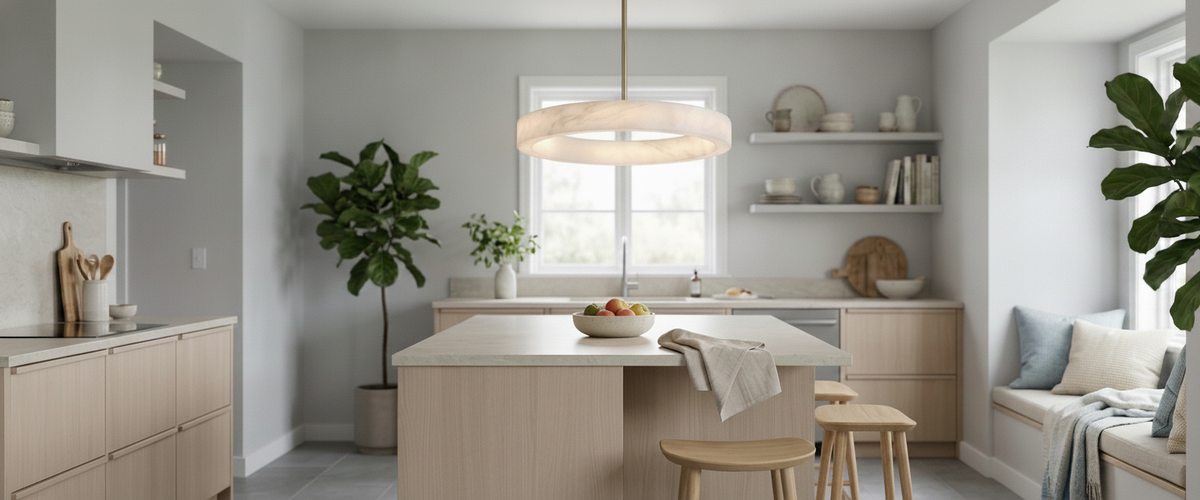
Recessed spots should stop at the island. Over a table or a run of stools, a stone pendant does a better job.

Why Lumens and Watts Say Nothing About How a Worktop Will Feel
Lumens measure total light output. Watts measure the power drawn. Neither tells you how the light behaves once it leaves the fitting, and that behaviour is what you actually live with. A downlight can be bright and still make a marble worktop look grey, or wash a walnut surface to a dull brown. This is the first place buyers overpay for the wrong best led downlights kitchen spec.
What you feel at the counter is a mix of colour rendering, beam shape, and how the light interacts with the surface finish. A honed stone worktop drinks light; a polished one bounces it back at you. Two identical fittings over those two surfaces produce very different rooms. That is why we always talk about the light before the fitting spec when clients ask us to plan a kitchen alongside their pendant order.
CRI and Colour Temperature That Flatter Food, Not Fluoresce It
Colour Rendering Index (CRI) tells you how faithfully a light source shows colour against natural daylight, on a scale to 100. For a kitchen, aim for CRI 90 or above. Below that, reds go muddy, greens flatten, and raw meat and fresh produce look off. The extra few pounds per fitting for high-CRI LEDs is the best money in the whole scheme, and it separates good best led downlights kitchen choices from cheap ones.
Colour temperature is the warmth of the white, measured in kelvin. Cooking and eating spaces read best at 2700K to 3000K, a warm white that keeps skin tones and food appetising. The cooler 4000K neutral white can suit a very architectural, stone-and-steel kitchen or a utility zone, but in a family kitchen it tips toward a canteen feel after dark. If you like the crispness of 4000K by day, that is a strong argument for a tunable warm-dim fitting rather than committing to cool white full time.
The guidance on brightness and colour from Energy Star is a useful reminder that lumens and kelvin are separate decisions; a warm light is not a dim one, and a bright light is not automatically a cold one.
Beam Angle and Spacing That Kill Scallops and Dark Corners
Beam angle is where good intentions collapse. A narrow beam throws a tight, punchy pool; a wide beam spreads a softer wash. Space narrow-beam fittings too far apart and you get scalloped shadows climbing the wall units and dead patches on the floor between them. Cram wide beams too close and the ceiling looks like a runway. Even the best led downlights kitchen fittings fail when they are spaced badly.
Even spacing keeps scallops off the wall units.
As a working rule for a standard 8 foot (2.4 metre) ceiling, keep fittings roughly 3 to 4 feet (0.9 to 1.2 metres) apart and around 2 feet (0.6 metres) off the wall so the beam catches the worktop rather than the cabinet doors. Run a dedicated line of fittings over the front edge of the worktop, not down the centre of the walkway, or you will spend every evening working in your own shadow. Adjustable, tiltable spots earn their place here; where you need to angle light onto a splashback or a shelf of stone-topped canisters rather than accept a fixed downward pool, a tilting fitting such as the Play Adjustable Recessed Downlight 13W 4000K is the difference between highlighting the good surfaces and lighting the floor. Over lower-output positions between the main task runs, the 7W version of the same fitting keeps the ceiling grid from feeling like a runway.
Warm-Dim Drivers: The Upgrade That Earns Its Price at Night
A standard dimmable LED gets darker but stays the same colour, so a dimmed kitchen can look grey and lifeless. A warm-dim driver shifts the light warmer as you lower it, mimicking the way a filament bulb glows amber at low output. Drop the recessed spots to 20 percent late in the evening and the whole room softens toward candlelight rather than a weak version of daytime. This one driver choice does more for the best led downlights kitchen feel than any lumen figure.
This is the feature that makes led downlights for kitchen schemes and our alabaster pieces read as one scheme rather than two. When the recessed fittings warm down and the stone lamps take over, a kitchen stops being a workroom. Confirm your dimmer switch is compatible with the specific driver; mismatched trailing-edge and leading-edge kit is the most common cause of flicker and buzz. If in any doubt about the wiring, have a qualified electrician handle the install and the dimmer pairing.
IP Ratings the Sink and Hob Zones Genuinely Demand
IP ratings describe how well a fitting resists solids and moisture, shown as two digits. Most of a kitchen ceiling is a dry zone, so a standard IP20 fitting is fine over the main floor and general worktops. The exceptions are the spots directly above the sink and the hob, where steam and splashes rise. Over those, step up to at least IP44, or IP65 if a fitting sits almost directly over a rolling boil. Matching the IP rating to the zone is a core part of the best led downlights kitchen decision.
Do not over-specify the whole ceiling to a wet-zone rating out of caution; it adds cost and often narrows your choice of good high-CRI fittings for no benefit. Rate the two or three fittings that need it and keep the rest simple. Trim finish matters more than people expect here too, since these fittings sit in the ceiling for years; where the scheme leans warm and metallic rather than clean white, a fixed IP20 fitting such as the GU10 Recessed Downlight in Matte Copper ties the ceiling into brass taps and handles instead of fighting them. For UK installs, follow the wiring regulations on bathroom and kitchen zoning and, again, use a registered electrician for anything near water. Electrical Safety First publishes clear home electrical safety guidance worth reading before you commit to a layout.
The Line Where Downlights Should Stop and a Stone Pendant Takes Over
Recessed spots are brilliant at task light and terrible at atmosphere. They flatten faces, cast shadows straight down, and leave nothing to look at above eye level. That is exactly what you want over a prep run and exactly what you do not want over a table or an island where people gather. Even the best led downlights kitchen grid needs help here.
The line we draw with clients is simple: recessed light up to the island edge, a hanging fixture from the island edge onward. Over a kitchen table or a run of bar stools, a low-hung alabaster or onyx pendant does three things a recessed fitting cannot. It brings the light down to human height, it glows as an object in its own right, and the stone diffuses the source so nobody eats under a hard beam. Alabaster in particular scatters light through its own veining, giving a warm, uneven glow that a flat LED panel never will; the mineral background on alabaster from Britannica explains why the translucency varies stone to stone, which is also why no two shades light identically.
We shipped a pair of alabaster pendants to a Cotswolds kitchen last year where the owners already had a full grid of recessed spots in place. They kept every fitting, added the two pendants over the island, and told us the room finally felt finished. The downlights were never the problem; they were just doing the wrong job on their own. If you are planning your fixtures, our alabaster lighting collection is the natural place to find the pendant that takes over where the recessed spots stop, and the broader lighting range covers the wall lights and table lamps that fill in the corners downlights ignore.
A Quick Buyer's Checklist Before You Order
CRI: 90+ across all kitchen fittings, no exceptions.
Colour temperature: 2700K to 3000K, or a warm-dim fitting if you want cool crispness by day.
Beam angle: mix a wider wash for general light with a couple of adjustable narrow beams for splashbacks and shelves.
Spacing: plan the layout around the worktop edge, not the ceiling grid.
Dimming: confirm driver and dimmer compatibility before install.
IP rating: IP44 or higher only over sink and hob; IP20 elsewhere.
Layering: budget for one pendant or stone fixture from the start, not as an afterthought.
Get those six things right and the best LED downlights kitchen planners specify disappear into the ceiling, which is exactly what they should do. Run through that checklist and your best led downlights kitchen shortlist writes itself. The stone above the island is what people will remember. Because material, scale, engineering, and finishing all shape the final figure, the sensible move on the decorative pieces is to request a tailored quote rather than guessing at a budget from a spec sheet.