
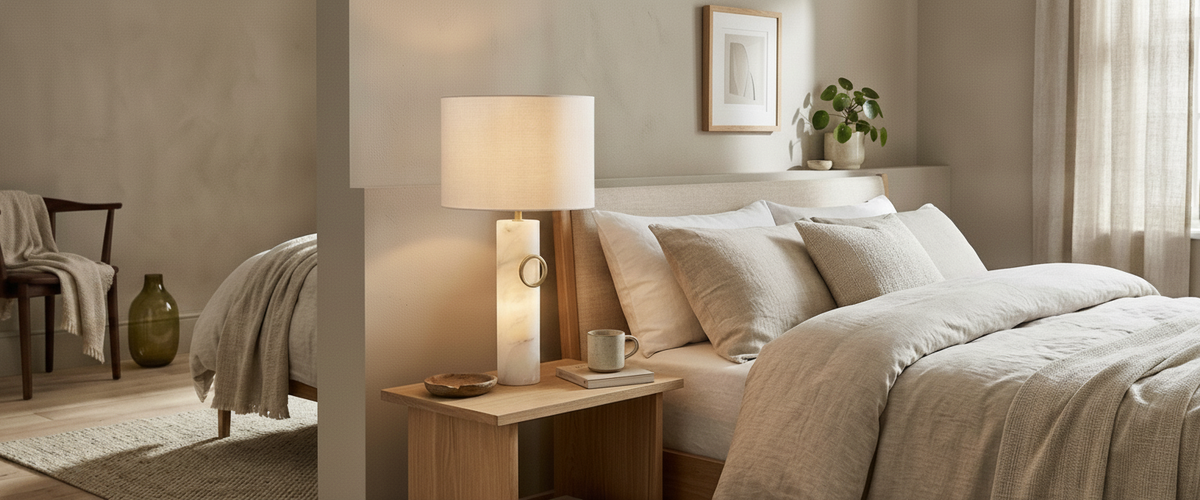

The nightstand decides the lamp, not the catalogue photo. A slim alabaster base can look perfect on screen and then swallow a narrow bedside table, tip forward every time you reach for a book, or throw light two feet above the page you're trying to read. Getting bedside table modern lamps right is mostly a sizing and placement problem, and once you treat it that way the choices narrow fast.
At Niori we work in alabaster and natural stone, so the bedside table modern lamps we talk about here do something a printed shade can't: the stone itself glows. That changes how you size them, where you sit them, and how they behave at 11pm.
An alabaster base sized to its nightstand rather than to a catalogue photo.

Key Takeaways
Measure the table first. Base footprint and table depth matter more than the lamp's total height.
Match height to the mattress. The bottom of the shade should sit near eye level when you're propped up reading.
Skinny nightstands need tall, slim lamps that carry light upward without a base that overhangs the edge.
Modern nightstand lamps can differ across a shared bed as long as height and light output roughly agree.
Watch the glare line. A shade too high or a lamp pushed too far back are the two most common mistakes we see.

Why the Table Decides the Lamp, Not the Other Way Round
Start with the surface. A bedside table's depth, width, and height set the terms, and the lamp has to work inside them. A deep console beside a low platform bed asks for something completely different than a shallow shelf-style nightstand in a city flat.
The rule we give clients: the base of your bedside table modern lamps should occupy no more than about a third of the table's surface, leaving room for a glass of water, a phone, a book, and reading glasses. If the base already crowds the table, the room reads cluttered no matter how good the lamp is. Alabaster and stone bases carry visual weight, so a compact carved form often does more work than a larger one. When you're browsing our alabaster lighting range, look at the base diameter before the height; it's the number that decides whether the piece actually fits your life on that table.

The Skinny Nightstand Problem
Narrow bedside tables are everywhere now, especially in London bedrooms and smaller US apartments where a wide nightstand simply won't fit beside the bed. The trap is obvious once you've made the mistake: a lamp with a broad base or a wide shade hangs over the edge, catches your elbow, and looks unbalanced. This is where modern nightstand lamps have to earn their footprint.
A skinny bedside table lamps solves this by going vertical instead of wide. Think a slim column base in alabaster or marble, a modest footprint, and height that lifts the light where you need it. For a shallow nightstand that can't take a flared shade, a tight carved form such as the Essence Round Table Lamp, Black keeps the tabletop clear while still holding its own next to the pillow. If your nightstand is under about 12 inches (30 cm) deep, prioritize a lamp whose base stays well inside that measurement and whose shade doesn't flare past the table edge.
One more thing on stability: stone-based bedside table modern lamps are heavier than they look, which is an advantage on a narrow surface. A weighted base won't tip when you tug the switch cord, and it sits with a solidity that hollow metal bases never quite match.
Height matched to the mattress so light lands on the page, not in your eyes.
Matching Lamp Height to the Mattress
This is the part almost everyone skips, and it's the one that decides whether the lamp actually earns its place. The light needs to land on your book, not on the wall behind you or the ceiling above.
Sit up in bed as you would to read. The bottom edge of the shade should sit roughly at your eye level, or a touch below, so light spills down onto the page rather than straight into your eyes. In practice that means most bedside table modern lamps land somewhere around 24 to 28 inches (61 to 71 cm) tall, measured to the top, but the honest answer depends on your mattress height and how many pillows you stack.
Tall platform bed with a thick mattress? You'll want a taller lamp or a higher nightstand. Low-slung bed close to the floor? A shorter lamp keeps the shade from towering over you. Measure from the floor to the top of your mattress, add the height of the nightstand, then choose a lamp that puts the shade opening near your seated eye line. The wider lighting collection gives you a sense of the range of proportions before you commit.
Pairing or Mismatching Lamps Across a Shared Bed
Do bedside lamps have to match? No, and strict symmetry can make a bedroom feel like a hotel. What has to agree is the light and the scale.
Two identical alabaster lamps give a calm, ordered look that suits a formal bedroom. But a pair of modern nightstand lamps that share height and brightness while differing in form can feel more considered, more like a room someone actually thought about. Where you want that deliberate contrast, keeping one silhouette rounded and the other squared works well: a base like the Essence Square Table Lamp, Black reads as a counterpoint to a round form when both stand the same height and take the same bulb. Keep the two pools of light even that way and the mismatch reads as intentional rather than accidental.
The failure mode is mismatched height or wildly different output. One bright lamp and one dim one across a shared bed looks off the moment both are on. If you're going to differ, keep the height within an inch or two and use the same bulb in both.
Reading Light Versus Mood Light
A modern base does two jobs, and it helps to know which one you're buying for.
Alabaster and onyx are translucent, so the stone glows softly when lit; that ambient wash is genuinely lovely for winding down and reads as mood light. What the glowing stone alone won't reliably do is give you crisp, directional reading light. For that you want a shade or an opening that pushes light downward onto the page.
The best bedside table modern lamps do both: warm ambient glow from the stone, plus enough directed light to read by. Pair that with the right bulb. We recommend a warm color temperature around 2700K for bedrooms, which the Sleep Foundation notes is gentler on your wind-down routine than cool blue-white light before bed. Put the lamp on a dimmer if you can, and use a bulb rated for it, so you can drop to a low glow late at night and bring it up for reading.
Placement Slips We See
Most complaints about modern nightstand lamps are really placement complaints. A few recurring ones:
Lamp pushed too far back. Against the wall, the light falls behind you and your book sits in shadow. Bring the lamp forward toward the front third of the table.
Shade too high. If you see the bright bulb or the underside of the shade while sitting up, the lamp is too tall for your bed and you'll get glare in the eyes every night.
Base too big for the table. It crowds everything else off and makes reaching past it awkward in the dark.
Cool bulb in a warm stone. A blue-white bulb kills the honeyed glow that alabaster does so well and makes the bedroom feel clinical.
No dimming. One brightness setting means either too bright to relax or too dim to read. A dimmable bulb fixes both.
A Quick Buyer's Checklist
Measure your nightstand depth and width, and the height from floor to the top of the mattress.
Choose a base that fills no more than a third of the tabletop.
Pick a lamp height that puts the bottom of the shade near your seated eye level.
For narrow tables, go tall and slim rather than wide.
Use a warm, dimmable bulb around 2700K.
Sit the lamp toward the front of the table, not shoved against the wall.
Care is simple with stone. Dust alabaster with a soft, dry cloth; avoid damp wiping and household sprays, which can mark the surface over time. The Natural Stone Institute has sensible guidance on cleaning porous natural stone if you want to go further. Treat your bedside table modern lamps like the pieces of stone they are and they will outlast several beds.
Get the sizing and placement right and bedside table modern lamps stop being decoration you switch off in irritation. They become the last warm thing you see at night and the first soft light in the morning, which is really the whole point.