
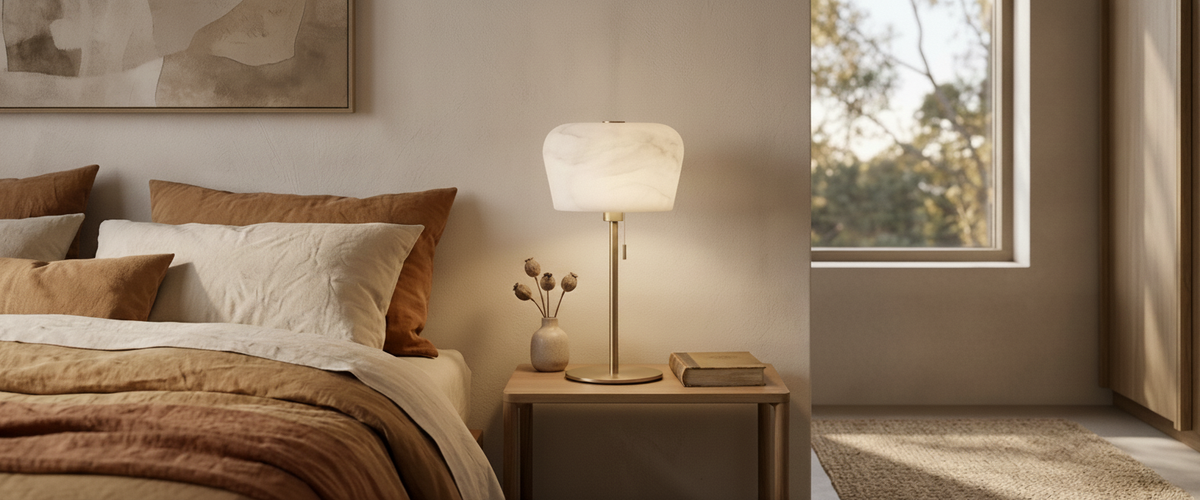

Most people buy the bedside lamps and table as two separate decisions, weeks apart, and then wonder why the reading light lands in their lap instead of on the page. The table came first because it fit the space. The lamp came later because it looked nice on a shelf. Put them together and the numbers rarely add up. Buy the bedside lamp and table as one composition and the whole corner of the room settles into place.
At the Niori studio we make alabaster and natural-stone lighting, and bedside setups are where we field the most questions, because a bedroom is the one room where light quality is personal. You lie beneath it. You read by it. You reach for the switch half asleep. A stone shade that throws a warm, low-glare glow changes how that space feels far more than the table it sits on. But when you plan a bedside lamp and table together, the table still has to earn its place.
A stone lamp and its table chosen as a single composition.

Key Takeaways for Choosing a Bedside Lamp and Table
Measure the bedside lamp and table together: table height plus lamp height decides where the light actually falls.
Aim for the bottom of the shade to sit roughly at shoulder or chin height when you're propped up in bed.
In small rooms, a skinny bedside table and a slim lamp keep the walkway clear without starving you of light.
Matching lamps are the safe choice, but a deliberate mismatch works when finishes or forms talk to each other.
Plan switch reach and cable runs before you buy, not after the box arrives.

Treat the Lamp and Table as One Composition
Think of the bedside corner as a single object with two parts. The table sets the platform; the lamp sets the light. When you choose a bedside lamp and table in isolation, you get a tall lamp on a tall table that glares straight into your eyes, or a squat lamp on a low table that lights the carpet and nothing else.
Start with what the surface has to do. A phone, a glass of water, a book, maybe reading glasses. That footprint tells you the tabletop size. Then the lamp follows, sized to the table and to the height of your headboard. A useful rule from the studio: the lamp should read as roughly two-thirds the width of the table it sits on, so it looks anchored rather than perched. Get that proportion right and even a plain bedside lamp and table looks considered.

How Table Height and Lamp Height Add Up to the Light You Read By
Here is the calculation almost nobody makes. Your bedside table height and your lamp height stack on top of each other, and the total decides where the light lands. For most beds, you want the bottom edge of the shade to sit somewhere between your shoulder and your chin when you're sitting up against the pillows. Too high and the bare bulb glares. Too low and you cast a shadow over your own book.
In practice, a standard table beside the bed runs about 24 to 28 inches (61 to 71 cm) tall, close to the top of a typical mattress. On a surface like that, one of the taller table lamps for bedside use, roughly 20 to 26 inches (51 to 66 cm), usually lands the shade where you want it. Lower the table and you need a taller lamp to compensate; raise it and you go shorter. This is exactly why buying the bedside lamp and table together saves grief.
Alabaster earns its keep here. Because the stone is translucent, the whole shade glows rather than just spilling light from the top and bottom. That softens the glare problem and gives you a gentler pool to read by. You can see the effect across our alabaster lighting range, where the material does the diffusing work a fabric shade only half manages.
A slim stone base keeps the walkway clear in a tight room.
Small Bedside Table Lamps for Tight Rooms
Small rooms punish clumsy choices. A bulky lamp on a deep table eats the walkway and forces you to squeeze past the bed frame every night. The fix is a skinny bedside table lamp on a narrow table: a slim profile that gives you light without a footprint. A tight room is where a well-planned bedside lamp and table really shows its worth.
Small bedside table lamps don't have to mean weak light. A compact stone base with a tall, slender shade can put out a generous glow while taking up barely any surface. Where the tabletop is shallow and you want warmth without a wide base, a rounded form such as the Essence Round Table Lamp sits within a tight footprint while still throwing a soft, even glow. If floor space is truly tight, consider a wall light or a slim table lamp that leaves the whole tabletop free for a book and a glass.
One client bedroom in a converted flat had bedside tables barely 10 inches (25 cm) deep. A conventional lamp would have overhung the edge. We paired each side with a narrow stone table lamp that sat within the footprint, and the room read calm instead of crowded. The lesson: match the base diameter to the table depth first, then choose the shade, and treat the bedside lamp and table as a set from the start.
Modern Bedside Setups Where Finishes Talk to Each Other
Bedside table modern lamps live or die on finish. In a contemporary bedroom, the lamp, the table hardware, the handles on the chest of drawers and the frame of a mirror should share a language. That does not mean everything matches exactly. It means the metals and tones agree, so your bedside lamp and table sit in the same family.
Brushed brass on a lamp base wants brass or warm-toned fittings nearby, not a cold chrome handle two feet away. A black stone lamp reads best against pale linens where the form stands out. In a sharper, more geometric scheme, a crisp-edged base like the Essence Square Table Lamp holds its line against angular hardware and framed art, where a rounded form would soften too much. Onyx and marble bring their own veining, so let them be the pattern in the corner and keep the table plain. When you're browsing options across the wider lighting collection, hold your table hardware sample next to the fixture before you commit; a photo on a screen flattens the tone.
Switch Reach, Cable Runs and the Clutter No One Plans For
The unglamorous details decide whether you actually enjoy the lamp. Can you reach the switch without sitting fully up? An inline switch on the cable, or a base you can tap, beats a fiddly rotary under a hot bulb every time. If you charge a phone on the table, plan where that cable goes before the lamp arrives, because two trailing wires on a small surface look terrible and tangle nightly. A tidy bedside lamp and table starts with these choices, not with the styling.
Cable runs matter more than people expect. A short flex on a lamp positioned far from the socket means either an ugly stretch or an extension lead on the floor. Measure the distance from your nearest outlet to the tabletop and check the lamp's cable length covers it with slack to spare. For any hardwired wall-mounted reading light, that's a job for a qualified electrician; the guidance from Electrical Safety First is worth a read before you commit to anything fixed.
Common Mismatches We Fix in Client Bedrooms
A few bedside lamp and table problems come up again and again:
Lamp too tall for the table. The shade sits above eye line and the bulb glares straight into the room. Shorter lamp or lower table.
Shade too small for the base. A tiny shade on a chunky base looks top-heavy and throws a mean, narrow pool of light.
Cold bulb in a warm stone shade. Alabaster wants a warm color temperature, around 2700K, to keep the honey tone in the stone. A daylight-white bulb kills it.
No dimming. A bedside lamp should be able to drop to a low, restful level. A dimmable bulb and switch turn one lamp into both a reading light and a wind-down light.
Mismatched heights across the bed. Two different lamps at two different heights on either side pull the whole room off balance. If you mix, keep the shade bottoms level.
A Quick Bedside Buying Checklist
Measure your mattress-top height and your sitting-up shoulder height.
Choose the table depth to match the walkway you can spare.
Pick a lamp whose base fits within the table depth.
Check the shade bottom lands near shoulder or chin height once assembled.
Confirm cable length reaches the socket with slack.
Specify a warm, dimmable bulb.
Hold finishes together in the room's own light before buying.
Care and Longevity for Stone Bedside Lamps
Alabaster is a soft stone and it likes gentle handling. Dust with a dry, soft cloth and skip household sprays, which can mark the surface over time. Keep it clear of water rings from a glass on the same table; the stone is porous and can stain. Treated well, a stone lamp base outlasts almost anything else on your bedside lamp and table, which is part of why we point buyers toward it over throwaway alternatives on the Niori homepage.
Buy the bedside lamp and table as one and the math works: height, reach, glow and finish all pull in the same direction. That is the difference between a bedside corner you tolerate and one you actually look forward to switching off at night.